Impact of Clinical and Pharmacological Parameters on Faecal Microbiota Transplantation Outcome in Clostridioides difficile Infections: Results of a 5-Year French National Survey
Nicolas Benech, Nadim Cassir, Laurent Alric, Frédéric Barbut, Rui Batista, Alexandre Bleibtreu, Thomas Briot, Benjamin Davido, Tatiana Galperine, Anne-Christine Joly, Nathalie Kapel, Chloé Melchior, Alexis Mosca, Biba Nebbad, Bénédicte Pigneur, Stéphane M. Schneider, Mathieu Wasiak, Julien Scanzi, Harry Sokol, the French Faecal Transplant Group (GFTF)
{"title":"Impact of Clinical and Pharmacological Parameters on Faecal Microbiota Transplantation Outcome in Clostridioides difficile Infections: Results of a 5-Year French National Survey","authors":"Nicolas Benech, Nadim Cassir, Laurent Alric, Frédéric Barbut, Rui Batista, Alexandre Bleibtreu, Thomas Briot, Benjamin Davido, Tatiana Galperine, Anne-Christine Joly, Nathalie Kapel, Chloé Melchior, Alexis Mosca, Biba Nebbad, Bénédicte Pigneur, Stéphane M. Schneider, Mathieu Wasiak, Julien Scanzi, Harry Sokol, the French Faecal Transplant Group (GFTF)","doi":"10.1111/apt.18330","DOIUrl":null,"url":null,"abstract":"<div>\n \n \n <section>\n \n <h3> Background</h3>\n \n <p>Detailed comparative assessment of procedure-related factors associated with faecal microbiota transplantation (FMT) efficacy in <i>Clostridioides difficile</i> infection (CDI) is limited.</p>\n </section>\n \n <section>\n \n <h3> Aims</h3>\n \n <p>We took advantage of the differences in procedures at the various French FMT centres to determine clinical and procedure-related factors associated with FMT success in CDI.</p>\n </section>\n \n <section>\n \n <h3> Methods</h3>\n \n <p>We performed a nationwide retrospective multicentre cohort study. All FMTs performed within The French Faecal Transplant Group for CDI from 2018 to 2022 were included. Clinical data were collected retrospectively from recipient medical files, characteristics of stool transplant preparations were prospectively collected by each Pharmacy involved. Univariate and multivariate analyses were performed using Fisher's test and multiple logistic regression.</p>\n </section>\n \n <section>\n \n <h3> Results</h3>\n \n <p>Six hundred fifty-eight FMTs were performed for 617 patients in 17 centres. The overall efficacy of FMT was 84.3% (520/617), with 0.5% of severe adverse events possibly related to FMT (3/658). Forty-seven patients were treated at the first recurrence of CDI with a similar success rate (85.1%). Severe chronic kidney disease (CKD; OR: 2.18, 95%CI [1.20–3.88]), non-severe refractory CDI (OR: 15.35, [1.94–318.2]), the use of ≥ 80% glycerol (OR: 2.52, [1.11–5.67]), insufficient bowel cleansing (OR: 5.47, [1.57–20.03]) and partial FMT retention (OR: 9.97, [2.62–48.49]) were associated with CDI recurrence within 8 weeks.</p>\n </section>\n \n <section>\n \n <h3> Conclusions</h3>\n \n <p>Conditions of transplant manufacturing, bowel cleansing, and a route of delivery tailored to the patient's characteristics are key factors in optimising FMT efficacy. FMT at first recurrence showed high success in real-life practice, whereas it had lower efficacy in severe CDI and non-severe refractory CDI.</p>\n </section>\n </div>","PeriodicalId":121,"journal":{"name":"Alimentary Pharmacology & Therapeutics","volume":"61 1","pages":"159-167"},"PeriodicalIF":6.7000,"publicationDate":"2024-10-10","publicationTypes":"Journal Article","fieldsOfStudy":null,"isOpenAccess":false,"openAccessPdf":"https://onlinelibrary.wiley.com/doi/epdf/10.1111/apt.18330","citationCount":"0","resultStr":null,"platform":"Semanticscholar","paperid":null,"PeriodicalName":"Alimentary Pharmacology & Therapeutics","FirstCategoryId":"3","ListUrlMain":"https://onlinelibrary.wiley.com/doi/10.1111/apt.18330","RegionNum":1,"RegionCategory":"医学","ArticlePicture":[],"TitleCN":null,"AbstractTextCN":null,"PMCID":null,"EPubDate":"","PubModel":"","JCR":"Q1","JCRName":"GASTROENTEROLOGY & HEPATOLOGY","Score":null,"Total":0}
引用次数: 0
Abstract
Background
Detailed comparative assessment of procedure-related factors associated with faecal microbiota transplantation (FMT) efficacy in Clostridioides difficile infection (CDI) is limited.
Aims
We took advantage of the differences in procedures at the various French FMT centres to determine clinical and procedure-related factors associated with FMT success in CDI.
Methods
We performed a nationwide retrospective multicentre cohort study. All FMTs performed within The French Faecal Transplant Group for CDI from 2018 to 2022 were included. Clinical data were collected retrospectively from recipient medical files, characteristics of stool transplant preparations were prospectively collected by each Pharmacy involved. Univariate and multivariate analyses were performed using Fisher's test and multiple logistic regression.
Results
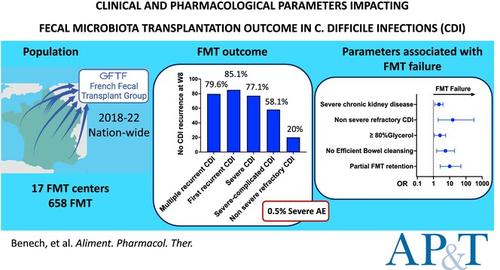
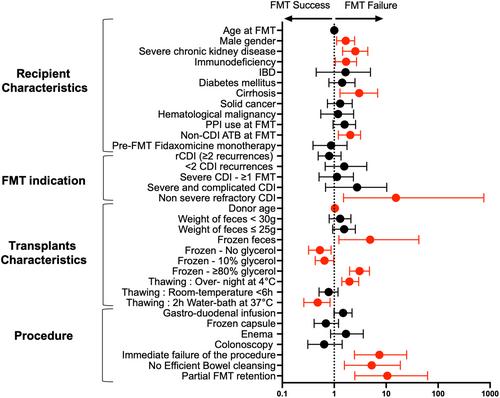
Six hundred fifty-eight FMTs were performed for 617 patients in 17 centres. The overall efficacy of FMT was 84.3% (520/617), with 0.5% of severe adverse events possibly related to FMT (3/658). Forty-seven patients were treated at the first recurrence of CDI with a similar success rate (85.1%). Severe chronic kidney disease (CKD; OR: 2.18, 95%CI [1.20–3.88]), non-severe refractory CDI (OR: 15.35, [1.94–318.2]), the use of ≥ 80% glycerol (OR: 2.52, [1.11–5.67]), insufficient bowel cleansing (OR: 5.47, [1.57–20.03]) and partial FMT retention (OR: 9.97, [2.62–48.49]) were associated with CDI recurrence within 8 weeks.
Conclusions
Conditions of transplant manufacturing, bowel cleansing, and a route of delivery tailored to the patient's characteristics are key factors in optimising FMT efficacy. FMT at first recurrence showed high success in real-life practice, whereas it had lower efficacy in severe CDI and non-severe refractory CDI.
期刊介绍:
Alimentary Pharmacology & Therapeutics is a global pharmacology journal focused on the impact of drugs on the human gastrointestinal and hepato-biliary systems. It covers a diverse range of topics, often with immediate clinical relevance to its readership.



 京公网安备 11010802042870号
京ICP备2023020795号-1
京公网安备 11010802042870号
京ICP备2023020795号-1

 分享
分享
 求助内容:
求助内容: 应助结果提醒方式:
 扫码关注我们
