Xiaoyan Hao, Yuan Guo, Xueyuan Yu, Lin He, Youcheng He, Maoguo Shu
{"title":"Exosomes from adipose-derived stem cells overexpressing microRNA-671–3p promote fat graft angiogenesis and adipogenic differentiation","authors":"Xiaoyan Hao, Yuan Guo, Xueyuan Yu, Lin He, Youcheng He, Maoguo Shu","doi":"10.1016/j.tice.2024.102575","DOIUrl":null,"url":null,"abstract":"<div><div>Exosomes from adipose-derived stem cells (ADSCs) have been demonstrated to benefit angiogenesis, wound healing, and fat grafting. Small noncoding RNAs such as microRNA (miRNA) and circular RNA play critical roles in mediating the function of ADSCs-derived exosomes. However, the underlying mechanisms have not been fully elucidated. In this study, we investigated the function and mechanism of human ADSCs-derived exosomes (hADSCs-Exo) in promoting fat graft angiogenesis and adipogenic differentiation. hADSCs-Exo were isolated and identified, and treatment with hADSCs-Exo enhanced fat graft angiogenesis and adipogenic differentiation in a mouse fat graft implantation model. We found that hADSCs-Exo overexpressed miR-671–3p and promoted human umbilical vein endothelial cell (HUVEC) proliferation, migration, and invasion. Bioinformatics analysis and luciferase reporter assay validated that TMEM127 is a direct target of miR-671–3p. Rescue experiments demonstrated that TMEM127 overexpression partially antagonized the function of hADSCs-Exo <em>in vitro</em>, such as suppressing HUVEC cell proliferation, migration, and invasion. Moreover, TMEM127 overexpression abrogated the function of hADSCs-Exo on fat graft angiogenesis and adipogenic differentiation. Taken together, our findings demonstrate that miR-671–3p-overexpressing exosomes from ADSC promote fat graft angiogenesis and adipogenic differentiation, which highlights the potential of targeting the ADSC-Exosomes-miR-671–3p/TMEM127 axis to improve outcome of fat graft and tissue engineering regenerative medicine.</div></div>","PeriodicalId":23201,"journal":{"name":"Tissue & cell","volume":"91 ","pages":"Article 102575"},"PeriodicalIF":2.5000,"publicationDate":"2024-12-01","publicationTypes":"Journal Article","fieldsOfStudy":null,"isOpenAccess":false,"openAccessPdf":"","citationCount":"0","resultStr":null,"platform":"Semanticscholar","paperid":null,"PeriodicalName":"Tissue & cell","FirstCategoryId":"99","ListUrlMain":"https://www.sciencedirect.com/science/article/pii/S0040816624002763","RegionNum":4,"RegionCategory":"生物学","ArticlePicture":[],"TitleCN":null,"AbstractTextCN":null,"PMCID":null,"EPubDate":"2024/10/1 0:00:00","PubModel":"Epub","JCR":"Q1","JCRName":"ANATOMY & MORPHOLOGY","Score":null,"Total":0}
引用次数: 0
Abstract
Exosomes from adipose-derived stem cells (ADSCs) have been demonstrated to benefit angiogenesis, wound healing, and fat grafting. Small noncoding RNAs such as microRNA (miRNA) and circular RNA play critical roles in mediating the function of ADSCs-derived exosomes. However, the underlying mechanisms have not been fully elucidated. In this study, we investigated the function and mechanism of human ADSCs-derived exosomes (hADSCs-Exo) in promoting fat graft angiogenesis and adipogenic differentiation. hADSCs-Exo were isolated and identified, and treatment with hADSCs-Exo enhanced fat graft angiogenesis and adipogenic differentiation in a mouse fat graft implantation model. We found that hADSCs-Exo overexpressed miR-671–3p and promoted human umbilical vein endothelial cell (HUVEC) proliferation, migration, and invasion. Bioinformatics analysis and luciferase reporter assay validated that TMEM127 is a direct target of miR-671–3p. Rescue experiments demonstrated that TMEM127 overexpression partially antagonized the function of hADSCs-Exo in vitro, such as suppressing HUVEC cell proliferation, migration, and invasion. Moreover, TMEM127 overexpression abrogated the function of hADSCs-Exo on fat graft angiogenesis and adipogenic differentiation. Taken together, our findings demonstrate that miR-671–3p-overexpressing exosomes from ADSC promote fat graft angiogenesis and adipogenic differentiation, which highlights the potential of targeting the ADSC-Exosomes-miR-671–3p/TMEM127 axis to improve outcome of fat graft and tissue engineering regenerative medicine.
期刊介绍:
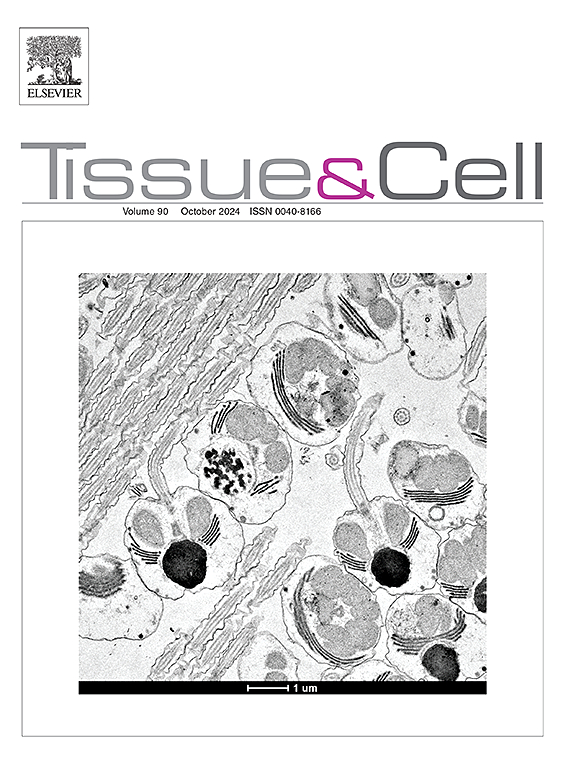
Tissue and Cell is devoted to original research on the organization of cells, subcellular and extracellular components at all levels, including the grouping and interrelations of cells in tissues and organs. The journal encourages submission of ultrastructural studies that provide novel insights into structure, function and physiology of cells and tissues, in health and disease. Bioengineering and stem cells studies focused on the description of morphological and/or histological data are also welcomed.
Studies investigating the effect of compounds and/or substances on structure of cells and tissues are generally outside the scope of this journal. For consideration, studies should contain a clear rationale on the use of (a) given substance(s), have a compelling morphological and structural focus and present novel incremental findings from previous literature.




 京公网安备 11010802042870号
京ICP备2023020795号-1
京公网安备 11010802042870号
京ICP备2023020795号-1

 分享
分享
 求助内容:
求助内容: 应助结果提醒方式:
 扫码关注我们
