{"title":"Hematological and Physiological Changes in Rainbow Trout, Oncorhynchus mykiss, Exposed for 30 Days to Critical Low Temperature","authors":"Franz Lahnsteiner, Anna Dünser","doi":"10.1155/2024/2925959","DOIUrl":null,"url":null,"abstract":"<div>\n <p>Rainbow trout (<i>Oncorhynchus mykiss</i>) acclimated to 9°C were exposed to 1.8 ± 1.0°C water for 30 days. Survival rate decreased by 8%, and RNA expression of the heat shock protein heatshock protein 90 (<i>hsp90</i>) gene was upregulated, indicating thermal stress. The fish exhibited no growth but lost weight (daily growth rate −0.17% ± 0.03%). This was not due to depletion of energy reserves, as liver glycogen, liver triglycerides, and visceral fat levels remained unchanged. The growth hormone receptor 1 (<i>ghr1</i>) gene, encoding a growth hormone receptor, and the ATP synthase membrane subunit f (<i>atp5j2</i>) gene, encoding a component of mitochondrial ATP synthase, were downregulated, suggesting a reduced metabolic rate. Hematological investigations revealed the following results: Immune activity was suppressed, evidenced by decreased numbers of granulocytes, lymphocytes, thrombocytes, and total immunoglobulin levels. Serum aspartate aminotransferase and alanine aminotransferase activities increased by 90% and 230%, respectively, indicating disturbance in liver functions. Adaptations to the cold included changes in erythrocyte morphology and blood hemoglobin concentration. Erythrocyte cell volume increased by 15%, cytoplasm volume by 10%, nucleus volume by 5%, and cell surface area by 7%, with a concurrent rise in hemoglobin content. These changes likely represent adaptations to altered metabolic demands. Concentrations of blood erythrocytes, erythroblasts, serum Na<sup>+</sup>, K<sup>+</sup>, Cl<sup>−</sup>, and activities of lactate dehydrogenase, lysozyme, and the alternative complement pathway remained consistent between the two temperature regimes. In summary, the data demonstrate that exposing rainbow trout to temperatures of 1.8 ± 1.0°C leads to negative effects on fish performance, the development of thermal stress, suppression of immune parameters, and liver damage. Potential adaptations were observed in erythrocyte size and hemoglobin content.</p>\n </div>","PeriodicalId":8104,"journal":{"name":"Aquaculture Research","volume":"2024 1","pages":""},"PeriodicalIF":1.9000,"publicationDate":"2024-10-10","publicationTypes":"Journal Article","fieldsOfStudy":null,"isOpenAccess":false,"openAccessPdf":"https://onlinelibrary.wiley.com/doi/epdf/10.1155/2024/2925959","citationCount":"0","resultStr":null,"platform":"Semanticscholar","paperid":null,"PeriodicalName":"Aquaculture Research","FirstCategoryId":"97","ListUrlMain":"https://onlinelibrary.wiley.com/doi/10.1155/2024/2925959","RegionNum":4,"RegionCategory":"农林科学","ArticlePicture":[],"TitleCN":null,"AbstractTextCN":null,"PMCID":null,"EPubDate":"","PubModel":"","JCR":"Q2","JCRName":"FISHERIES","Score":null,"Total":0}
引用次数: 0
Abstract
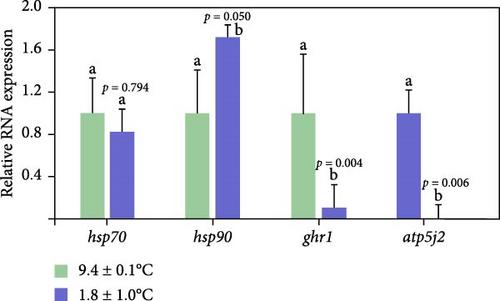
Rainbow trout (Oncorhynchus mykiss) acclimated to 9°C were exposed to 1.8 ± 1.0°C water for 30 days. Survival rate decreased by 8%, and RNA expression of the heat shock protein heatshock protein 90 (hsp90) gene was upregulated, indicating thermal stress. The fish exhibited no growth but lost weight (daily growth rate −0.17% ± 0.03%). This was not due to depletion of energy reserves, as liver glycogen, liver triglycerides, and visceral fat levels remained unchanged. The growth hormone receptor 1 (ghr1) gene, encoding a growth hormone receptor, and the ATP synthase membrane subunit f (atp5j2) gene, encoding a component of mitochondrial ATP synthase, were downregulated, suggesting a reduced metabolic rate. Hematological investigations revealed the following results: Immune activity was suppressed, evidenced by decreased numbers of granulocytes, lymphocytes, thrombocytes, and total immunoglobulin levels. Serum aspartate aminotransferase and alanine aminotransferase activities increased by 90% and 230%, respectively, indicating disturbance in liver functions. Adaptations to the cold included changes in erythrocyte morphology and blood hemoglobin concentration. Erythrocyte cell volume increased by 15%, cytoplasm volume by 10%, nucleus volume by 5%, and cell surface area by 7%, with a concurrent rise in hemoglobin content. These changes likely represent adaptations to altered metabolic demands. Concentrations of blood erythrocytes, erythroblasts, serum Na+, K+, Cl−, and activities of lactate dehydrogenase, lysozyme, and the alternative complement pathway remained consistent between the two temperature regimes. In summary, the data demonstrate that exposing rainbow trout to temperatures of 1.8 ± 1.0°C leads to negative effects on fish performance, the development of thermal stress, suppression of immune parameters, and liver damage. Potential adaptations were observed in erythrocyte size and hemoglobin content.
期刊介绍:
International in perspective, Aquaculture Research is published 12 times a year and specifically addresses research and reference needs of all working and studying within the many varied areas of aquaculture. The Journal regularly publishes papers on applied or scientific research relevant to freshwater, brackish, and marine aquaculture. It covers all aquatic organisms, floristic and faunistic, related directly or indirectly to human consumption. The journal also includes review articles, short communications and technical papers. Young scientists are particularly encouraged to submit short communications based on their own research.



 京公网安备 11010802042870号
京ICP备2023020795号-1
京公网安备 11010802042870号
京ICP备2023020795号-1

 分享
分享
 求助内容:
求助内容: 应助结果提醒方式:
 扫码关注我们
