Haitao Wang, Jipeng Fan, Jing Zou, Yujie Zheng, Dingsheng Wang and Jizhou Jiang
{"title":"Sulfur-doped g-C3N4/V2C MXene Schottky junctions for superior photocatalytic H2 evolution†","authors":"Haitao Wang, Jipeng Fan, Jing Zou, Yujie Zheng, Dingsheng Wang and Jizhou Jiang","doi":"10.1039/D4TA05929H","DOIUrl":null,"url":null,"abstract":"<p >Graphitic carbon nitride (g-C<small><sub>3</sub></small>N<small><sub>4</sub></small>) is considered to be a promising photocatalyst for the hydrogen evolution reaction (HER). However, the photocatalytic HER performance of pristine g-C<small><sub>3</sub></small>N<small><sub>4</sub></small> is unsatisfactory. In this work, theoretical predictions reveal that integrating sulfur dopants and coupling vanadium carbide (V<small><sub>2</sub></small>C) MXene can significantly optimize the hydrogen adsorbed Gibbs free energy (Δ<em>G</em><small><sub>H*</sub></small>) of g-C<small><sub>3</sub></small>N<small><sub>4</sub></small> to near zero. Inspired by the theoretical predictions, a sulfur-doped g-C<small><sub>3</sub></small>N<small><sub>4</sub></small>/V<small><sub>2</sub></small>C MXene (SCN/V<small><sub>2</sub></small>C) Schottky junction photocatalyst is fabricated by vacuum ball milling and subsequent annealing treatment. The strong SCN–V<small><sub>2</sub></small>C interface-electron interaction not only improves hydrophilicity and light absorption, but also facilitates the separation and migration of photoexcited carriers. Density functional theory calculations and the <em>in situ</em> characterization results corroborate that the carrier migration of SCN/V<small><sub>2</sub></small>C adheres to the typical Schottky heterojunction mechanism. Femtosecond transient absorption (fs-TA) spectroscopy demonstrates the favorable carrier dynamic behavior of SCN/V<small><sub>2</sub></small>C. Thus, SCN/V<small><sub>2</sub></small>C achieves a superior H<small><sub>2</sub></small> production rate of 8003 μmol g<small><sup>−1</sup></small> h<small><sup>−1</sup></small>. This research provides valuable insights into the further strategic design and construction of high-performance Schottky heterojunction catalysts.</p>","PeriodicalId":82,"journal":{"name":"Journal of Materials Chemistry A","volume":" 44","pages":" 30429-30441"},"PeriodicalIF":9.5000,"publicationDate":"2024-10-11","publicationTypes":"Journal Article","fieldsOfStudy":null,"isOpenAccess":false,"openAccessPdf":"","citationCount":"0","resultStr":null,"platform":"Semanticscholar","paperid":null,"PeriodicalName":"Journal of Materials Chemistry A","FirstCategoryId":"88","ListUrlMain":"https://pubs.rsc.org/en/content/articlelanding/2024/ta/d4ta05929h","RegionNum":2,"RegionCategory":"材料科学","ArticlePicture":[],"TitleCN":null,"AbstractTextCN":null,"PMCID":null,"EPubDate":"","PubModel":"","JCR":"Q1","JCRName":"CHEMISTRY, PHYSICAL","Score":null,"Total":0}
引用次数: 0
Abstract
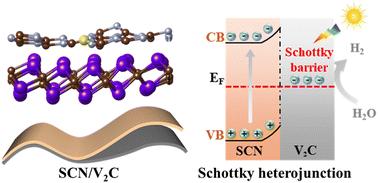
Graphitic carbon nitride (g-C3N4) is considered to be a promising photocatalyst for the hydrogen evolution reaction (HER). However, the photocatalytic HER performance of pristine g-C3N4 is unsatisfactory. In this work, theoretical predictions reveal that integrating sulfur dopants and coupling vanadium carbide (V2C) MXene can significantly optimize the hydrogen adsorbed Gibbs free energy (ΔGH*) of g-C3N4 to near zero. Inspired by the theoretical predictions, a sulfur-doped g-C3N4/V2C MXene (SCN/V2C) Schottky junction photocatalyst is fabricated by vacuum ball milling and subsequent annealing treatment. The strong SCN–V2C interface-electron interaction not only improves hydrophilicity and light absorption, but also facilitates the separation and migration of photoexcited carriers. Density functional theory calculations and the in situ characterization results corroborate that the carrier migration of SCN/V2C adheres to the typical Schottky heterojunction mechanism. Femtosecond transient absorption (fs-TA) spectroscopy demonstrates the favorable carrier dynamic behavior of SCN/V2C. Thus, SCN/V2C achieves a superior H2 production rate of 8003 μmol g−1 h−1. This research provides valuable insights into the further strategic design and construction of high-performance Schottky heterojunction catalysts.
期刊介绍:
The Journal of Materials Chemistry A, B & C covers a wide range of high-quality studies in the field of materials chemistry, with each section focusing on specific applications of the materials studied. Journal of Materials Chemistry A emphasizes applications in energy and sustainability, including topics such as artificial photosynthesis, batteries, and fuel cells. Journal of Materials Chemistry B focuses on applications in biology and medicine, while Journal of Materials Chemistry C covers applications in optical, magnetic, and electronic devices. Example topic areas within the scope of Journal of Materials Chemistry A include catalysis, green/sustainable materials, sensors, and water treatment, among others.



 京公网安备 11010802042870号
京ICP备2023020795号-1
京公网安备 11010802042870号
京ICP备2023020795号-1

 分享
分享
 求助内容:
求助内容: 应助结果提醒方式:
 扫码关注我们
