Novel BODIPY-based NIR fluorescent probe with appropriate Stokes shift for diagnosis and treatment evaluation of epilepsy via imaging ONOO− fluctuation
Ruiqi Han , Xiaoteng Ma , Jiamin Wang , Bo Zhang , Minghao Ruan , Junrong Jiao , Weili Zhao , Jian Zhang
{"title":"Novel BODIPY-based NIR fluorescent probe with appropriate Stokes shift for diagnosis and treatment evaluation of epilepsy via imaging ONOO− fluctuation","authors":"Ruiqi Han , Xiaoteng Ma , Jiamin Wang , Bo Zhang , Minghao Ruan , Junrong Jiao , Weili Zhao , Jian Zhang","doi":"10.1016/j.snb.2024.136766","DOIUrl":null,"url":null,"abstract":"<div><div>Epilepsy is a chronic brain disorder characterized by recurrent seizures that has severely threatened human health. Cumulative research achievements uncover that the pathological progression of epilepsy is closely related to peroxynitrite (ONOO<sup>−</sup>). In this work, we first constructed BODIPY dye containing pyridine group and indoline group to make it have the donor-acceptor structure, thus achieving NIR emission wavelength (740 nm) and appropriate Stokes shift (80 nm). Based on the BODIPY dye, the novel probe <strong>BDP-NIR-Fa</strong> was developed that displayed good specificity, faster response speed (60 s), and high signal to noise ratio (247-fold) for monitoring ONOO<sup>−</sup>. Based on these excellent properties, <strong>BDP-NIR-Fa</strong> was able to trace endogenous/exogenous ONOO<sup>−</sup> fluctuations in living cells and mice without interference from other reactive oxygen species. Most importantly, <strong>BDP-NIR-Fa</strong> could visualize the changes of endogenous ONOO<sup>−</sup> with remarkable temporal-spatial resolution in KA-induced seizures cell and mice models, that furnishing a potentially forceful tool for diagnosing epilepsy. Finally, <strong>BDP-NIR-Fa</strong> successfully realized imaging the concentration reduction of ONOO<sup>−</sup> in epilepsy model during the treatment by an antiepileptic drug. Therefore, the present work provided a reliable approach to investigate the diagnosis and therapy of epilepsy via imaging ONOO<sup>−</sup> fluctuation.</div></div>","PeriodicalId":425,"journal":{"name":"Sensors and Actuators B: Chemical","volume":"423 ","pages":"Article 136766"},"PeriodicalIF":3.7000,"publicationDate":"2025-01-15","publicationTypes":"Journal Article","fieldsOfStudy":null,"isOpenAccess":false,"openAccessPdf":"","citationCount":"0","resultStr":null,"platform":"Semanticscholar","paperid":null,"PeriodicalName":"Sensors and Actuators B: Chemical","FirstCategoryId":"92","ListUrlMain":"https://www.sciencedirect.com/science/article/pii/S0925400524014965","RegionNum":1,"RegionCategory":"化学","ArticlePicture":[],"TitleCN":null,"AbstractTextCN":null,"PMCID":null,"EPubDate":"2024/10/11 0:00:00","PubModel":"Epub","JCR":"Q1","JCRName":"CHEMISTRY, ANALYTICAL","Score":null,"Total":0}
引用次数: 0
Abstract
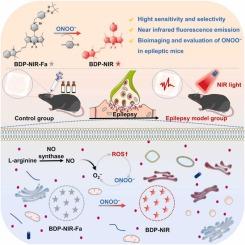
Epilepsy is a chronic brain disorder characterized by recurrent seizures that has severely threatened human health. Cumulative research achievements uncover that the pathological progression of epilepsy is closely related to peroxynitrite (ONOO−). In this work, we first constructed BODIPY dye containing pyridine group and indoline group to make it have the donor-acceptor structure, thus achieving NIR emission wavelength (740 nm) and appropriate Stokes shift (80 nm). Based on the BODIPY dye, the novel probe BDP-NIR-Fa was developed that displayed good specificity, faster response speed (60 s), and high signal to noise ratio (247-fold) for monitoring ONOO−. Based on these excellent properties, BDP-NIR-Fa was able to trace endogenous/exogenous ONOO− fluctuations in living cells and mice without interference from other reactive oxygen species. Most importantly, BDP-NIR-Fa could visualize the changes of endogenous ONOO− with remarkable temporal-spatial resolution in KA-induced seizures cell and mice models, that furnishing a potentially forceful tool for diagnosing epilepsy. Finally, BDP-NIR-Fa successfully realized imaging the concentration reduction of ONOO− in epilepsy model during the treatment by an antiepileptic drug. Therefore, the present work provided a reliable approach to investigate the diagnosis and therapy of epilepsy via imaging ONOO− fluctuation.
期刊介绍:
Sensors & Actuators, B: Chemical is an international journal focused on the research and development of chemical transducers. It covers chemical sensors and biosensors, chemical actuators, and analytical microsystems. The journal is interdisciplinary, aiming to publish original works showcasing substantial advancements beyond the current state of the art in these fields, with practical applicability to solving meaningful analytical problems. Review articles are accepted by invitation from an Editor of the journal.




 京公网安备 11010802042870号
京ICP备2023020795号-1
京公网安备 11010802042870号
京ICP备2023020795号-1

 分享
分享
 求助内容:
求助内容: 应助结果提醒方式:
 扫码关注我们
