The effect of biochar amendment on Cd accumulation in Bidens pilosa L: Changing Cd subcellular distribution, cell wall polysaccharide Cd-binding capacity and composition
Xinying Zhang , Jingxian Lu , Panxue Gu , Xiaoyan Liu , Beibei Li , Yan Liu
{"title":"The effect of biochar amendment on Cd accumulation in Bidens pilosa L: Changing Cd subcellular distribution, cell wall polysaccharide Cd-binding capacity and composition","authors":"Xinying Zhang , Jingxian Lu , Panxue Gu , Xiaoyan Liu , Beibei Li , Yan Liu","doi":"10.1016/j.plaphy.2024.109177","DOIUrl":null,"url":null,"abstract":"<div><div>Biochar can reduce Cd uptake by plants, thereby reducing its biotoxicity, but the mechanisms involved at the subcellular level have not been thoroughly elucidated. In this work, we explored the effect of maize straw biochar on Cd accumulation by <em>Bidens pilosa</em> L. and its mechanism at subcellular levels. After 90 days of potting experiment, the subcellular fractions were extracted by differential centrifugation, and the polysaccharide fractions of root cell walls were extracted by leaching centrifugation, and then the Cd content of each fraction was determined. Results showed that Cd was preferentially distributed in cell walls of three organs. Additionally, biochar addition resulted in a greater distribution of Cd from cell wall to soluble fractions and organelles in stems. These results suggested that cell wall immobilization and intracellular compartmentalization were critical detoxification mechanisms tackling Cd stress with biochar addition of <em>Bidens pilosa</em> L. Pectin was the main sink where Cd was stored. And galacturonic acid content in pectin occupied the highest ratio among the three polysaccharide fractions. After biochar addition, in hemicellulose the change of Cd content was consistent with the change of galacturonic acid content. These results suggested that the galacturonic acid in hemicellulose played an important role in Cd binding. Biochar addition reduced the bioavailability of soil Cd and improved the growth environment, thus inducing <em>Bidens pilosa</em> L. to change the composition of root cell wall in response to Cd stress.</div></div>","PeriodicalId":20234,"journal":{"name":"Plant Physiology and Biochemistry","volume":"216 ","pages":"Article 109177"},"PeriodicalIF":5.7000,"publicationDate":"2024-10-03","publicationTypes":"Journal Article","fieldsOfStudy":null,"isOpenAccess":false,"openAccessPdf":"","citationCount":"0","resultStr":null,"platform":"Semanticscholar","paperid":null,"PeriodicalName":"Plant Physiology and Biochemistry","FirstCategoryId":"99","ListUrlMain":"https://www.sciencedirect.com/science/article/pii/S0981942824008453","RegionNum":2,"RegionCategory":"生物学","ArticlePicture":[],"TitleCN":null,"AbstractTextCN":null,"PMCID":null,"EPubDate":"","PubModel":"","JCR":"Q1","JCRName":"PLANT SCIENCES","Score":null,"Total":0}
引用次数: 0
Abstract
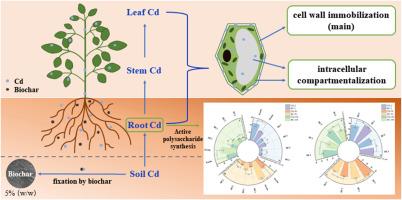
Biochar can reduce Cd uptake by plants, thereby reducing its biotoxicity, but the mechanisms involved at the subcellular level have not been thoroughly elucidated. In this work, we explored the effect of maize straw biochar on Cd accumulation by Bidens pilosa L. and its mechanism at subcellular levels. After 90 days of potting experiment, the subcellular fractions were extracted by differential centrifugation, and the polysaccharide fractions of root cell walls were extracted by leaching centrifugation, and then the Cd content of each fraction was determined. Results showed that Cd was preferentially distributed in cell walls of three organs. Additionally, biochar addition resulted in a greater distribution of Cd from cell wall to soluble fractions and organelles in stems. These results suggested that cell wall immobilization and intracellular compartmentalization were critical detoxification mechanisms tackling Cd stress with biochar addition of Bidens pilosa L. Pectin was the main sink where Cd was stored. And galacturonic acid content in pectin occupied the highest ratio among the three polysaccharide fractions. After biochar addition, in hemicellulose the change of Cd content was consistent with the change of galacturonic acid content. These results suggested that the galacturonic acid in hemicellulose played an important role in Cd binding. Biochar addition reduced the bioavailability of soil Cd and improved the growth environment, thus inducing Bidens pilosa L. to change the composition of root cell wall in response to Cd stress.
期刊介绍:
Plant Physiology and Biochemistry publishes original theoretical, experimental and technical contributions in the various fields of plant physiology (biochemistry, physiology, structure, genetics, plant-microbe interactions, etc.) at diverse levels of integration (molecular, subcellular, cellular, organ, whole plant, environmental). Opinions expressed in the journal are the sole responsibility of the authors and publication does not imply the editors'' agreement.
Manuscripts describing molecular-genetic and/or gene expression data that are not integrated with biochemical analysis and/or actual measurements of plant physiological processes are not suitable for PPB. Also "Omics" studies (transcriptomics, proteomics, metabolomics, etc.) reporting descriptive analysis without an element of functional validation assays, will not be considered. Similarly, applied agronomic or phytochemical studies that generate no new, fundamental insights in plant physiological and/or biochemical processes are not suitable for publication in PPB.
Plant Physiology and Biochemistry publishes several types of articles: Reviews, Papers and Short Papers. Articles for Reviews are either invited by the editor or proposed by the authors for the editor''s prior agreement. Reviews should not exceed 40 typewritten pages and Short Papers no more than approximately 8 typewritten pages. The fundamental character of Plant Physiology and Biochemistry remains that of a journal for original results.



 京公网安备 11010802042870号
京ICP备2023020795号-1
京公网安备 11010802042870号
京ICP备2023020795号-1

 分享
分享
 求助内容:
求助内容: 应助结果提醒方式:
 扫码关注我们
