Stability Assessment in Aqueous and Organic Solvents of Metal–Organic Framework PCN 333 Nanoparticles through a Combination of Physicochemical Characterization and Computational Simulations
Xiaoli Liu, Andres Ortega-Guerrero, Nency P. Domingues, Miriam Jasmin Pougin, Berend Smit, Leticia Hosta-Rigau, Chris Oostenbrink
{"title":"Stability Assessment in Aqueous and Organic Solvents of Metal–Organic Framework PCN 333 Nanoparticles through a Combination of Physicochemical Characterization and Computational Simulations","authors":"Xiaoli Liu, Andres Ortega-Guerrero, Nency P. Domingues, Miriam Jasmin Pougin, Berend Smit, Leticia Hosta-Rigau, Chris Oostenbrink","doi":"10.1021/acs.langmuir.4c01684","DOIUrl":null,"url":null,"abstract":"Mesoporous metal–organic frameworks (MOFs) have been recognized as powerful platforms for drug delivery, especially for biomolecules. Unfortunately, the application of MOFs is restricted due to their relatively poor stability in aqueous media, which is crucial for drug delivery applications. An exception is the porous coordination network (PCN)-series (e.g., PCN-333 and PCN-332), a series of MOFs with outstanding stability in aqueous media at the pH range from 3 to 9. In this study, we fabricate PCN-333 nanoparticles (nPCN) and investigate their stability in different solvents, including water, ethanol, and methanol. Surprisingly, the experimental characterizations in terms of X-ray diffraction, Brunauer–Emmett–Teller (BET), and scanning electron microscopy demonstrated that nPCN is not as stable in water as previously reported. Specifically, the crystalline structure of nPCN lost its typical octahedral shape and even decomposed into an irregular amorphous form when exposed to water for only 2 h, but not when ethanol and methanol were used. Meanwhile, the porosity of nPCN substantially diminished while being exposed to water, as demonstrated by the BET measurement. With the assistance of computational simulations, the mechanism behind the collapse of PCN-333 is illuminated. By molecular dynamics simulation and umbrella sampling, we elucidate that the degradation of PCN-333 occurs by hydrolysis, wherein polar solvent molecules initiate the attack and subsequent breakage of the metal–ligand reversible coordination bonds.","PeriodicalId":50,"journal":{"name":"Langmuir","volume":"56 1","pages":""},"PeriodicalIF":3.9000,"publicationDate":"2024-10-12","publicationTypes":"Journal Article","fieldsOfStudy":null,"isOpenAccess":false,"openAccessPdf":"","citationCount":"0","resultStr":null,"platform":"Semanticscholar","paperid":null,"PeriodicalName":"Langmuir","FirstCategoryId":"92","ListUrlMain":"https://doi.org/10.1021/acs.langmuir.4c01684","RegionNum":2,"RegionCategory":"化学","ArticlePicture":[],"TitleCN":null,"AbstractTextCN":null,"PMCID":null,"EPubDate":"","PubModel":"","JCR":"Q2","JCRName":"CHEMISTRY, MULTIDISCIPLINARY","Score":null,"Total":0}
引用次数: 0
Abstract
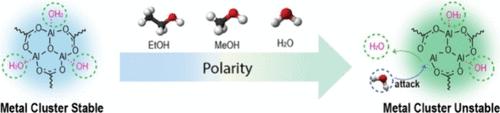
Mesoporous metal–organic frameworks (MOFs) have been recognized as powerful platforms for drug delivery, especially for biomolecules. Unfortunately, the application of MOFs is restricted due to their relatively poor stability in aqueous media, which is crucial for drug delivery applications. An exception is the porous coordination network (PCN)-series (e.g., PCN-333 and PCN-332), a series of MOFs with outstanding stability in aqueous media at the pH range from 3 to 9. In this study, we fabricate PCN-333 nanoparticles (nPCN) and investigate their stability in different solvents, including water, ethanol, and methanol. Surprisingly, the experimental characterizations in terms of X-ray diffraction, Brunauer–Emmett–Teller (BET), and scanning electron microscopy demonstrated that nPCN is not as stable in water as previously reported. Specifically, the crystalline structure of nPCN lost its typical octahedral shape and even decomposed into an irregular amorphous form when exposed to water for only 2 h, but not when ethanol and methanol were used. Meanwhile, the porosity of nPCN substantially diminished while being exposed to water, as demonstrated by the BET measurement. With the assistance of computational simulations, the mechanism behind the collapse of PCN-333 is illuminated. By molecular dynamics simulation and umbrella sampling, we elucidate that the degradation of PCN-333 occurs by hydrolysis, wherein polar solvent molecules initiate the attack and subsequent breakage of the metal–ligand reversible coordination bonds.
期刊介绍:
Langmuir is an interdisciplinary journal publishing articles in the following subject categories:
Colloids: surfactants and self-assembly, dispersions, emulsions, foams
Interfaces: adsorption, reactions, films, forces
Biological Interfaces: biocolloids, biomolecular and biomimetic materials
Materials: nano- and mesostructured materials, polymers, gels, liquid crystals
Electrochemistry: interfacial charge transfer, charge transport, electrocatalysis, electrokinetic phenomena, bioelectrochemistry
Devices and Applications: sensors, fluidics, patterning, catalysis, photonic crystals
However, when high-impact, original work is submitted that does not fit within the above categories, decisions to accept or decline such papers will be based on one criteria: What Would Irving Do?
Langmuir ranks #2 in citations out of 136 journals in the category of Physical Chemistry with 113,157 total citations. The journal received an Impact Factor of 4.384*.
This journal is also indexed in the categories of Materials Science (ranked #1) and Multidisciplinary Chemistry (ranked #5).



 京公网安备 11010802042870号
京ICP备2023020795号-1
京公网安备 11010802042870号
京ICP备2023020795号-1

 分享
分享
 求助内容:
求助内容: 应助结果提醒方式:
 扫码关注我们
