{"title":"Self-forming Na3P/Na2O interphase on a novel biphasic Na3Zr2Si2PO12/Na3PO4 solid electrolyte for long-cycling solid-state Na-metal batteries","authors":"Le Xiang, Yue Gao, Yifei Ding, Xiutao Li, Daochuan Jiang, Chuanqiang Wu, Xiaowen Zhan, Lingyun Zhu","doi":"10.1016/j.ensm.2024.103831","DOIUrl":null,"url":null,"abstract":"<div><div>A novel biphasic Na<sub>3</sub>Zr<sub>2</sub>Si<sub>2</sub>PO<sub>12</sub>/Na<sub>3</sub>PO<sub>4</sub> solid electrolyte is proposed to effectively address critical anode interface challenges for solid-state Na-metal batteries (SSSMBs). The Na<sub>3</sub>PO<sub>4</sub> phase, at an optimal composition of ∼20 mol%, transforms the interface chemistry throughout the NZSP electrolyte, which results in dense electrolytes with high Young's modulus, rapid ion transport (6.2 × 10<sup>−4</sup> S cm<sup>-1</sup>) at low activation barrier (0.19 eV), negligible electronic conductivity, and excellent sodiophilicity. The AIMD/DFT calculations and XPS analysis reveal a self-formed, (electro)chemically stable mixed Na<sup>+</sup>/electron-conducting interphase, comprising Na<sub>3</sub>P and Na<sub>2</sub>O, at the Na anode interface. The interphase not only homogenizes the Na<sup>+</sup> flux distribution and accelerates the interfacial charge transport, but prevents continuous interfacial reactions, thereby stabilizing the anode interface against dendrite formation. Benefiting from the low-impedance, dendrite-free anode interface, Na symmetric cells demonstrate a low interface resistance of 12.7 Ω cm<sup>2</sup> and exceptional cyclability of 3000 h. Additionally, full cells with Na<sub>3</sub>V<sub>2</sub>(PO<sub>4</sub>)<sub>3</sub> cathodes achieve 93 % capacity retention after 550 cycles at 0.5 C. This research comprehensively elucidates and leverages the critical advantages of Na<sub>3</sub>PO<sub>4</sub> in enhancing the bulk and interface properties of Na<sub>3</sub>Zr<sub>2</sub>Si<sub>2</sub>PO<sub>12</sub> solid electrolytes. The design strategy of biphasic solid electrolytes presented here offers new insights into the developing high-performance solid electrolytes for advanced SSSMBs.</div></div>","PeriodicalId":306,"journal":{"name":"Energy Storage Materials","volume":"73 ","pages":"Article 103831"},"PeriodicalIF":20.2000,"publicationDate":"2024-10-12","publicationTypes":"Journal Article","fieldsOfStudy":null,"isOpenAccess":false,"openAccessPdf":"","citationCount":"0","resultStr":null,"platform":"Semanticscholar","paperid":null,"PeriodicalName":"Energy Storage Materials","FirstCategoryId":"88","ListUrlMain":"https://www.sciencedirect.com/science/article/pii/S2405829724006573","RegionNum":1,"RegionCategory":"材料科学","ArticlePicture":[],"TitleCN":null,"AbstractTextCN":null,"PMCID":null,"EPubDate":"","PubModel":"","JCR":"Q1","JCRName":"CHEMISTRY, PHYSICAL","Score":null,"Total":0}
引用次数: 0
Abstract
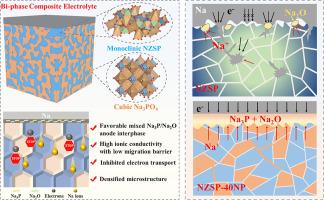
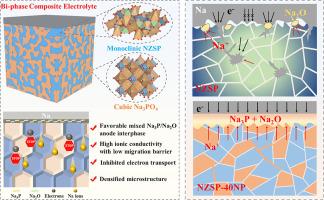
A novel biphasic Na3Zr2Si2PO12/Na3PO4 solid electrolyte is proposed to effectively address critical anode interface challenges for solid-state Na-metal batteries (SSSMBs). The Na3PO4 phase, at an optimal composition of ∼20 mol%, transforms the interface chemistry throughout the NZSP electrolyte, which results in dense electrolytes with high Young's modulus, rapid ion transport (6.2 × 10⁻⁴ S cm-1) at low activation barrier (0.19 eV), negligible electronic conductivity, and excellent sodiophilicity. The AIMD/DFT calculations and XPS analysis reveal a self-formed, (electro)chemically stable mixed Na+/electron-conducting interphase, comprising Na3P and Na2O, at the Na anode interface. The interphase not only homogenizes the Na+ flux distribution and accelerates the interfacial charge transport, but prevents continuous interfacial reactions, thereby stabilizing the anode interface against dendrite formation. Benefiting from the low-impedance, dendrite-free anode interface, Na symmetric cells demonstrate a low interface resistance of 12.7 Ω cm2 and exceptional cyclability of 3000 h. Additionally, full cells with Na3V2(PO4)3 cathodes achieve 93 % capacity retention after 550 cycles at 0.5 C. This research comprehensively elucidates and leverages the critical advantages of Na3PO4 in enhancing the bulk and interface properties of Na3Zr2Si2PO12 solid electrolytes. The design strategy of biphasic solid electrolytes presented here offers new insights into the developing high-performance solid electrolytes for advanced SSSMBs.
期刊介绍:
Energy Storage Materials is a global interdisciplinary journal dedicated to sharing scientific and technological advancements in materials and devices for advanced energy storage and related energy conversion, such as in metal-O2 batteries. The journal features comprehensive research articles, including full papers and short communications, as well as authoritative feature articles and reviews by leading experts in the field.
Energy Storage Materials covers a wide range of topics, including the synthesis, fabrication, structure, properties, performance, and technological applications of energy storage materials. Additionally, the journal explores strategies, policies, and developments in the field of energy storage materials and devices for sustainable energy.
Published papers are selected based on their scientific and technological significance, their ability to provide valuable new knowledge, and their relevance to the international research community.



 京公网安备 11010802042870号
京ICP备2023020795号-1
京公网安备 11010802042870号
京ICP备2023020795号-1

 分享
分享
 求助内容:
求助内容: 应助结果提醒方式:
 扫码关注我们
