Imtiaz Ahmed;Satish T. S. Bukkapatnam;Bhaskar Botcha;Yu Ding
{"title":"Toward Futuristic Autonomous Experimentation—A Surprise-Reacting Sequential Experiment Policy","authors":"Imtiaz Ahmed;Satish T. S. Bukkapatnam;Bhaskar Botcha;Yu Ding","doi":"10.1109/TASE.2024.3474549","DOIUrl":null,"url":null,"abstract":"An autonomous experimentation platform in manufacturing is supposedly capable of conducting a sequential search for finding suitable manufacturing conditions by itself or even for discovering new materials with minimal human intervention. The core of the intelligent control of such platforms is a policy to decide where to conduct the next experiment based on what has been done thus far. Such policy inevitably trades off between exploitation and exploration. Currently, the prevailing approach is to use various acquisition functions in the Bayesian optimization framework. We discuss whether it is beneficial to trade off exploitation versus exploration by measuring the element and degree of surprise associated with the immediate past observation. We devise a surprise-reacting policy using two existing surprise metrics, known as the Shannon surprise and Bayesian surprise. Our analysis shows that the surprise-reacting policy appears to be better suited for quickly characterizing the overall landscape of a response surface under resource constraints. We do not claim that we have a fully autonomous experimentation system but believe that the surprise-reacting capability benefits the automation of sequential decisions in autonomous experimentation.Note to Practitioners Autonomous systems should be able to go beyond repetitive automatic actions that are generally pre-programmed through a recipe. To decide what to do next on the fly differentiates autonomy from automation. Arguably, autonomy is the highest form of automation. To endow a manufacturing with autonomy, one necessary capability is for it to react properly to the “unexpected,” which are those observations disagreeing with its model’s anticipation. Are these bad measurements, an anomaly, or an indicator of model inadequacy? Should the observations be discarded or should the model be updated using the new observation? If latter, should model be updated gradually overtime or radically altered? Figuratively, upon observing the unexpected, we say that a manufacturing control system is “surprised” and ask the question of how it should react. Our investigation shares our current insights on this question.","PeriodicalId":51060,"journal":{"name":"IEEE Transactions on Automation Science and Engineering","volume":"22 ","pages":"7912-7926"},"PeriodicalIF":6.4000,"publicationDate":"2024-10-11","publicationTypes":"Journal Article","fieldsOfStudy":null,"isOpenAccess":false,"openAccessPdf":"","citationCount":"0","resultStr":null,"platform":"Semanticscholar","paperid":null,"PeriodicalName":"IEEE Transactions on Automation Science and Engineering","FirstCategoryId":"94","ListUrlMain":"https://ieeexplore.ieee.org/document/10714007/","RegionNum":2,"RegionCategory":"计算机科学","ArticlePicture":[],"TitleCN":null,"AbstractTextCN":null,"PMCID":null,"EPubDate":"","PubModel":"","JCR":"Q1","JCRName":"AUTOMATION & CONTROL SYSTEMS","Score":null,"Total":0}
引用次数: 0
Abstract
An autonomous experimentation platform in manufacturing is supposedly capable of conducting a sequential search for finding suitable manufacturing conditions by itself or even for discovering new materials with minimal human intervention. The core of the intelligent control of such platforms is a policy to decide where to conduct the next experiment based on what has been done thus far. Such policy inevitably trades off between exploitation and exploration. Currently, the prevailing approach is to use various acquisition functions in the Bayesian optimization framework. We discuss whether it is beneficial to trade off exploitation versus exploration by measuring the element and degree of surprise associated with the immediate past observation. We devise a surprise-reacting policy using two existing surprise metrics, known as the Shannon surprise and Bayesian surprise. Our analysis shows that the surprise-reacting policy appears to be better suited for quickly characterizing the overall landscape of a response surface under resource constraints. We do not claim that we have a fully autonomous experimentation system but believe that the surprise-reacting capability benefits the automation of sequential decisions in autonomous experimentation.Note to Practitioners Autonomous systems should be able to go beyond repetitive automatic actions that are generally pre-programmed through a recipe. To decide what to do next on the fly differentiates autonomy from automation. Arguably, autonomy is the highest form of automation. To endow a manufacturing with autonomy, one necessary capability is for it to react properly to the “unexpected,” which are those observations disagreeing with its model’s anticipation. Are these bad measurements, an anomaly, or an indicator of model inadequacy? Should the observations be discarded or should the model be updated using the new observation? If latter, should model be updated gradually overtime or radically altered? Figuratively, upon observing the unexpected, we say that a manufacturing control system is “surprised” and ask the question of how it should react. Our investigation shares our current insights on this question.
期刊介绍:
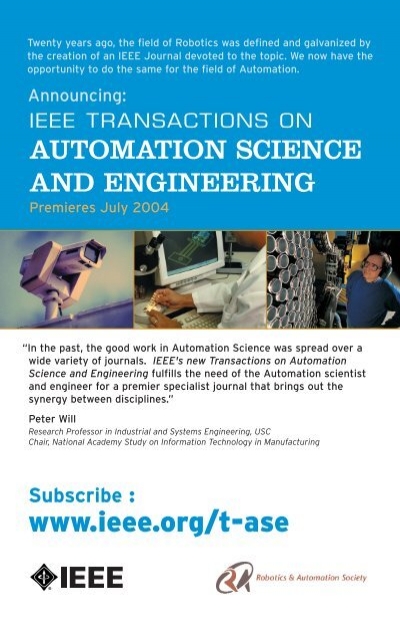
The IEEE Transactions on Automation Science and Engineering (T-ASE) publishes fundamental papers on Automation, emphasizing scientific results that advance efficiency, quality, productivity, and reliability. T-ASE encourages interdisciplinary approaches from computer science, control systems, electrical engineering, mathematics, mechanical engineering, operations research, and other fields. T-ASE welcomes results relevant to industries such as agriculture, biotechnology, healthcare, home automation, maintenance, manufacturing, pharmaceuticals, retail, security, service, supply chains, and transportation. T-ASE addresses a research community willing to integrate knowledge across disciplines and industries. For this purpose, each paper includes a Note to Practitioners that summarizes how its results can be applied or how they might be extended to apply in practice.



 京公网安备 11010802042870号
京ICP备2023020795号-1
京公网安备 11010802042870号
京ICP备2023020795号-1

 分享
分享
 求助内容:
求助内容: 应助结果提醒方式:
 扫码关注我们
