Swati Gajbhiye , Yatish R. Parauha , Naumov G. Nikolay , S.J. Dhoble
{"title":"Structural and luminescence properties of Y2O3:Ho3+ phosphor: Potential applications in plant cultivation LEDs and thermoluminescent dosimetry","authors":"Swati Gajbhiye , Yatish R. Parauha , Naumov G. Nikolay , S.J. Dhoble","doi":"10.1016/j.chphi.2024.100746","DOIUrl":null,"url":null,"abstract":"<div><div>Current research on Y<sub>2</sub>O<sub>3</sub>:Ho<sup>3+</sup> phosphors highlight their promising luminescence properties, but often lacks an environmentally friendly synthesis method and comprehensive analysis of their applications. In this study, we address these gaps by successfully synthesizing Y<sub>2</sub>O<sub>3</sub>:Ho<sup>3+</sup> phosphors using a green synthesis route with varying concentrations of Ho<sup>3+</sup>. Our work provides detailed characterization of their photoluminescence (PL) and thermoluminescent (TL) properties. The PL excitation (PLE) spectra reveal a distinct peak at 439 nm, attributed to the <sup>5</sup>I<sub>8</sub>→(<sup>5</sup>K<sub>5</sub>; <sup>5</sup>G<sub>5</sub>) transition of Ho<sup>3+</sup>ions. Upon excitation at 439 nm, the emission spectra show a sharp emission peak around 660 nm from the <sup>5</sup>F<sub>5</sub>→<sup>5</sup>I<sub>8</sub> transition, with the 0.1 mol% Ho<sup>3+</sup> phosphors exhibiting particularly strong red emission, indicating their suitability for indoor plant cultivation under LED lighting. Additionally, TL properties were evaluated after gamma-ray exposure, with the highest emission intensity at 0.1 mol% Ho<sup>3+</sup> concentration. TL glow curves were analyzed for various radiation doses using the Computerized Glow Curve Deconvolution (CGCD) method, and TL trapping parameters were determined through Chen's peak shape and the Initial Rise methods. This work demonstrates significant potential for using these phosphors to enhance indoor plant growth and for applications in thermoluminescent dosimetry (TLD).</div></div>","PeriodicalId":9758,"journal":{"name":"Chemical Physics Impact","volume":"9 ","pages":"Article 100746"},"PeriodicalIF":4.3000,"publicationDate":"2024-12-01","publicationTypes":"Journal Article","fieldsOfStudy":null,"isOpenAccess":false,"openAccessPdf":"","citationCount":"0","resultStr":null,"platform":"Semanticscholar","paperid":null,"PeriodicalName":"Chemical Physics Impact","FirstCategoryId":"1085","ListUrlMain":"https://www.sciencedirect.com/science/article/pii/S2667022424002901","RegionNum":0,"RegionCategory":null,"ArticlePicture":[],"TitleCN":null,"AbstractTextCN":null,"PMCID":null,"EPubDate":"2024/9/25 0:00:00","PubModel":"Epub","JCR":"Q2","JCRName":"CHEMISTRY, PHYSICAL","Score":null,"Total":0}
引用次数: 0
Abstract
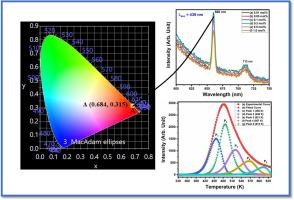
Current research on Y2O3:Ho3+ phosphors highlight their promising luminescence properties, but often lacks an environmentally friendly synthesis method and comprehensive analysis of their applications. In this study, we address these gaps by successfully synthesizing Y2O3:Ho3+ phosphors using a green synthesis route with varying concentrations of Ho3+. Our work provides detailed characterization of their photoluminescence (PL) and thermoluminescent (TL) properties. The PL excitation (PLE) spectra reveal a distinct peak at 439 nm, attributed to the 5I8→(5K5; 5G5) transition of Ho3+ions. Upon excitation at 439 nm, the emission spectra show a sharp emission peak around 660 nm from the 5F5→5I8 transition, with the 0.1 mol% Ho3+ phosphors exhibiting particularly strong red emission, indicating their suitability for indoor plant cultivation under LED lighting. Additionally, TL properties were evaluated after gamma-ray exposure, with the highest emission intensity at 0.1 mol% Ho3+ concentration. TL glow curves were analyzed for various radiation doses using the Computerized Glow Curve Deconvolution (CGCD) method, and TL trapping parameters were determined through Chen's peak shape and the Initial Rise methods. This work demonstrates significant potential for using these phosphors to enhance indoor plant growth and for applications in thermoluminescent dosimetry (TLD).



 京公网安备 11010802042870号
京ICP备2023020795号-1
京公网安备 11010802042870号
京ICP备2023020795号-1

 分享
分享
 求助内容:
求助内容: 应助结果提醒方式:
 扫码关注我们
