Jingshuang Zhang , Xiaohui Song , Ying Tie , Cheng Li , Huadong Zhao
{"title":"A novel sandwich-structural cooling and heating system with high power, high COP and small size based on thermoelectric cooler","authors":"Jingshuang Zhang , Xiaohui Song , Ying Tie , Cheng Li , Huadong Zhao","doi":"10.1016/j.enconman.2024.119126","DOIUrl":null,"url":null,"abstract":"<div><div>In practical settings, thermoelectric coolers (TEC) typically exhibit a cooling capacity (<em>Q<sub>c</sub></em>) below 200 W and a coefficient of cooling performance (<em>COP<sub>c</sub></em>) less than 1, limiting their application in high-demand scenarios. Despite their compactness, TEC require extensive heat dissipation structures in actual deployment. This study introduces an advanced thermoelectric sandwich-structural cooling and heating system (TESSCH), integrating TEC, flat water channels, and folded fins. The TESSCH system incorporates 72 TECs within a maximum external dimension of 172 mm*170 mm*30 mm, significantly reducing the footprint compared to traditional TEC system. Experimental findings reveal that the TESSCH system’s coefficient of heating performance (<em>COP<sub>h</sub></em>) is 196.7 % of that provided by a conventional PTC heater, achieving <em>COP<sub>h</sub></em> and heating capacity (<em>Q<sub>h</sub></em>) values of 2.18 and 1088.82 W, respectively. Under an input power of 500 W, the TESSCH system’s <em>COP<sub>c</sub></em> and cooling capacity (<em>Q<sub>c</sub></em>) reach 1.18 and 588.82 W, surpassing typical TEC figures. Compared with traditional air–water cooling systems, TESSCH offers substantially enhanced performance in a more compact form. Using RMS method and BBD experimental design, the regression models of the response variables about the design variables were obtain. The optimal combination of design parameters is obtained by the optimization method.</div></div>","PeriodicalId":11664,"journal":{"name":"Energy Conversion and Management","volume":"322 ","pages":"Article 119126"},"PeriodicalIF":10.9000,"publicationDate":"2024-12-15","publicationTypes":"Journal Article","fieldsOfStudy":null,"isOpenAccess":false,"openAccessPdf":"","citationCount":"0","resultStr":null,"platform":"Semanticscholar","paperid":null,"PeriodicalName":"Energy Conversion and Management","FirstCategoryId":"5","ListUrlMain":"https://www.sciencedirect.com/science/article/pii/S0196890424010677","RegionNum":1,"RegionCategory":"工程技术","ArticlePicture":[],"TitleCN":null,"AbstractTextCN":null,"PMCID":null,"EPubDate":"2024/10/9 0:00:00","PubModel":"Epub","JCR":"Q1","JCRName":"ENERGY & FUELS","Score":null,"Total":0}
引用次数: 0
Abstract
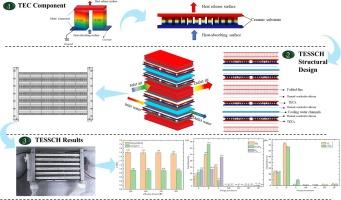
In practical settings, thermoelectric coolers (TEC) typically exhibit a cooling capacity (Qc) below 200 W and a coefficient of cooling performance (COPc) less than 1, limiting their application in high-demand scenarios. Despite their compactness, TEC require extensive heat dissipation structures in actual deployment. This study introduces an advanced thermoelectric sandwich-structural cooling and heating system (TESSCH), integrating TEC, flat water channels, and folded fins. The TESSCH system incorporates 72 TECs within a maximum external dimension of 172 mm*170 mm*30 mm, significantly reducing the footprint compared to traditional TEC system. Experimental findings reveal that the TESSCH system’s coefficient of heating performance (COPh) is 196.7 % of that provided by a conventional PTC heater, achieving COPh and heating capacity (Qh) values of 2.18 and 1088.82 W, respectively. Under an input power of 500 W, the TESSCH system’s COPc and cooling capacity (Qc) reach 1.18 and 588.82 W, surpassing typical TEC figures. Compared with traditional air–water cooling systems, TESSCH offers substantially enhanced performance in a more compact form. Using RMS method and BBD experimental design, the regression models of the response variables about the design variables were obtain. The optimal combination of design parameters is obtained by the optimization method.
期刊介绍:
The journal Energy Conversion and Management provides a forum for publishing original contributions and comprehensive technical review articles of interdisciplinary and original research on all important energy topics.
The topics considered include energy generation, utilization, conversion, storage, transmission, conservation, management and sustainability. These topics typically involve various types of energy such as mechanical, thermal, nuclear, chemical, electromagnetic, magnetic and electric. These energy types cover all known energy resources, including renewable resources (e.g., solar, bio, hydro, wind, geothermal and ocean energy), fossil fuels and nuclear resources.



 京公网安备 11010802042870号
京ICP备2023020795号-1
京公网安备 11010802042870号
京ICP备2023020795号-1

 分享
分享
 求助内容:
求助内容: 应助结果提醒方式:
 扫码关注我们
