Low sintering temperature, interface characteristic and microwave/terahertz dielectric properties of ternary-phase Nd2O3-P2O5 based ceramics for patch antenna application
Xiangyu Xu , Wei Du , Jialun Du , Lianwei Shan , Zhanbai Feng , Haitao Wu
{"title":"Low sintering temperature, interface characteristic and microwave/terahertz dielectric properties of ternary-phase Nd2O3-P2O5 based ceramics for patch antenna application","authors":"Xiangyu Xu , Wei Du , Jialun Du , Lianwei Shan , Zhanbai Feng , Haitao Wu","doi":"10.1016/j.surfin.2024.105201","DOIUrl":null,"url":null,"abstract":"<div><div>In this work, LiF was chosen as a sintering aid to lower the sintering temperature required for monoclinic NdPO<sub>4</sub> (NPO) ceramic. A comprehensive investigation was conducted to analyze the impact of LiF on the sintering characteristics, microstructures, phase compositions, crystalline structures, interface characteristics, and microwave dielectric properties of NPO ceramic. Structure-property relationships were discussed based on the density, crystallite size, and lattice strain. The complex impedance spectroscopy revealed the mechanism underlying the interface characteristics of LiF on NPO ceramic. Additionally, far-infrared reflectance spectra and THz time-domain spectra revealed the intrinsic dielectric properties of NdPO<sub>4</sub>–1 wt.%LiF (NPO1). Notably, 1 wt.% LiF effectively reduced the sintering temperature from 1300 °C to 850 °C, significantly improving densification and dielectric properties. Typical properties such as <em>Q × f</em> = 55,840 GHz (at 9.58 GHz), ε<sub>r</sub> = 10.4, and τ<sub>f</sub> = −43.1 ppm °C<sup>−1</sup> were obtained for NPO1 ceramic after sintering at 850 °C. Furthermore, its compatibility with Ag was explored as a prerequisite for LTCC applications. Finally, the NPO1 ceramic was designed as a microstrip antenna with high gain (6.83 dB) and low return loss (−18.85 dB) at a centre frequency of 2.56 GHz, demonstrating its potential for Wi-Fi and Bluetooth applications. This work provides a theoretical foundation and practical guidance for developing orthophosphate ceramics.</div></div>","PeriodicalId":22081,"journal":{"name":"Surfaces and Interfaces","volume":"54 ","pages":"Article 105201"},"PeriodicalIF":6.3000,"publicationDate":"2024-11-01","publicationTypes":"Journal Article","fieldsOfStudy":null,"isOpenAccess":false,"openAccessPdf":"","citationCount":"0","resultStr":null,"platform":"Semanticscholar","paperid":null,"PeriodicalName":"Surfaces and Interfaces","FirstCategoryId":"88","ListUrlMain":"https://www.sciencedirect.com/science/article/pii/S2468023024013579","RegionNum":2,"RegionCategory":"材料科学","ArticlePicture":[],"TitleCN":null,"AbstractTextCN":null,"PMCID":null,"EPubDate":"2024/9/30 0:00:00","PubModel":"Epub","JCR":"Q2","JCRName":"CHEMISTRY, PHYSICAL","Score":null,"Total":0}
引用次数: 0
Abstract
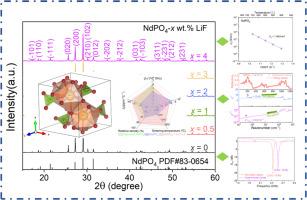
In this work, LiF was chosen as a sintering aid to lower the sintering temperature required for monoclinic NdPO4 (NPO) ceramic. A comprehensive investigation was conducted to analyze the impact of LiF on the sintering characteristics, microstructures, phase compositions, crystalline structures, interface characteristics, and microwave dielectric properties of NPO ceramic. Structure-property relationships were discussed based on the density, crystallite size, and lattice strain. The complex impedance spectroscopy revealed the mechanism underlying the interface characteristics of LiF on NPO ceramic. Additionally, far-infrared reflectance spectra and THz time-domain spectra revealed the intrinsic dielectric properties of NdPO4–1 wt.%LiF (NPO1). Notably, 1 wt.% LiF effectively reduced the sintering temperature from 1300 °C to 850 °C, significantly improving densification and dielectric properties. Typical properties such as Q × f = 55,840 GHz (at 9.58 GHz), εr = 10.4, and τf = −43.1 ppm °C−1 were obtained for NPO1 ceramic after sintering at 850 °C. Furthermore, its compatibility with Ag was explored as a prerequisite for LTCC applications. Finally, the NPO1 ceramic was designed as a microstrip antenna with high gain (6.83 dB) and low return loss (−18.85 dB) at a centre frequency of 2.56 GHz, demonstrating its potential for Wi-Fi and Bluetooth applications. This work provides a theoretical foundation and practical guidance for developing orthophosphate ceramics.
期刊介绍:
The aim of the journal is to provide a respectful outlet for ''sound science'' papers in all research areas on surfaces and interfaces. We define sound science papers as papers that describe new and well-executed research, but that do not necessarily provide brand new insights or are merely a description of research results.
Surfaces and Interfaces publishes research papers in all fields of surface science which may not always find the right home on first submission to our Elsevier sister journals (Applied Surface, Surface and Coatings Technology, Thin Solid Films)




 京公网安备 11010802042870号
京ICP备2023020795号-1
京公网安备 11010802042870号
京ICP备2023020795号-1

 分享
分享
 求助内容:
求助内容: 应助结果提醒方式:
 扫码关注我们
