{"title":"Green synthesis of cubic spinel ferrites and their potential biomedical applications","authors":"Siddikha Sultana Liyakath Ali , Satheesh Selvaraj , Khalid Mujasam Batoo , Ankush Chauhan , Garima Rana , Susmitha Kalaichelvan , Arunkumar Radhakrishnan","doi":"10.1016/j.ceramint.2024.10.084","DOIUrl":null,"url":null,"abstract":"<div><div>Cubic spinel ferrites have developed significant attention in materials science owing to their distinctive characteristics and diverse applications. The present review emphasizes on the cubic spinel ferrites fabricated via green synthesis routes focusing on their structural characteristics and their influence on the potential biomedical applications. Various green synthesis approaches, including sol-gel, hydrothermal, microwave irradiated, microorganism and plant-mediated methods, are discussed in detail, highlighting their eco-friendly approach allows for the fabrication of ferrites with customizable properties. Metal conjugate ferrites such as zinc, manganese, magnesium, cobalt, copper, nickel, and magnetite are synthesised using these green routes, highlighting the versatility and efficacy of green synthesis techniques in materials fabrication. Furthermore, the biomedical applications of cubic spinel ferrites are elucidated, illustrating their utility in cancer therapy, antibacterial properties, biosensing and drug delivery systems. This review emphasizes the importance of using green chemistry principles and natural resources to advance sustainable material development methods, as well as fully utilising cubic spinel ferrites in various medicinal domains to enhance innovation and tackle global challenges in a sustainable way.</div></div>","PeriodicalId":267,"journal":{"name":"Ceramics International","volume":"50 24","pages":"Pages 52159-52189"},"PeriodicalIF":5.6000,"publicationDate":"2024-12-15","publicationTypes":"Journal Article","fieldsOfStudy":null,"isOpenAccess":false,"openAccessPdf":"","citationCount":"0","resultStr":null,"platform":"Semanticscholar","paperid":null,"PeriodicalName":"Ceramics International","FirstCategoryId":"88","ListUrlMain":"https://www.sciencedirect.com/science/article/pii/S0272884224045966","RegionNum":2,"RegionCategory":"材料科学","ArticlePicture":[],"TitleCN":null,"AbstractTextCN":null,"PMCID":null,"EPubDate":"","PubModel":"","JCR":"Q1","JCRName":"MATERIALS SCIENCE, CERAMICS","Score":null,"Total":0}
引用次数: 0
Abstract
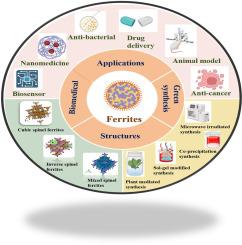
Cubic spinel ferrites have developed significant attention in materials science owing to their distinctive characteristics and diverse applications. The present review emphasizes on the cubic spinel ferrites fabricated via green synthesis routes focusing on their structural characteristics and their influence on the potential biomedical applications. Various green synthesis approaches, including sol-gel, hydrothermal, microwave irradiated, microorganism and plant-mediated methods, are discussed in detail, highlighting their eco-friendly approach allows for the fabrication of ferrites with customizable properties. Metal conjugate ferrites such as zinc, manganese, magnesium, cobalt, copper, nickel, and magnetite are synthesised using these green routes, highlighting the versatility and efficacy of green synthesis techniques in materials fabrication. Furthermore, the biomedical applications of cubic spinel ferrites are elucidated, illustrating their utility in cancer therapy, antibacterial properties, biosensing and drug delivery systems. This review emphasizes the importance of using green chemistry principles and natural resources to advance sustainable material development methods, as well as fully utilising cubic spinel ferrites in various medicinal domains to enhance innovation and tackle global challenges in a sustainable way.
期刊介绍:
Ceramics International covers the science of advanced ceramic materials. The journal encourages contributions that demonstrate how an understanding of the basic chemical and physical phenomena may direct materials design and stimulate ideas for new or improved processing techniques, in order to obtain materials with desired structural features and properties.
Ceramics International covers oxide and non-oxide ceramics, functional glasses, glass ceramics, amorphous inorganic non-metallic materials (and their combinations with metal and organic materials), in the form of particulates, dense or porous bodies, thin/thick films and laminated, graded and composite structures. Process related topics such as ceramic-ceramic joints or joining ceramics with dissimilar materials, as well as surface finishing and conditioning are also covered. Besides traditional processing techniques, manufacturing routes of interest include innovative procedures benefiting from externally applied stresses, electromagnetic fields and energetic beams, as well as top-down and self-assembly nanotechnology approaches. In addition, the journal welcomes submissions on bio-inspired and bio-enabled materials designs, experimentally validated multi scale modelling and simulation for materials design, and the use of the most advanced chemical and physical characterization techniques of structure, properties and behaviour.
Technologically relevant low-dimensional systems are a particular focus of Ceramics International. These include 0, 1 and 2-D nanomaterials (also covering CNTs, graphene and related materials, and diamond-like carbons), their nanocomposites, as well as nano-hybrids and hierarchical multifunctional nanostructures that might integrate molecular, biological and electronic components.




 京公网安备 11010802042870号
京ICP备2023020795号-1
京公网安备 11010802042870号
京ICP备2023020795号-1

 分享
分享
 求助内容:
求助内容: 应助结果提醒方式:
 扫码关注我们
