Liang Yang, Hong Wang, Deying Leng, Shipeng Fang, Yanning Yang, Yurun Du
{"title":"Machine learning applications in nanomaterials: Recent advances and future perspectives","authors":"Liang Yang, Hong Wang, Deying Leng, Shipeng Fang, Yanning Yang, Yurun Du","doi":"10.1016/j.cej.2024.156687","DOIUrl":null,"url":null,"abstract":"<div><div>Nanomaterials demonstrate enormous potential applications in various scientific and engineering fields due to their unique physical and chemical properties. With the rapid development of machine learning (ML) technology, its role in the application of nanomaterials is becoming increasingly prominent. Nanomaterials, assisted by various ML algorithms, efficiently model their structure–property relationships, enabling precise prediction and rational design. This review aims to explore the state-of-the-art and future trends of ML in nanomaterial research. It focuses on analyzing research strategies for ML-assisted nanomaterials, including design, characterization, and preparation strategies. The review systematically examines research outcomes in property prediction, structure optimization, synthesis design, characterization analysis, image processing, and quality control, while also summarizing and looking ahead to future development directions. The ML not only accelerates the discovery and development of nanomaterials but also enhances the understanding of nanoscale phenomena, broadens the practical applications of nanoscience, and provides new ideas and technological means for intelligent, high-throughput nanomaterial research and development.</div></div>","PeriodicalId":270,"journal":{"name":"Chemical Engineering Journal","volume":"500 ","pages":"Article 156687"},"PeriodicalIF":13.2000,"publicationDate":"2024-10-14","publicationTypes":"Journal Article","fieldsOfStudy":null,"isOpenAccess":false,"openAccessPdf":"","citationCount":"0","resultStr":null,"platform":"Semanticscholar","paperid":null,"PeriodicalName":"Chemical Engineering Journal","FirstCategoryId":"5","ListUrlMain":"https://www.sciencedirect.com/science/article/pii/S1385894724081786","RegionNum":1,"RegionCategory":"工程技术","ArticlePicture":[],"TitleCN":null,"AbstractTextCN":null,"PMCID":null,"EPubDate":"","PubModel":"","JCR":"Q1","JCRName":"ENGINEERING, CHEMICAL","Score":null,"Total":0}
引用次数: 0
Abstract
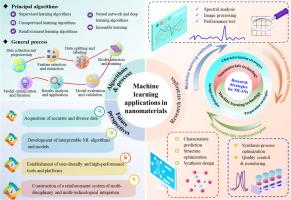
Nanomaterials demonstrate enormous potential applications in various scientific and engineering fields due to their unique physical and chemical properties. With the rapid development of machine learning (ML) technology, its role in the application of nanomaterials is becoming increasingly prominent. Nanomaterials, assisted by various ML algorithms, efficiently model their structure–property relationships, enabling precise prediction and rational design. This review aims to explore the state-of-the-art and future trends of ML in nanomaterial research. It focuses on analyzing research strategies for ML-assisted nanomaterials, including design, characterization, and preparation strategies. The review systematically examines research outcomes in property prediction, structure optimization, synthesis design, characterization analysis, image processing, and quality control, while also summarizing and looking ahead to future development directions. The ML not only accelerates the discovery and development of nanomaterials but also enhances the understanding of nanoscale phenomena, broadens the practical applications of nanoscience, and provides new ideas and technological means for intelligent, high-throughput nanomaterial research and development.
纳米材料因其独特的物理和化学性质,在各种科学和工程领域展现出巨大的应用潜力。随着机器学习(ML)技术的快速发展,其在纳米材料应用中的作用也日益凸显。在各种 ML 算法的辅助下,纳米材料可以有效地模拟其结构-性能关系,从而实现精确预测和合理设计。本综述旨在探讨 ML 在纳米材料研究中的最新进展和未来趋势。它重点分析了 ML 辅助纳米材料的研究策略,包括设计、表征和制备策略。综述系统地考察了性能预测、结构优化、合成设计、表征分析、图像处理和质量控制等方面的研究成果,同时也总结和展望了未来的发展方向。ML不仅加速了纳米材料的发现和开发,而且增强了对纳米尺度现象的理解,拓宽了纳米科学的实际应用,为智能化、高通量纳米材料的研究和开发提供了新的思路和技术手段。
期刊介绍:
The Chemical Engineering Journal is an international research journal that invites contributions of original and novel fundamental research. It aims to provide an international platform for presenting original fundamental research, interpretative reviews, and discussions on new developments in chemical engineering. The journal welcomes papers that describe novel theory and its practical application, as well as those that demonstrate the transfer of techniques from other disciplines. It also welcomes reports on carefully conducted experimental work that is soundly interpreted. The main focus of the journal is on original and rigorous research results that have broad significance. The Catalysis section within the Chemical Engineering Journal focuses specifically on Experimental and Theoretical studies in the fields of heterogeneous catalysis, molecular catalysis, and biocatalysis. These studies have industrial impact on various sectors such as chemicals, energy, materials, foods, healthcare, and environmental protection.




 京公网安备 11010802042870号
京ICP备2023020795号-1
京公网安备 11010802042870号
京ICP备2023020795号-1

 分享
分享
 求助内容:
求助内容: 应助结果提醒方式:
 扫码关注我们
