Weiyu Chen, Dean R. Jerry, Ronald D. White, Leo Nankervis
{"title":"Non-Invasive Prediction of Barramundi (Lates calcarifer) Flesh Lightness Using Near-Infrared Spectroscopy","authors":"Weiyu Chen, Dean R. Jerry, Ronald D. White, Leo Nankervis","doi":"10.1155/2024/1524148","DOIUrl":null,"url":null,"abstract":"<div>\n <p>Barramundi (<i>Lates calcarifer</i>) is an important aquaculture species extensively farmed throughout its natural distribution of Australia and Southeast Asia, as well as being increasingly farmed in the Middle East, USA, and Europe. Barramundi has a firm, pink-white flesh; however, fillets from farmed barramundi often exhibit grey colouration. This grey colouration detracts from its market appeal, leading to challenges in consumer acceptance and competitiveness of the product against other white fillet fish. Selective breeding, environmental manipulation, and dietary adjustments are being investigated to reduce grey flesh colouration. Yet, the absence of a rapid, noninvasive approach to predict greyness in flesh means that large numbers of samples cannot be quickly evaluated, and issues cannot be mitigated preharvest and noninvasively to preserve the fish. To address this issue, rapid analysis of flesh greyness was developed using noninvasive near-infrared (NIR) spectroscopy through the fish skin. Thirty fish were purchased from a barramundi farm, filleted, and divided into 3 cm sections, yielding a total of 335 samples from both dorsal and ventral fillet regions. NIR spectral data were obtained from the skin side of all samples, and colouration data were collected from the flesh side of the same samples. Data were randomised into a training set (256 spectra) and a validation set (79 spectra). Predictive models were developed using flesh colour as the training input for skin NIR spectra. The refined partial least squares regression model explained 78% of the variation in the medial flesh colour (R<sup>2</sup><sub>pe</sub> of 0.776, an RMSEP of 2.820, and an RPD<sub>pe</sub> of 2.122) demonstrating the ability to adequately predict the flesh quality through skin spectra. This highlights the potential of NIR spectroscopy as a dependable, noninvasive tool, enabling the rapid evaluation of large samples and offering the potential to address flesh colouration issues in barramundi preharvest.</p>\n </div>","PeriodicalId":8104,"journal":{"name":"Aquaculture Research","volume":"2024 1","pages":""},"PeriodicalIF":1.9000,"publicationDate":"2024-10-15","publicationTypes":"Journal Article","fieldsOfStudy":null,"isOpenAccess":false,"openAccessPdf":"https://onlinelibrary.wiley.com/doi/epdf/10.1155/2024/1524148","citationCount":"0","resultStr":null,"platform":"Semanticscholar","paperid":null,"PeriodicalName":"Aquaculture Research","FirstCategoryId":"97","ListUrlMain":"https://onlinelibrary.wiley.com/doi/10.1155/2024/1524148","RegionNum":4,"RegionCategory":"农林科学","ArticlePicture":[],"TitleCN":null,"AbstractTextCN":null,"PMCID":null,"EPubDate":"","PubModel":"","JCR":"Q2","JCRName":"FISHERIES","Score":null,"Total":0}
引用次数: 0
Abstract
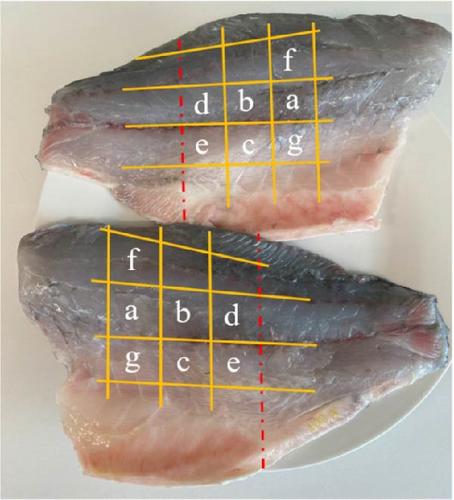
Barramundi (Lates calcarifer) is an important aquaculture species extensively farmed throughout its natural distribution of Australia and Southeast Asia, as well as being increasingly farmed in the Middle East, USA, and Europe. Barramundi has a firm, pink-white flesh; however, fillets from farmed barramundi often exhibit grey colouration. This grey colouration detracts from its market appeal, leading to challenges in consumer acceptance and competitiveness of the product against other white fillet fish. Selective breeding, environmental manipulation, and dietary adjustments are being investigated to reduce grey flesh colouration. Yet, the absence of a rapid, noninvasive approach to predict greyness in flesh means that large numbers of samples cannot be quickly evaluated, and issues cannot be mitigated preharvest and noninvasively to preserve the fish. To address this issue, rapid analysis of flesh greyness was developed using noninvasive near-infrared (NIR) spectroscopy through the fish skin. Thirty fish were purchased from a barramundi farm, filleted, and divided into 3 cm sections, yielding a total of 335 samples from both dorsal and ventral fillet regions. NIR spectral data were obtained from the skin side of all samples, and colouration data were collected from the flesh side of the same samples. Data were randomised into a training set (256 spectra) and a validation set (79 spectra). Predictive models were developed using flesh colour as the training input for skin NIR spectra. The refined partial least squares regression model explained 78% of the variation in the medial flesh colour (R2pe of 0.776, an RMSEP of 2.820, and an RPDpe of 2.122) demonstrating the ability to adequately predict the flesh quality through skin spectra. This highlights the potential of NIR spectroscopy as a dependable, noninvasive tool, enabling the rapid evaluation of large samples and offering the potential to address flesh colouration issues in barramundi preharvest.
期刊介绍:
International in perspective, Aquaculture Research is published 12 times a year and specifically addresses research and reference needs of all working and studying within the many varied areas of aquaculture. The Journal regularly publishes papers on applied or scientific research relevant to freshwater, brackish, and marine aquaculture. It covers all aquatic organisms, floristic and faunistic, related directly or indirectly to human consumption. The journal also includes review articles, short communications and technical papers. Young scientists are particularly encouraged to submit short communications based on their own research.



 京公网安备 11010802042870号
京ICP备2023020795号-1
京公网安备 11010802042870号
京ICP备2023020795号-1

 分享
分享
 求助内容:
求助内容: 应助结果提醒方式:
 扫码关注我们
