{"title":"Highly efficient Li-CO2 batteries with regulated discharge product enabled by a hetero-structured N-C/Fe3C/Fe cathodic catalyst","authors":"Shilin Hu, Ying Xiao, Fenglian Gong, Shasha Xiao, Wanting Wu, Yu Yang, Lei Hua, Shimou Chen","doi":"10.1016/j.jpowsour.2024.235592","DOIUrl":null,"url":null,"abstract":"<div><div>Lithium carbon dioxide (Li-CO<sub>2</sub>) batteries have been regarded as a promising technology to alleviate the greenhouse effect and meet the demands for high-energy applications. However, the sluggish CO<sub>2</sub> transformation kinetics and the Li<sub>2</sub>CO<sub>3</sub>-related parasitic reactions degrade the battery's performance. Herein, we introduce a heterostructure N-doped carbon combined Fe<sub>3</sub>C/Fe as a low-cost catalyst to regulate the formation of discharged product and accelerate the CO<sub>2</sub> redox kinetics. Systematically experimental characterizations reveal that the as-designed heterostructure can control the discharge product as the amorphous form to reduce the polarization voltage, thereby improving the cycle stability and increasing the energy efficiency of the battery. As a result, the assembled Li-CO<sub>2</sub> batteries exhibit a high full discharge capacity of 16550 mAh g<sup>−1</sup> with an excellent initial Coulombic efficiency of 96.7 % and maintain a low overpotential of 1.42 V over 200 cycles at 300 mA g<sup>−1</sup>. This work provides a new research insight to design high-efficient and low-cost Li-CO<sub>2</sub> batteries with small overpotential and long-lifespan.</div></div>","PeriodicalId":377,"journal":{"name":"Journal of Power Sources","volume":"624 ","pages":"Article 235592"},"PeriodicalIF":7.9000,"publicationDate":"2024-12-30","publicationTypes":"Journal Article","fieldsOfStudy":null,"isOpenAccess":false,"openAccessPdf":"","citationCount":"0","resultStr":null,"platform":"Semanticscholar","paperid":null,"PeriodicalName":"Journal of Power Sources","FirstCategoryId":"5","ListUrlMain":"https://www.sciencedirect.com/science/article/pii/S0378775324015441","RegionNum":2,"RegionCategory":"工程技术","ArticlePicture":[],"TitleCN":null,"AbstractTextCN":null,"PMCID":null,"EPubDate":"2024/10/14 0:00:00","PubModel":"Epub","JCR":"Q1","JCRName":"CHEMISTRY, PHYSICAL","Score":null,"Total":0}
引用次数: 0
Abstract
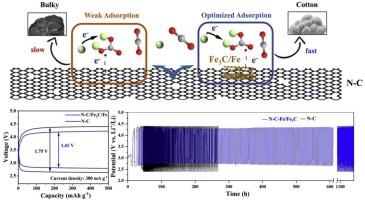
Lithium carbon dioxide (Li-CO2) batteries have been regarded as a promising technology to alleviate the greenhouse effect and meet the demands for high-energy applications. However, the sluggish CO2 transformation kinetics and the Li2CO3-related parasitic reactions degrade the battery's performance. Herein, we introduce a heterostructure N-doped carbon combined Fe3C/Fe as a low-cost catalyst to regulate the formation of discharged product and accelerate the CO2 redox kinetics. Systematically experimental characterizations reveal that the as-designed heterostructure can control the discharge product as the amorphous form to reduce the polarization voltage, thereby improving the cycle stability and increasing the energy efficiency of the battery. As a result, the assembled Li-CO2 batteries exhibit a high full discharge capacity of 16550 mAh g−1 with an excellent initial Coulombic efficiency of 96.7 % and maintain a low overpotential of 1.42 V over 200 cycles at 300 mA g−1. This work provides a new research insight to design high-efficient and low-cost Li-CO2 batteries with small overpotential and long-lifespan.
二氧化碳锂电池(Li-CO2)一直被认为是缓解温室效应和满足高能量应用需求的一项前景广阔的技术。然而,缓慢的二氧化碳转化动力学和与 Li2CO3 相关的寄生反应降低了电池的性能。在此,我们引入了一种掺杂 N 的异质结构碳结合 Fe3C/Fe 作为低成本催化剂,以调节放电产物的形成并加速 CO2 氧化还原动力学。通过系统的实验表征发现,所设计的异质结构可以将放电产物控制为非晶态,从而降低极化电压,提高电池的循环稳定性和能量效率。因此,组装后的二氧化碳锂电池显示出 16550 mAh g-1 的高完全放电容量和 96.7 % 的出色初始库仑效率,并且在 300 mA g-1 的条件下循环 200 次仍能保持 1.42 V 的低过电位。这项工作为设计过电位小、寿命长的高效低成本二氧化碳锂电池提供了新的研究视角。
期刊介绍:
The Journal of Power Sources is a publication catering to researchers and technologists interested in various aspects of the science, technology, and applications of electrochemical power sources. It covers original research and reviews on primary and secondary batteries, fuel cells, supercapacitors, and photo-electrochemical cells.
Topics considered include the research, development and applications of nanomaterials and novel componentry for these devices. Examples of applications of these electrochemical power sources include:
• Portable electronics
• Electric and Hybrid Electric Vehicles
• Uninterruptible Power Supply (UPS) systems
• Storage of renewable energy
• Satellites and deep space probes
• Boats and ships, drones and aircrafts
• Wearable energy storage systems




 京公网安备 11010802042870号
京ICP备2023020795号-1
京公网安备 11010802042870号
京ICP备2023020795号-1

 分享
分享
 求助内容:
求助内容: 应助结果提醒方式:
 扫码关注我们
