{"title":"Modelling the membrane decomposition induced recoverable performance loss of proton exchange membrane fuel cells","authors":"Yuwei Pan , Huizhi Wang , Nigel P. Brandon","doi":"10.1016/j.jpowsour.2024.235574","DOIUrl":null,"url":null,"abstract":"<div><div>Rapid and reversible performance loss in proton exchange membrane fuel cells (PEMFCs) has been observed due to membrane chemical degradation. Despite various experimental efforts, challenges persist in studying the membrane degradation dynamics and its connection to performance loss. While many membrane degradation models exist, they significantly underestimate the performance decay and fail to replicate its reversibility, limiting their predictive capacity. To address this gap, we present a physics-based membrane degradation model that effectively captures the decay and recovery of both open circuit voltage (OCV) and performance by incorporating the release and transport of sulfate and sulfonate, byproducts of membrane degradation, as well as their interactions with catalyst layers. Simulation results are compared with experimental data from the literature, successfully replicating sulfate adsorption, OCV/performance loss/recovery, and byproduct release rates. Further analyses reveals the role of membrane degradation in reversible performance loss, suggesting that the performance decay is primarily attributed to catalyst poisoning, while the reduced resistance is due to membrane thinning from the much faster mainchain degradation process. Our results also indicate that the H<sub>2</sub>/N<sub>2</sub> recovery protocol is less effective than H<sub>2</sub>/air due to the fast condensation of supersaturated gases in channels and the absence of water generated by electrochemical reactions.</div></div>","PeriodicalId":377,"journal":{"name":"Journal of Power Sources","volume":"624 ","pages":"Article 235574"},"PeriodicalIF":7.9000,"publicationDate":"2024-12-30","publicationTypes":"Journal Article","fieldsOfStudy":null,"isOpenAccess":false,"openAccessPdf":"","citationCount":"0","resultStr":null,"platform":"Semanticscholar","paperid":null,"PeriodicalName":"Journal of Power Sources","FirstCategoryId":"5","ListUrlMain":"https://www.sciencedirect.com/science/article/pii/S037877532401526X","RegionNum":2,"RegionCategory":"工程技术","ArticlePicture":[],"TitleCN":null,"AbstractTextCN":null,"PMCID":null,"EPubDate":"2024/10/14 0:00:00","PubModel":"Epub","JCR":"Q1","JCRName":"CHEMISTRY, PHYSICAL","Score":null,"Total":0}
引用次数: 0
Abstract
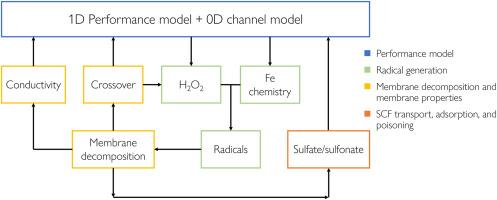
Rapid and reversible performance loss in proton exchange membrane fuel cells (PEMFCs) has been observed due to membrane chemical degradation. Despite various experimental efforts, challenges persist in studying the membrane degradation dynamics and its connection to performance loss. While many membrane degradation models exist, they significantly underestimate the performance decay and fail to replicate its reversibility, limiting their predictive capacity. To address this gap, we present a physics-based membrane degradation model that effectively captures the decay and recovery of both open circuit voltage (OCV) and performance by incorporating the release and transport of sulfate and sulfonate, byproducts of membrane degradation, as well as their interactions with catalyst layers. Simulation results are compared with experimental data from the literature, successfully replicating sulfate adsorption, OCV/performance loss/recovery, and byproduct release rates. Further analyses reveals the role of membrane degradation in reversible performance loss, suggesting that the performance decay is primarily attributed to catalyst poisoning, while the reduced resistance is due to membrane thinning from the much faster mainchain degradation process. Our results also indicate that the H2/N2 recovery protocol is less effective than H2/air due to the fast condensation of supersaturated gases in channels and the absence of water generated by electrochemical reactions.
期刊介绍:
The Journal of Power Sources is a publication catering to researchers and technologists interested in various aspects of the science, technology, and applications of electrochemical power sources. It covers original research and reviews on primary and secondary batteries, fuel cells, supercapacitors, and photo-electrochemical cells.
Topics considered include the research, development and applications of nanomaterials and novel componentry for these devices. Examples of applications of these electrochemical power sources include:
• Portable electronics
• Electric and Hybrid Electric Vehicles
• Uninterruptible Power Supply (UPS) systems
• Storage of renewable energy
• Satellites and deep space probes
• Boats and ships, drones and aircrafts
• Wearable energy storage systems



 京公网安备 11010802042870号
京ICP备2023020795号-1
京公网安备 11010802042870号
京ICP备2023020795号-1

 分享
分享
 求助内容:
求助内容: 应助结果提醒方式:
 扫码关注我们
