Emilie T. Reas, Seraphina K. Solders, Amaryllis Tsiknia, Curtis Triebswetter, Qian Shen, Charlotte S. Rivera, Murray J. Andrews, Austin Alderson-Myers, James B. Brewer
{"title":"APOE 𝜀4-related blood–brain barrier breakdown is associated with microstructural abnormalities","authors":"Emilie T. Reas, Seraphina K. Solders, Amaryllis Tsiknia, Curtis Triebswetter, Qian Shen, Charlotte S. Rivera, Murray J. Andrews, Austin Alderson-Myers, James B. Brewer","doi":"10.1002/alz.14302","DOIUrl":null,"url":null,"abstract":"<div>\n \n \n <section>\n \n <h3> INTRODUCTION</h3>\n \n <p>Blood–brain barrier (BBB) dysfunction occurs in Alzheimer's disease (AD). Yet, the stage at which it appears along the AD time course and whether it contributes to neurodegeneration remain unclear.</p>\n </section>\n \n <section>\n \n <h3> METHODS</h3>\n \n <p>Older adults (61 to 90 years) from cognitively normal (CN) to mildly cognitively impaired (CI), enriched for <i>APOE</i> <i>𝜀4</i> and amyloid positivity, underwent dynamic contrast-enhanced (DCE) magnetic resonance imaging (MRI) and diffusion MRI to measure BBB permeability and brain microstructure. Analysis of variance compared BBB permeability according to cognitive status, amyloid beta (Aβ), and <i>APOE4</i>. Linear regressions assessed associations of BBB permeability with brain microstructure and interactions with Aβ and <i>APOE4</i>.</p>\n </section>\n \n <section>\n \n <h3> RESULTS</h3>\n \n <p>BBB permeability was elevated for <i>APOE4</i> carriers across the cortical gray matter, with the strongest differences among CN amyloid-negative individuals. Associations between entorhinal BBB permeability and microstructure interacted with Aβ and <i>APOE4</i>, with the strongest relationships in amyloid-positive individuals and <i>APOE4</i> carriers.</p>\n </section>\n \n <section>\n \n <h3> DISCUSSION</h3>\n \n <p><i>APOE4</i> may drive widespread BBB dysfunction in preclinical AD, which may contribute to neurodegenerative changes early along the AD cascade.</p>\n </section>\n \n <section>\n \n <h3> Highlights</h3>\n \n <div>\n <ul>\n \n <li>Gray matter blood–brain barrier (BBB) permeability is elevated for APOE4 carriers.</li>\n \n <li>APOE4-related BBB breakdown appears in the absence of cognitive decline or amyloid.</li>\n \n <li>BBB leakage correlates with entorhinal cortex microstructural injury.</li>\n \n <li>Associations with microstructure are strongest for amyloid-positive APOE4 carriers.</li>\n </ul>\n </div>\n </section>\n </div>","PeriodicalId":7471,"journal":{"name":"Alzheimer's & Dementia","volume":"20 12","pages":"8615-8624"},"PeriodicalIF":11.1000,"publicationDate":"2024-10-16","publicationTypes":"Journal Article","fieldsOfStudy":null,"isOpenAccess":false,"openAccessPdf":"https://onlinelibrary.wiley.com/doi/epdf/10.1002/alz.14302","citationCount":"0","resultStr":null,"platform":"Semanticscholar","paperid":null,"PeriodicalName":"Alzheimer's & Dementia","FirstCategoryId":"3","ListUrlMain":"https://alz-journals.onlinelibrary.wiley.com/doi/10.1002/alz.14302","RegionNum":1,"RegionCategory":"医学","ArticlePicture":[],"TitleCN":null,"AbstractTextCN":null,"PMCID":null,"EPubDate":"","PubModel":"","JCR":"Q1","JCRName":"CLINICAL NEUROLOGY","Score":null,"Total":0}
引用次数: 0
Abstract
INTRODUCTION
Blood–brain barrier (BBB) dysfunction occurs in Alzheimer's disease (AD). Yet, the stage at which it appears along the AD time course and whether it contributes to neurodegeneration remain unclear.
METHODS
Older adults (61 to 90 years) from cognitively normal (CN) to mildly cognitively impaired (CI), enriched for APOE𝜀4 and amyloid positivity, underwent dynamic contrast-enhanced (DCE) magnetic resonance imaging (MRI) and diffusion MRI to measure BBB permeability and brain microstructure. Analysis of variance compared BBB permeability according to cognitive status, amyloid beta (Aβ), and APOE4. Linear regressions assessed associations of BBB permeability with brain microstructure and interactions with Aβ and APOE4.
RESULTS
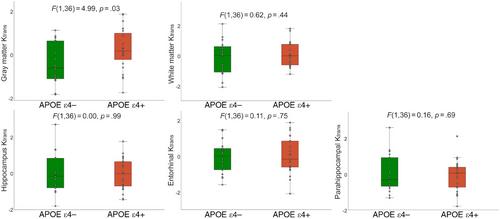
BBB permeability was elevated for APOE4 carriers across the cortical gray matter, with the strongest differences among CN amyloid-negative individuals. Associations between entorhinal BBB permeability and microstructure interacted with Aβ and APOE4, with the strongest relationships in amyloid-positive individuals and APOE4 carriers.
DISCUSSION
APOE4 may drive widespread BBB dysfunction in preclinical AD, which may contribute to neurodegenerative changes early along the AD cascade.
Highlights
Gray matter blood–brain barrier (BBB) permeability is elevated for APOE4 carriers.
APOE4-related BBB breakdown appears in the absence of cognitive decline or amyloid.
BBB leakage correlates with entorhinal cortex microstructural injury.
Associations with microstructure are strongest for amyloid-positive APOE4 carriers.
期刊介绍:
Alzheimer's & Dementia is a peer-reviewed journal that aims to bridge knowledge gaps in dementia research by covering the entire spectrum, from basic science to clinical trials to social and behavioral investigations. It provides a platform for rapid communication of new findings and ideas, optimal translation of research into practical applications, increasing knowledge across diverse disciplines for early detection, diagnosis, and intervention, and identifying promising new research directions. In July 2008, Alzheimer's & Dementia was accepted for indexing by MEDLINE, recognizing its scientific merit and contribution to Alzheimer's research.





 京公网安备 11010802042870号
京ICP备2023020795号-1
京公网安备 11010802042870号
京ICP备2023020795号-1

 分享
分享
 求助内容:
求助内容: 应助结果提醒方式:
 扫码关注我们
