Li Wang, Song Wang, Guoheng Xu, Youzhi Qu, Hongjie Zhang, Wenchao Liu, Jiqing Dai, Ting Wang, Zhiyuan Liu, Quanying Liu, Kai Xiao
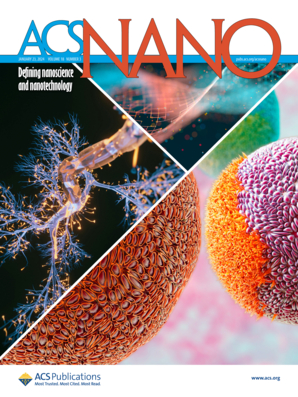
{"title":"Ionic Potential Relaxation Effect in a Hydrogel Enabling Synapse-Like Information Processing","authors":"Li Wang, Song Wang, Guoheng Xu, Youzhi Qu, Hongjie Zhang, Wenchao Liu, Jiqing Dai, Ting Wang, Zhiyuan Liu, Quanying Liu, Kai Xiao","doi":"10.1021/acsnano.4c09154","DOIUrl":null,"url":null,"abstract":"The next-generation brain-like intelligence based on neuromorphic architectures emphasizes learning the ionic language of the brain, aiming for efficient brain-like computation and seamless human-computer interaction. Ionic neuromorphic devices, with ions serving as information carriers, provide possibilities to achieve this goal. Soft and biocompatible ionic conductive hydrogels are an ideal substrate for constructing ionic neuromorphic devices, but it remains a challenge to modulate the ion transport behavior in hydrogels to mimic neuroelectric signals. Here, we describe an ionic potential relaxation effect in a hydrogel device prepared by sandwiching a layer of polycationic hydrogel (CH) between two layers of neutral hydrogel (NH), allowing this device to simulate various electrical signal patterns observed in biological synapses, including short- and long-term plasticity patterns. Theoretical and experimental results show that the selective permeation and hysteretic diffusion of ions caused by the anion selectivity of the CH layer are responsible for potential relaxation. Such an effect allows us with hydrogels to enable synapse-like information processing functions, including tactile perception, learning, memory, and neuromorphic computing. Additionally, the hydrogel device can operate stably even under 180° bending and 50% tensile strain, expanding the pathway for implementing advanced brain-like intelligent systems.","PeriodicalId":21,"journal":{"name":"ACS Nano","volume":"60 1","pages":""},"PeriodicalIF":16.0000,"publicationDate":"2024-10-16","publicationTypes":"Journal Article","fieldsOfStudy":null,"isOpenAccess":false,"openAccessPdf":"","citationCount":"0","resultStr":null,"platform":"Semanticscholar","paperid":null,"PeriodicalName":"ACS Nano","FirstCategoryId":"88","ListUrlMain":"https://doi.org/10.1021/acsnano.4c09154","RegionNum":1,"RegionCategory":"材料科学","ArticlePicture":[],"TitleCN":null,"AbstractTextCN":null,"PMCID":null,"EPubDate":"","PubModel":"","JCR":"Q1","JCRName":"CHEMISTRY, MULTIDISCIPLINARY","Score":null,"Total":0}
引用次数: 0
Abstract
The next-generation brain-like intelligence based on neuromorphic architectures emphasizes learning the ionic language of the brain, aiming for efficient brain-like computation and seamless human-computer interaction. Ionic neuromorphic devices, with ions serving as information carriers, provide possibilities to achieve this goal. Soft and biocompatible ionic conductive hydrogels are an ideal substrate for constructing ionic neuromorphic devices, but it remains a challenge to modulate the ion transport behavior in hydrogels to mimic neuroelectric signals. Here, we describe an ionic potential relaxation effect in a hydrogel device prepared by sandwiching a layer of polycationic hydrogel (CH) between two layers of neutral hydrogel (NH), allowing this device to simulate various electrical signal patterns observed in biological synapses, including short- and long-term plasticity patterns. Theoretical and experimental results show that the selective permeation and hysteretic diffusion of ions caused by the anion selectivity of the CH layer are responsible for potential relaxation. Such an effect allows us with hydrogels to enable synapse-like information processing functions, including tactile perception, learning, memory, and neuromorphic computing. Additionally, the hydrogel device can operate stably even under 180° bending and 50% tensile strain, expanding the pathway for implementing advanced brain-like intelligent systems.
期刊介绍:
ACS Nano, published monthly, serves as an international forum for comprehensive articles on nanoscience and nanotechnology research at the intersections of chemistry, biology, materials science, physics, and engineering. The journal fosters communication among scientists in these communities, facilitating collaboration, new research opportunities, and advancements through discoveries. ACS Nano covers synthesis, assembly, characterization, theory, and simulation of nanostructures, nanobiotechnology, nanofabrication, methods and tools for nanoscience and nanotechnology, and self- and directed-assembly. Alongside original research articles, it offers thorough reviews, perspectives on cutting-edge research, and discussions envisioning the future of nanoscience and nanotechnology.





 京公网安备 11010802042870号
京ICP备2023020795号-1
京公网安备 11010802042870号
京ICP备2023020795号-1

 分享
分享
 求助内容:
求助内容: 应助结果提醒方式:
 扫码关注我们
