{"title":"Detection of chlorine in potassium chloride and potassium sulfate using chemical imaging and artificial neural network","authors":"Mohammad Hossein Nargesi , Kobra Heidarbeigi , Zahra Moradi , Sahar Abdolahi","doi":"10.1016/j.saa.2024.125253","DOIUrl":null,"url":null,"abstract":"<div><div>Chlorine in potassium chloride and potassium sulfate must be detected due to its negative effect on soil. Although the laboratory-based chlorine measurement tests are reliable, they are time-consuming, expensive, and requires chemical agents and highly skilled operators. Therefore, the novelty of the present research is developing a fast, accurate, and cheap machine-based method to measure the amount of chlorine. The purpose of this research was to apply hyperspectral imaging and machine learning techniques to detect chlorine content in potassium chloride and potassium sulfate. Different percentages of chlorine in potassium chloride and potassium sulfate products were prepared with ranges of 53.1–50.05 and 1.47–2.13 %, respectively. Hyperspectral images were captured from the sample at the range of 400–950 nm. Mean, minimum, maximum, median, variance, and standard deviation features were extracted from the image channels corresponding to the effective wavelengths. The extracted features were classified using artificial neural network method and highest accuracy of the best models for potassium chloride and potassium sulfate were 95.6 and 94.4, respectively. The combination of hyperspectral imaging and machine learning promises reliable detection of chlorine content in potassium chloride and potassium sulfate in industrial systems with high speed and low cost.</div></div>","PeriodicalId":433,"journal":{"name":"Spectrochimica Acta Part A: Molecular and Biomolecular Spectroscopy","volume":"326 ","pages":"Article 125253"},"PeriodicalIF":4.6000,"publicationDate":"2025-02-05","publicationTypes":"Journal Article","fieldsOfStudy":null,"isOpenAccess":false,"openAccessPdf":"","citationCount":"0","resultStr":null,"platform":"Semanticscholar","paperid":null,"PeriodicalName":"Spectrochimica Acta Part A: Molecular and Biomolecular Spectroscopy","FirstCategoryId":"92","ListUrlMain":"https://www.sciencedirect.com/science/article/pii/S1386142524014197","RegionNum":2,"RegionCategory":"化学","ArticlePicture":[],"TitleCN":null,"AbstractTextCN":null,"PMCID":null,"EPubDate":"2024/10/10 0:00:00","PubModel":"Epub","JCR":"Q1","JCRName":"SPECTROSCOPY","Score":null,"Total":0}
引用次数: 0
Abstract
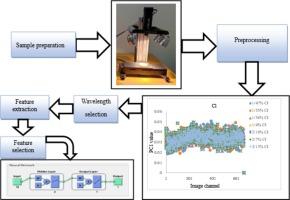
Chlorine in potassium chloride and potassium sulfate must be detected due to its negative effect on soil. Although the laboratory-based chlorine measurement tests are reliable, they are time-consuming, expensive, and requires chemical agents and highly skilled operators. Therefore, the novelty of the present research is developing a fast, accurate, and cheap machine-based method to measure the amount of chlorine. The purpose of this research was to apply hyperspectral imaging and machine learning techniques to detect chlorine content in potassium chloride and potassium sulfate. Different percentages of chlorine in potassium chloride and potassium sulfate products were prepared with ranges of 53.1–50.05 and 1.47–2.13 %, respectively. Hyperspectral images were captured from the sample at the range of 400–950 nm. Mean, minimum, maximum, median, variance, and standard deviation features were extracted from the image channels corresponding to the effective wavelengths. The extracted features were classified using artificial neural network method and highest accuracy of the best models for potassium chloride and potassium sulfate were 95.6 and 94.4, respectively. The combination of hyperspectral imaging and machine learning promises reliable detection of chlorine content in potassium chloride and potassium sulfate in industrial systems with high speed and low cost.
期刊介绍:
Spectrochimica Acta, Part A: Molecular and Biomolecular Spectroscopy (SAA) is an interdisciplinary journal which spans from basic to applied aspects of optical spectroscopy in chemistry, medicine, biology, and materials science.
The journal publishes original scientific papers that feature high-quality spectroscopic data and analysis. From the broad range of optical spectroscopies, the emphasis is on electronic, vibrational or rotational spectra of molecules, rather than on spectroscopy based on magnetic moments.
Criteria for publication in SAA are novelty, uniqueness, and outstanding quality. Routine applications of spectroscopic techniques and computational methods are not appropriate.
Topics of particular interest of Spectrochimica Acta Part A include, but are not limited to:
Spectroscopy and dynamics of bioanalytical, biomedical, environmental, and atmospheric sciences,
Novel experimental techniques or instrumentation for molecular spectroscopy,
Novel theoretical and computational methods,
Novel applications in photochemistry and photobiology,
Novel interpretational approaches as well as advances in data analysis based on electronic or vibrational spectroscopy.



 京公网安备 11010802042870号
京ICP备2023020795号-1
京公网安备 11010802042870号
京ICP备2023020795号-1

 分享
分享
 求助内容:
求助内容: 应助结果提醒方式:
 扫码关注我们
