Rianne J.M. Lammers, Amelia Pietropaolo, Giovanni Cacciamani, Juan Gomez Rivas, Riccardo Campi, Beatriz Bañuelos Marco, All Young Academic Urologists (YAU) Board Members
{"title":"Embracing diversity, equity, and inclusion in academic urology: the Young Academic Urologists (YAU) perspective","authors":"Rianne J.M. Lammers, Amelia Pietropaolo, Giovanni Cacciamani, Juan Gomez Rivas, Riccardo Campi, Beatriz Bañuelos Marco, All Young Academic Urologists (YAU) Board Members","doi":"10.1111/bju.16549","DOIUrl":null,"url":null,"abstract":"<p>The Young Academic Urologists (YAU) is a group of young clinician-scientists (aged <40 years) within the European Association of Urology (EAU) focusing on the development of clinical, educational, and research projects. In particular, due to strategic partnerships with the Guidelines Office, the Sections Office and the European School of Urology (ESU), the goals of YAU are to promote both high-quality studies to provide strong evidence for the best urological practice, and educational programmes to boost European training standards. The aim of creating a platform for close international cooperation for the future urology leaders in Europe (and beyond) is one of the YAU objectives as well. More information is available at: https://uroweb.org/young-academic-urologists-yau.</p><p>The YAU was established as part of the Young Urologists Office (YUO) in 2012, and started with nine working groups (Andrology, Bladder Cancer, Benign Prostatic Hyperplasia, Functional Urology, Paediatric Urology, Prostate Cancer, Renal Cancer, Robotics, and Urolithiasis). Over time, we have grown to 13 groups: Urothelial, Reconstructive, Urotechnology and Digital Health, Endourology and Urolithiasis, Functional Urology, Paediatric Urology, Penile and Testis Cancer, Prostate Cancer, Kidney Transplantation, Renal Cell Carcinoma, Robotic in Urology, Sexual and Reproductive Health, and very recently Infections in Urology. Each group is coordinated by a chairperson, who is actively involved in the YAU Board.</p><p>The YAU members are selected according to their academic career. The YAU groups recently expanded including members of other non-European countries. This is related to the term ‘diversity, equity and inclusion’ (DEI). Diversity refers to the individuals represented in the working force, including gender, ethnicity, religion, and disability. Equity refers to the concept of fairness and justice, e.g., equal access. As such, it is different from equality, which assumes that all people should be treated the same, whereas, with equity the final result will be equal. Lastly, inclusion means that everyone can make meaningful contributions, speak up and all voices will be heard. The YAU groups should therefore include members of different genders, countries, and cultural backgrounds.</p><p>In this research letter, our main objective was to analyse how gender and country representation within the YAU changed over time and we set goals for improvement in the future. Therefore, we collected data regarding member characteristics (gender, country) from 2012 to October 2023 and we stratified them by YAU group. Then, we analysed all papers published by the YAU and checked for gender representation in authorship, by using PubMed with the search code ‘young academic urologist’.</p><p>In the initial period (2012) members were predominantly male (74/78 [95%]), and only a few members came from outside Europe (Appendix A; Fig. A1 and Table A1). During recent years, the situation has gradually improved: currently women constitute 21% of the total number of members (40/191). We also witnessed a rise of interest from non-European members (24/191 [13%] in 2023).</p><p>Groups that deal with oncological topics have more members and thus a higher number of female representations. For example, the Renal Cell Cancer Working Group has a female representation of 29% (six of 21). The highest female representation is in the Paediatric Urology Working Group (five of 10 [50%]) and this group has two generations of female chairs.</p><p>The literature search on YAU publications yielded 396 results. After eliminating duplicates and not-YAU-related articles, we found 344 manuscripts. Considering first and last authorship (in total 688 authorships), 92 of them have female authors (13%). Among the 344 articles, 71 articles (20%) had a female first author, whereas only 21 articles (6%) had a female last author. It is noteworthy to mention that not all YAU articles were coded accurately, thus a possibility of oversight exists; however, the prevailing trend remains evident.</p><p>These numbers needs to be related to EAU membership numbers. Dr Proietti, a member of the EAU DEI task force, wrote a statement article analysing female contributions [<span>1</span>]: in nine European countries 63% of medical students, 48% of all residents, and 24% of all urology consultants, are female. Moreno-Fontela et al. [<span>2</span>] recently analysed Spanish trends and found that 50–61% of the residents were female in 2022.</p><p>Concerning congress activities within the EAU: up until 2021 women presented <20% of all posters, chaired <10% of the scientific sessions, and female faculty representation at congresses was ~12% [<span>1</span>]. The YAU Paediatric Working Group [<span>3</span>] analysed female representation on paediatric urology congresses, which also showed gradual improvement over the years. In the United States the same trends of slowly improving figures are seen [<span>4, 5</span>]. To improve these numbers the EAU DEI task force defined aims and objectives, and a 5–10 year plan with concrete actions. Unfortunately, to date no other work for the EAU DEI task force has emerged.</p><p>Several causes of inequal gender distribution can be pointed out: lack of awareness, limited mentorship opportunities, harassment, disparity regarding promotion opportunities due to e.g., maternity leave, unequal care tasks for women leaving less time left for research compared to men, etc. [<span>4, 5</span>]. This latter may be relevant for the specific case of the YAU working groups: in order to enter YAU the applicant will need to pass a selection, which requires multiple articles in the field of interest. This principle might sometimes benefit male gender.</p><p>Additionally, ‘imposter syndrome’ may play a role. This term, introduced by Clance in 1978, describes a persistent internalised fear of being exposed as frauds. Those individuals experiencing this phenomenon do not believe they deserve their success or luck, regardless of external evidence of their skills. There is scarce literature on imposter syndrome in urologists. According to a large survey done by Jefferson et al. [<span>6</span>] younger and female urologists experience impostor syndrome more severely and it is also independently associated with burnout.</p><p>With the current understanding of the situation, consideration should be given to enhancing DEI within the YAU working groups. Therefore, a ‘Strengths, Weaknesses, Opportunities, and Threats’ (SWOT) analysis is described in Box 1. The DEI criteria are currently being defined and will be published on the YAU website. DEI should be included in the mission of the YAU working groups, including regular evaluation and using it for selecting new members and chairpersons.</p><p>Overall, there is a positive trend in female representation within the YAU working groups; however, numbers are still behind those observed in residency programmes. Several suggestions have been stated. We hope that these efforts raise awareness within the YAU, thus paving the way for further improve in DEI. Our analysis can also encourage other groups to interrogate themselves and improve gender and diversity distributions among their members and board.</p><p>Beatriz Bañuelos Marco: support for congress by Uromune and ITAI.</p>","PeriodicalId":8985,"journal":{"name":"BJU International","volume":"135 1","pages":"9-12"},"PeriodicalIF":4.4000,"publicationDate":"2024-10-15","publicationTypes":"Journal Article","fieldsOfStudy":null,"isOpenAccess":false,"openAccessPdf":"https://onlinelibrary.wiley.com/doi/epdf/10.1111/bju.16549","citationCount":"0","resultStr":null,"platform":"Semanticscholar","paperid":null,"PeriodicalName":"BJU International","FirstCategoryId":"3","ListUrlMain":"https://bjui-journals.onlinelibrary.wiley.com/doi/10.1111/bju.16549","RegionNum":2,"RegionCategory":"医学","ArticlePicture":[],"TitleCN":null,"AbstractTextCN":null,"PMCID":null,"EPubDate":"","PubModel":"","JCR":"Q1","JCRName":"UROLOGY & NEPHROLOGY","Score":null,"Total":0}
引用次数: 0
Abstract
The Young Academic Urologists (YAU) is a group of young clinician-scientists (aged <40 years) within the European Association of Urology (EAU) focusing on the development of clinical, educational, and research projects. In particular, due to strategic partnerships with the Guidelines Office, the Sections Office and the European School of Urology (ESU), the goals of YAU are to promote both high-quality studies to provide strong evidence for the best urological practice, and educational programmes to boost European training standards. The aim of creating a platform for close international cooperation for the future urology leaders in Europe (and beyond) is one of the YAU objectives as well. More information is available at: https://uroweb.org/young-academic-urologists-yau.
The YAU was established as part of the Young Urologists Office (YUO) in 2012, and started with nine working groups (Andrology, Bladder Cancer, Benign Prostatic Hyperplasia, Functional Urology, Paediatric Urology, Prostate Cancer, Renal Cancer, Robotics, and Urolithiasis). Over time, we have grown to 13 groups: Urothelial, Reconstructive, Urotechnology and Digital Health, Endourology and Urolithiasis, Functional Urology, Paediatric Urology, Penile and Testis Cancer, Prostate Cancer, Kidney Transplantation, Renal Cell Carcinoma, Robotic in Urology, Sexual and Reproductive Health, and very recently Infections in Urology. Each group is coordinated by a chairperson, who is actively involved in the YAU Board.
The YAU members are selected according to their academic career. The YAU groups recently expanded including members of other non-European countries. This is related to the term ‘diversity, equity and inclusion’ (DEI). Diversity refers to the individuals represented in the working force, including gender, ethnicity, religion, and disability. Equity refers to the concept of fairness and justice, e.g., equal access. As such, it is different from equality, which assumes that all people should be treated the same, whereas, with equity the final result will be equal. Lastly, inclusion means that everyone can make meaningful contributions, speak up and all voices will be heard. The YAU groups should therefore include members of different genders, countries, and cultural backgrounds.
In this research letter, our main objective was to analyse how gender and country representation within the YAU changed over time and we set goals for improvement in the future. Therefore, we collected data regarding member characteristics (gender, country) from 2012 to October 2023 and we stratified them by YAU group. Then, we analysed all papers published by the YAU and checked for gender representation in authorship, by using PubMed with the search code ‘young academic urologist’.
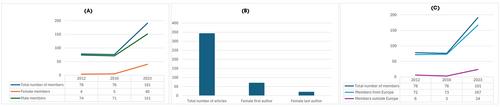
In the initial period (2012) members were predominantly male (74/78 [95%]), and only a few members came from outside Europe (Appendix A; Fig. A1 and Table A1). During recent years, the situation has gradually improved: currently women constitute 21% of the total number of members (40/191). We also witnessed a rise of interest from non-European members (24/191 [13%] in 2023).
Groups that deal with oncological topics have more members and thus a higher number of female representations. For example, the Renal Cell Cancer Working Group has a female representation of 29% (six of 21). The highest female representation is in the Paediatric Urology Working Group (five of 10 [50%]) and this group has two generations of female chairs.
The literature search on YAU publications yielded 396 results. After eliminating duplicates and not-YAU-related articles, we found 344 manuscripts. Considering first and last authorship (in total 688 authorships), 92 of them have female authors (13%). Among the 344 articles, 71 articles (20%) had a female first author, whereas only 21 articles (6%) had a female last author. It is noteworthy to mention that not all YAU articles were coded accurately, thus a possibility of oversight exists; however, the prevailing trend remains evident.
These numbers needs to be related to EAU membership numbers. Dr Proietti, a member of the EAU DEI task force, wrote a statement article analysing female contributions [1]: in nine European countries 63% of medical students, 48% of all residents, and 24% of all urology consultants, are female. Moreno-Fontela et al. [2] recently analysed Spanish trends and found that 50–61% of the residents were female in 2022.
Concerning congress activities within the EAU: up until 2021 women presented <20% of all posters, chaired <10% of the scientific sessions, and female faculty representation at congresses was ~12% [1]. The YAU Paediatric Working Group [3] analysed female representation on paediatric urology congresses, which also showed gradual improvement over the years. In the United States the same trends of slowly improving figures are seen [4, 5]. To improve these numbers the EAU DEI task force defined aims and objectives, and a 5–10 year plan with concrete actions. Unfortunately, to date no other work for the EAU DEI task force has emerged.
Several causes of inequal gender distribution can be pointed out: lack of awareness, limited mentorship opportunities, harassment, disparity regarding promotion opportunities due to e.g., maternity leave, unequal care tasks for women leaving less time left for research compared to men, etc. [4, 5]. This latter may be relevant for the specific case of the YAU working groups: in order to enter YAU the applicant will need to pass a selection, which requires multiple articles in the field of interest. This principle might sometimes benefit male gender.
Additionally, ‘imposter syndrome’ may play a role. This term, introduced by Clance in 1978, describes a persistent internalised fear of being exposed as frauds. Those individuals experiencing this phenomenon do not believe they deserve their success or luck, regardless of external evidence of their skills. There is scarce literature on imposter syndrome in urologists. According to a large survey done by Jefferson et al. [6] younger and female urologists experience impostor syndrome more severely and it is also independently associated with burnout.
With the current understanding of the situation, consideration should be given to enhancing DEI within the YAU working groups. Therefore, a ‘Strengths, Weaknesses, Opportunities, and Threats’ (SWOT) analysis is described in Box 1. The DEI criteria are currently being defined and will be published on the YAU website. DEI should be included in the mission of the YAU working groups, including regular evaluation and using it for selecting new members and chairpersons.
Overall, there is a positive trend in female representation within the YAU working groups; however, numbers are still behind those observed in residency programmes. Several suggestions have been stated. We hope that these efforts raise awareness within the YAU, thus paving the way for further improve in DEI. Our analysis can also encourage other groups to interrogate themselves and improve gender and diversity distributions among their members and board.
Beatriz Bañuelos Marco: support for congress by Uromune and ITAI.
期刊介绍:
BJUI is one of the most highly respected medical journals in the world, with a truly international range of published papers and appeal. Every issue gives invaluable practical information in the form of original articles, reviews, comments, surgical education articles, and translational science articles in the field of urology. BJUI employs topical sections, and is in full colour, making it easier to browse or search for something specific.






 京公网安备 11010802042870号
京ICP备2023020795号-1
京公网安备 11010802042870号
京ICP备2023020795号-1

 分享
分享
 求助内容:
求助内容: 应助结果提醒方式:
 扫码关注我们
