Nicklas Brustad, Julie Nyholm Kyvsgaard, Casper-Emil Tingskov Pedersen, Laura Marie Hesselberg, Anders U. Eliasen, Signe Kjeldgaard Jensen, Luo Yang, Nilofar Vahman, Jakob Stokholm, Klaus Bønnelykke, Bo L. Chawes
{"title":"Vitamin D in early life and risk of daily registered childhood infection episodes","authors":"Nicklas Brustad, Julie Nyholm Kyvsgaard, Casper-Emil Tingskov Pedersen, Laura Marie Hesselberg, Anders U. Eliasen, Signe Kjeldgaard Jensen, Luo Yang, Nilofar Vahman, Jakob Stokholm, Klaus Bønnelykke, Bo L. Chawes","doi":"10.1111/all.16354","DOIUrl":null,"url":null,"abstract":"<p>We previously demonstrated that higher 25(OH)D levels measured at age 6 months in childhood were associated with a reduced risk of developing atopic diseases and a trend toward an overall reduced infection risk.<span><sup>1</sup></span> However, no investigation was made on the specific subtype of infections from our daily diaries of the children during the first 3 years of life and the potential combined effects with a high-dose prenatal vitamin D intervention from pregnancy week 24. Due to the proposed antibacterial and antiviral effects of vitamin D,<span><sup>2</sup></span> we hypothesized that early vitamin D exposure could protect against the development of the most common childhood infections.</p><p>We utilized data on longitudinally registered infection episodes from daily diaries in the Danish population-based COPSAC<sub>2010</sub> cohort and explored associations between 25(OH)D levels at age 6 months both individually and in combination with high-dose vitamin D (2800 IU/day vs. 400 IUI/day) intervention in pregnancy from a randomized controlled trial (RCT) (NCT00798226)<span><sup>3</sup></span> in relation to cold (upper respiratory tract infection symptoms), gastroenteritis (diarrhea or vomiting symptoms), any fever (>38°C) and doctor diagnosed acute otitis media, tonsillitis, and pneumonia (defined by troublesome cough accompanied by tachypnea, fever, and abnormal auscultation).</p><p>Six hundred and ten children had available information on both diary registered infections and a measured 25(OH)D blood sample quantified using the DiaSorin LIAISON 25(OH)D Vitamin D Total Assay at age 6 months (median of 82.7 nmol/L). We previously associated season of blood sample, child age, and child BMI z-scores with 25(OH)D levels at 6 months,<span><sup>1</sup></span> and these covariates were adjusted for together with pregnancy interventions of vitamin D and fish oil<span><sup>3</sup></span> in our analyses. The interventions were not associated (<i>p</i> > .05) with 25(OH)D levels at age 6 months,<span><sup>4</sup></span> but have previously been shown to have an effect on respiratory infections.<span><sup>3</sup></span></p><p>In an adjusted Cox regression model, we found that high (>82.7 nmol/L) versus low (<82.7 nmol/L) levels of 25(OH)D at age 6 months were associated with a decreased risk of pneumonia until age 3 years; adjusted HR (aHR) (95% CI): 0.68 (0.50–0.92), <i>p</i> = .01 (Figure 1A). There was no difference between the two 25(OH)D groups when analyzing the risk of cold, gastroenteritis, fever, acute otitis media, or tonsillitis (all <i>p</i>-values>.05) (Table 1). In an adjusted Quasi–Poisson regression model, high versus low levels of 25(OH)D at age 6 months also associated with a reduced total number of pneumonia episodes; adjusted IRR (aIRR): 0.59 (0.43–0.82), <i>p</i> = .002 and not other infection types (Figure 1B). Furthermore, when dividing the 25(OH)D levels into tertiles, we found that being in the upper (>91.6 nmol/L) versus lower (<73.4 nmol/L) tertile was associated with a reduced risk of pneumonia as well; aIRR: 0.66 (0.43–0.99), <i>p</i> = .046. Using the 25(OH)D levels as a continuous variable, we found that a higher 25(OH)D per 10 nmol/L increase at age 6 months associated with a reduced risk of number of pneumonia episodes (aIRR: 0.93 (0.86–0.99), <i>p</i> = .03) and not other infection types (all <i>p</i>-values>.05).</p><p>We previously reported no effects of the vitamin D intervention on upper or lower respiratory tract infections including cold, tonsillitis, otitis media, and pneumonia episodes.<span><sup>5</sup></span> In this follow-up study, there was no interaction between the vitamin D intervention and 25(OH)D status at 6 months on risk of pneumonia (<i>p</i><sub>interaction</sub> = .62) and the association between high versus low 25(OH)D levels at age 6 months only among children (<i>n</i> = 267) whose mothers received vitamin D intervention was still significant in a stratified model aHR; 0.59 (0.37–0.91), <i>p</i> = .02 and aIRR; 0.47 (0.29–0.75), <i>p</i> = .002 and per 10 nmol/L increase; aIRR: 0.89 (0.80–0.98), <i>p</i> = .026 suggesting an independent association between 25(OH)D with pneumonia in early childhood. In children (<i>n</i> = 254) whose mothers did not receive high-dose vitamin D during pregnancy, there was no association between high versus low 25(OH)D and pneumonia; aHR: 0.72 (0.47–1.10), <i>p</i> = .13 and aIRR: 0.74 (0.47–1.15), <i>p</i> = .19. All four combinations were analyzed and illustrated (Table 1 and Figure 1C).</p><p>A previous RCT investigating vitamin D supplementation against pneumonia among infants did not find an effect;<span><sup>6</sup></span> however, an effect on respiratory tract infections was demonstrated in a recent meta-analysis with the largest effect among children.<span><sup>7</sup></span> This is possibly due to the induction of antimicrobial peptides including LL37 and cathelicidin in the defense against pathogens, strengthening the airway epithelium and inducing mucociliary clearance that suggests a protective role of vitamin D against early airway infections supported by the findings from this study. Furthermore, vitamin D has been shown to upregulate the airway immune profile and change the airway microbiota in young children.<span><sup>8</sup></span></p><p>NB has performed the statistical analyses and written the first draft of the manuscript. All authors have provided important intellectual input and contributed considerably to the interpretation of the data.</p><p>Nicklas Brustad received funding from the Capital Region Research Foundation (grant no.: A7187) and The Lundbeck Foundation (R381-2021-1428). BC received funding from The European Union's Horizon 2020 research and innovation program (grant no.: 946228).</p><p>All authors declare no potential, perceived, or real conflict of interest regarding the content of this manuscript.</p>","PeriodicalId":122,"journal":{"name":"Allergy","volume":"80 1","pages":"332-335"},"PeriodicalIF":12.0000,"publicationDate":"2024-10-16","publicationTypes":"Journal Article","fieldsOfStudy":null,"isOpenAccess":false,"openAccessPdf":"https://onlinelibrary.wiley.com/doi/epdf/10.1111/all.16354","citationCount":"0","resultStr":null,"platform":"Semanticscholar","paperid":null,"PeriodicalName":"Allergy","FirstCategoryId":"3","ListUrlMain":"https://onlinelibrary.wiley.com/doi/10.1111/all.16354","RegionNum":1,"RegionCategory":"医学","ArticlePicture":[],"TitleCN":null,"AbstractTextCN":null,"PMCID":null,"EPubDate":"","PubModel":"","JCR":"Q1","JCRName":"ALLERGY","Score":null,"Total":0}
引用次数: 0
Abstract
We previously demonstrated that higher 25(OH)D levels measured at age 6 months in childhood were associated with a reduced risk of developing atopic diseases and a trend toward an overall reduced infection risk.1 However, no investigation was made on the specific subtype of infections from our daily diaries of the children during the first 3 years of life and the potential combined effects with a high-dose prenatal vitamin D intervention from pregnancy week 24. Due to the proposed antibacterial and antiviral effects of vitamin D,2 we hypothesized that early vitamin D exposure could protect against the development of the most common childhood infections.
We utilized data on longitudinally registered infection episodes from daily diaries in the Danish population-based COPSAC2010 cohort and explored associations between 25(OH)D levels at age 6 months both individually and in combination with high-dose vitamin D (2800 IU/day vs. 400 IUI/day) intervention in pregnancy from a randomized controlled trial (RCT) (NCT00798226)3 in relation to cold (upper respiratory tract infection symptoms), gastroenteritis (diarrhea or vomiting symptoms), any fever (>38°C) and doctor diagnosed acute otitis media, tonsillitis, and pneumonia (defined by troublesome cough accompanied by tachypnea, fever, and abnormal auscultation).
Six hundred and ten children had available information on both diary registered infections and a measured 25(OH)D blood sample quantified using the DiaSorin LIAISON 25(OH)D Vitamin D Total Assay at age 6 months (median of 82.7 nmol/L). We previously associated season of blood sample, child age, and child BMI z-scores with 25(OH)D levels at 6 months,1 and these covariates were adjusted for together with pregnancy interventions of vitamin D and fish oil3 in our analyses. The interventions were not associated (p > .05) with 25(OH)D levels at age 6 months,4 but have previously been shown to have an effect on respiratory infections.3
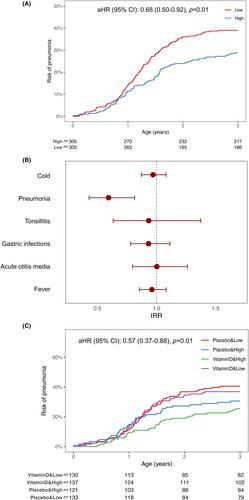
In an adjusted Cox regression model, we found that high (>82.7 nmol/L) versus low (<82.7 nmol/L) levels of 25(OH)D at age 6 months were associated with a decreased risk of pneumonia until age 3 years; adjusted HR (aHR) (95% CI): 0.68 (0.50–0.92), p = .01 (Figure 1A). There was no difference between the two 25(OH)D groups when analyzing the risk of cold, gastroenteritis, fever, acute otitis media, or tonsillitis (all p-values>.05) (Table 1). In an adjusted Quasi–Poisson regression model, high versus low levels of 25(OH)D at age 6 months also associated with a reduced total number of pneumonia episodes; adjusted IRR (aIRR): 0.59 (0.43–0.82), p = .002 and not other infection types (Figure 1B). Furthermore, when dividing the 25(OH)D levels into tertiles, we found that being in the upper (>91.6 nmol/L) versus lower (<73.4 nmol/L) tertile was associated with a reduced risk of pneumonia as well; aIRR: 0.66 (0.43–0.99), p = .046. Using the 25(OH)D levels as a continuous variable, we found that a higher 25(OH)D per 10 nmol/L increase at age 6 months associated with a reduced risk of number of pneumonia episodes (aIRR: 0.93 (0.86–0.99), p = .03) and not other infection types (all p-values>.05).
We previously reported no effects of the vitamin D intervention on upper or lower respiratory tract infections including cold, tonsillitis, otitis media, and pneumonia episodes.5 In this follow-up study, there was no interaction between the vitamin D intervention and 25(OH)D status at 6 months on risk of pneumonia (pinteraction = .62) and the association between high versus low 25(OH)D levels at age 6 months only among children (n = 267) whose mothers received vitamin D intervention was still significant in a stratified model aHR; 0.59 (0.37–0.91), p = .02 and aIRR; 0.47 (0.29–0.75), p = .002 and per 10 nmol/L increase; aIRR: 0.89 (0.80–0.98), p = .026 suggesting an independent association between 25(OH)D with pneumonia in early childhood. In children (n = 254) whose mothers did not receive high-dose vitamin D during pregnancy, there was no association between high versus low 25(OH)D and pneumonia; aHR: 0.72 (0.47–1.10), p = .13 and aIRR: 0.74 (0.47–1.15), p = .19. All four combinations were analyzed and illustrated (Table 1 and Figure 1C).
A previous RCT investigating vitamin D supplementation against pneumonia among infants did not find an effect;6 however, an effect on respiratory tract infections was demonstrated in a recent meta-analysis with the largest effect among children.7 This is possibly due to the induction of antimicrobial peptides including LL37 and cathelicidin in the defense against pathogens, strengthening the airway epithelium and inducing mucociliary clearance that suggests a protective role of vitamin D against early airway infections supported by the findings from this study. Furthermore, vitamin D has been shown to upregulate the airway immune profile and change the airway microbiota in young children.8
NB has performed the statistical analyses and written the first draft of the manuscript. All authors have provided important intellectual input and contributed considerably to the interpretation of the data.
Nicklas Brustad received funding from the Capital Region Research Foundation (grant no.: A7187) and The Lundbeck Foundation (R381-2021-1428). BC received funding from The European Union's Horizon 2020 research and innovation program (grant no.: 946228).
All authors declare no potential, perceived, or real conflict of interest regarding the content of this manuscript.
期刊介绍:
Allergy is an international and multidisciplinary journal that aims to advance, impact, and communicate all aspects of the discipline of Allergy/Immunology. It publishes original articles, reviews, position papers, guidelines, editorials, news and commentaries, letters to the editors, and correspondences. The journal accepts articles based on their scientific merit and quality.
Allergy seeks to maintain contact between basic and clinical Allergy/Immunology and encourages contributions from contributors and readers from all countries. In addition to its publication, Allergy also provides abstracting and indexing information. Some of the databases that include Allergy abstracts are Abstracts on Hygiene & Communicable Disease, Academic Search Alumni Edition, AgBiotech News & Information, AGRICOLA Database, Biological Abstracts, PubMed Dietary Supplement Subset, and Global Health, among others.




 京公网安备 11010802042870号
京ICP备2023020795号-1
京公网安备 11010802042870号
京ICP备2023020795号-1

 分享
分享
 求助内容:
求助内容: 应助结果提醒方式:
 扫码关注我们
