Jingyu Shi, Pengfei Ding, Jintao Zhu, Zhenyu Chen, Shuangjiao Gao, Xueliang Yu, Xiaochun Liao, Quan Liu and Ziyi Ge
{"title":"Well-regulated structure-featuring giant-molecule acceptors enable long-term stability and high-performance binary organic solar cells†","authors":"Jingyu Shi, Pengfei Ding, Jintao Zhu, Zhenyu Chen, Shuangjiao Gao, Xueliang Yu, Xiaochun Liao, Quan Liu and Ziyi Ge","doi":"10.1039/D4EE03754E","DOIUrl":null,"url":null,"abstract":"<p >Well-defined structure-featuring giant-molecule acceptors (GMAs) can exhibit unique properties of small-molecule acceptors and polymers simultaneously, and the consecutive innovations in materials design have enabled GMA-based organic solar cells (OSCs) to exhibit outstanding device power conversion efficiency (PCE) over 19% and extended long-term stability. Here, through systematically selecting the numbers and positions of the selenium atom, π-spacer linking units and the outermost conjugate ring of the central core of monomers, four novel GMAs are successfully synthesized, GMA-SSS, GMA-SSeS, GMA-SeSSe and GMA-SeSeSe. Surprisingly, the PM6:GMA-SSeS-based OSC yields the highest PCE of 19.37% with a remarkable open current voltage of 0.917 V with reduced voltage loss (Δ<em>E</em><small><sub>3</sub></small> = 0.246 eV) and excellent fill factor of 77.12%. Furthermore, when devices were annealed at 100 °C, the PM6:GMA-SSeS and PM6:GMA-SSS-based OSCs exhibited remarkably extended <em>t</em><small><sub>80%</sub></small> lifetimes of 5600 and 5250 h, respectively. Our work indicates that the selenium substituted regulation of linking units and monomers of GMA structures is a valuable approach to obtain devices with high-performance and long-term stability at the same time, shedding light on the further development of GMA-based OSCs.</p>","PeriodicalId":72,"journal":{"name":"Energy & Environmental Science","volume":" 23","pages":" 9144-9153"},"PeriodicalIF":30.8000,"publicationDate":"2024-10-18","publicationTypes":"Journal Article","fieldsOfStudy":null,"isOpenAccess":false,"openAccessPdf":"","citationCount":"0","resultStr":null,"platform":"Semanticscholar","paperid":null,"PeriodicalName":"Energy & Environmental Science","FirstCategoryId":"88","ListUrlMain":"https://pubs.rsc.org/en/content/articlelanding/2024/ee/d4ee03754e","RegionNum":1,"RegionCategory":"材料科学","ArticlePicture":[],"TitleCN":null,"AbstractTextCN":null,"PMCID":null,"EPubDate":"","PubModel":"","JCR":"Q1","JCRName":"CHEMISTRY, MULTIDISCIPLINARY","Score":null,"Total":0}
引用次数: 0
Abstract
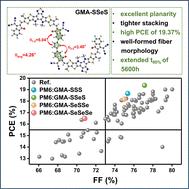
Well-defined structure-featuring giant-molecule acceptors (GMAs) can exhibit unique properties of small-molecule acceptors and polymers simultaneously, and the consecutive innovations in materials design have enabled GMA-based organic solar cells (OSCs) to exhibit outstanding device power conversion efficiency (PCE) over 19% and extended long-term stability. Here, through systematically selecting the numbers and positions of the selenium atom, π-spacer linking units and the outermost conjugate ring of the central core of monomers, four novel GMAs are successfully synthesized, GMA-SSS, GMA-SSeS, GMA-SeSSe and GMA-SeSeSe. Surprisingly, the PM6:GMA-SSeS-based OSC yields the highest PCE of 19.37% with a remarkable open current voltage of 0.917 V with reduced voltage loss (ΔE3 = 0.246 eV) and excellent fill factor of 77.12%. Furthermore, when devices were annealed at 100 °C, the PM6:GMA-SSeS and PM6:GMA-SSS-based OSCs exhibited remarkably extended t80% lifetimes of 5600 and 5250 h, respectively. Our work indicates that the selenium substituted regulation of linking units and monomers of GMA structures is a valuable approach to obtain devices with high-performance and long-term stability at the same time, shedding light on the further development of GMA-based OSCs.
期刊介绍:
Energy & Environmental Science, a peer-reviewed scientific journal, publishes original research and review articles covering interdisciplinary topics in the (bio)chemical and (bio)physical sciences, as well as chemical engineering disciplines. Published monthly by the Royal Society of Chemistry (RSC), a not-for-profit publisher, Energy & Environmental Science is recognized as a leading journal. It boasts an impressive impact factor of 8.500 as of 2009, ranking 8th among 140 journals in the category "Chemistry, Multidisciplinary," second among 71 journals in "Energy & Fuels," second among 128 journals in "Engineering, Chemical," and first among 181 scientific journals in "Environmental Sciences."
Energy & Environmental Science publishes various types of articles, including Research Papers (original scientific work), Review Articles, Perspectives, and Minireviews (feature review-type articles of broad interest), Communications (original scientific work of an urgent nature), Opinions (personal, often speculative viewpoints or hypotheses on current topics), and Analysis Articles (in-depth examination of energy-related issues).



 京公网安备 11010802042870号
京ICP备2023020795号-1
京公网安备 11010802042870号
京ICP备2023020795号-1

 分享
分享
 求助内容:
求助内容: 应助结果提醒方式:
 扫码关注我们
