Elsa L. S. A. van Liere, Dewkoemar Ramsoekh, Emma Daulton, Maya Dakkak, Joris M. van Lingen, Trenton K. Stewart, Sofie Bosch, Beatriz Carvalho, Evelien Dekker, Maarten A. J. M. Jacobs, Jan Jacob Koornstra, Johan P. Kuijvenhoven, Monique E. van Leerdam, Tim G. J. de Meij, Gerrit A. Meijer, Manon C. W. Spaander, James A. Covington, Nanne K. H. de Boer
{"title":"Faecal Volatile Organic Compounds to Detect Colorectal Neoplasia in Lynch Syndrome—A Prospective Longitudinal Multicentre Study","authors":"Elsa L. S. A. van Liere, Dewkoemar Ramsoekh, Emma Daulton, Maya Dakkak, Joris M. van Lingen, Trenton K. Stewart, Sofie Bosch, Beatriz Carvalho, Evelien Dekker, Maarten A. J. M. Jacobs, Jan Jacob Koornstra, Johan P. Kuijvenhoven, Monique E. van Leerdam, Tim G. J. de Meij, Gerrit A. Meijer, Manon C. W. Spaander, James A. Covington, Nanne K. H. de Boer","doi":"10.1111/apt.18328","DOIUrl":null,"url":null,"abstract":"<div>\n \n \n <section>\n \n <h3> Background</h3>\n \n <p>Non-invasive biomarkers may reduce post-colonoscopy colorectal cancer (CRC) rates and colonoscopy overuse in Lynch syndrome. Unlike faecal immunochemical test (FIT), faecal volatile organic compounds (VOCs) may accurately detect both advanced and non-advanced colorectal neoplasia.</p>\n </section>\n \n <section>\n \n <h3> Aim</h3>\n \n <p>The aim of this study was to evaluate the potential of faecal VOCs—separately and with FIT—to guide optimal colonoscopy intervals in Lynch syndrome.</p>\n </section>\n \n <section>\n \n <h3> Methods</h3>\n \n <p>Prospective longitudinal multicentre study in which individuals with Lynch syndrome collected faeces before and after high-quality surveillance colonoscopy. VOC-patterns were analysed using field asymmetric ion mobility spectrometry (FAIMS) and gas chromatography-ion mobility spectrometry (GC-IMS) followed by machine learning pipelines, and combined with FIT at 2.55 μg Hb/g faeces. Gas chromatography time-of-flight mass spectrometry analysed individual VOC abundance.</p>\n </section>\n \n <section>\n \n <h3> Results</h3>\n \n <p>Among 200 included individuals (57% female, median 51 years), 62 had relevant neoplasia at colonoscopy: 3 CRC, 6 advanced adenoma (AA), 3 advanced serrated lesion (ASL), and 50 non-advanced adenoma (NAA). Respective sensitivity and negative predictive value for CRC and AA (and also ASL in case of FAIMS) were 100% and 100% using FAIMS (54% specificity), and 89% and 99% using GC-IMS (58% specificity). Respective sensitivity and specificity for any relevant neoplasia were 88% and 44% (FAIMS) and 84% and 28% (GC-IMS); accuracy did not significantly improve upon VOC-FIT. VOC-patterns differed before and after polypectomy (AUC 0.70). NAA showed decreased faecal abundance of butanal, 2-oxohexane, dimethyldisulphide and dimethyltrisulphide.</p>\n </section>\n \n <section>\n \n <h3> Conclusions</h3>\n \n <p>In Lynch syndrome, faecal VOCs may be a promising strategy for postponing colonoscopy and for follow-up after polypectomy. Our results serve as a stepping stone for large validation studies.</p>\n </section>\n \n <section>\n \n <h3> Trial Registration</h3>\n \n <p>NL8749</p>\n </section>\n </div>","PeriodicalId":121,"journal":{"name":"Alimentary Pharmacology & Therapeutics","volume":"61 1","pages":"145-158"},"PeriodicalIF":6.7000,"publicationDate":"2024-10-18","publicationTypes":"Journal Article","fieldsOfStudy":null,"isOpenAccess":false,"openAccessPdf":"https://onlinelibrary.wiley.com/doi/epdf/10.1111/apt.18328","citationCount":"0","resultStr":null,"platform":"Semanticscholar","paperid":null,"PeriodicalName":"Alimentary Pharmacology & Therapeutics","FirstCategoryId":"3","ListUrlMain":"https://onlinelibrary.wiley.com/doi/10.1111/apt.18328","RegionNum":1,"RegionCategory":"医学","ArticlePicture":[],"TitleCN":null,"AbstractTextCN":null,"PMCID":null,"EPubDate":"","PubModel":"","JCR":"Q1","JCRName":"GASTROENTEROLOGY & HEPATOLOGY","Score":null,"Total":0}
引用次数: 0
Abstract
Background
Non-invasive biomarkers may reduce post-colonoscopy colorectal cancer (CRC) rates and colonoscopy overuse in Lynch syndrome. Unlike faecal immunochemical test (FIT), faecal volatile organic compounds (VOCs) may accurately detect both advanced and non-advanced colorectal neoplasia.
Aim
The aim of this study was to evaluate the potential of faecal VOCs—separately and with FIT—to guide optimal colonoscopy intervals in Lynch syndrome.
Methods
Prospective longitudinal multicentre study in which individuals with Lynch syndrome collected faeces before and after high-quality surveillance colonoscopy. VOC-patterns were analysed using field asymmetric ion mobility spectrometry (FAIMS) and gas chromatography-ion mobility spectrometry (GC-IMS) followed by machine learning pipelines, and combined with FIT at 2.55 μg Hb/g faeces. Gas chromatography time-of-flight mass spectrometry analysed individual VOC abundance.
Results
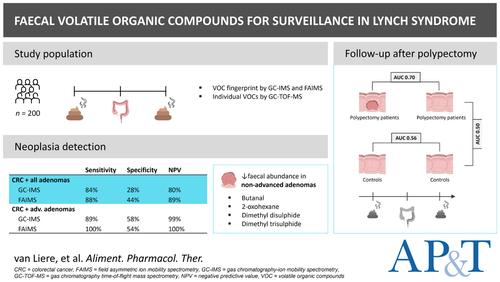
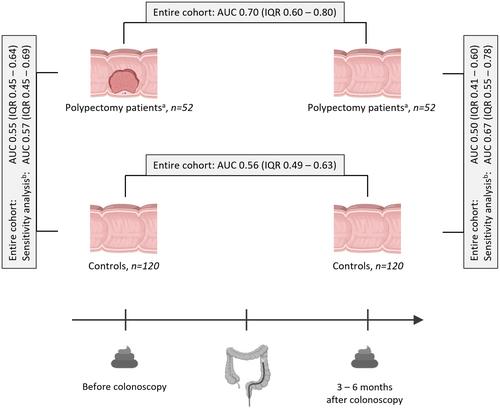
Among 200 included individuals (57% female, median 51 years), 62 had relevant neoplasia at colonoscopy: 3 CRC, 6 advanced adenoma (AA), 3 advanced serrated lesion (ASL), and 50 non-advanced adenoma (NAA). Respective sensitivity and negative predictive value for CRC and AA (and also ASL in case of FAIMS) were 100% and 100% using FAIMS (54% specificity), and 89% and 99% using GC-IMS (58% specificity). Respective sensitivity and specificity for any relevant neoplasia were 88% and 44% (FAIMS) and 84% and 28% (GC-IMS); accuracy did not significantly improve upon VOC-FIT. VOC-patterns differed before and after polypectomy (AUC 0.70). NAA showed decreased faecal abundance of butanal, 2-oxohexane, dimethyldisulphide and dimethyltrisulphide.
Conclusions
In Lynch syndrome, faecal VOCs may be a promising strategy for postponing colonoscopy and for follow-up after polypectomy. Our results serve as a stepping stone for large validation studies.
期刊介绍:
Alimentary Pharmacology & Therapeutics is a global pharmacology journal focused on the impact of drugs on the human gastrointestinal and hepato-biliary systems. It covers a diverse range of topics, often with immediate clinical relevance to its readership.



 京公网安备 11010802042870号
京ICP备2023020795号-1
京公网安备 11010802042870号
京ICP备2023020795号-1

 分享
分享
 求助内容:
求助内容: 应助结果提醒方式:
 扫码关注我们
