{"title":"Interfacial charge transfer modulation in laser-synthesized catalysts for efficient oxygen evolution†","authors":"Dong Hyeon Lee, Rahul Kerkar, Deepak Arumugam, Jayaraman Theerthagiri, Shankar Ramasamy, Soorathep Kheawhom and Myong Yong Choi","doi":"10.1039/D4TA06794K","DOIUrl":null,"url":null,"abstract":"<p >Advancements in laser-based material development have enabled precise engineering of catalysts, thus promoting efficient and sustainable water-splitting reactions. This study presents a green approach for synthesizing a layered double hydroxide (LDH)-based catalyst on nickel foam (NF) using pulse-laser irradiation in liquids and microwave processes. The enhanced catalytic efficiency of NiFe-based LDH compared to IrO<small><sub>2</sub></small>/NF is demonstrated by its low overpotential (<em>η</em> ∼ 292 mV), high current density, and enhanced charge transfer kinetics. Density functional theory calculations reveal the tailoring phenomenon of Fe on the material's electronic structure, significantly enhancing its performance in the oxygen evolution reaction (OER). Spin-polarized electrons contribute to spin-aligned oxygen generation <em>via</em> quantum spin–exchange interactions, accelerating the OER kinetics. Electrochemical and analytical techniques demonstrated that the surface of the NiFe LDH/Ni(OH)₂/NF transforms into high-valent Ni/FeOOH active species, optimizing the adsorption energy of *OH intermediates during OER. Furthermore, this study investigates the effective tuning of Fe incorporation on the structural, electronic, and catalytic properties of Ni(OH)<small><sub>2</sub></small> and NiFe LDHs, demonstrating a change in the band gap (from 1.77 eV to 1.81 eV) and an increase in the intrinsic magnetic moment (from 8 <em>μ</em><small><sub>B</sub></small> to 20.3 <em>μ</em><small><sub>B</sub></small>). Additionally, catalytic assessments revealed superior OER performance, a reduction in <em>η</em>, and a 57% improvement in efficiency for NiFe LDH, consistent with experimental findings and confirming the enhanced catalytic effects of NiFe LDH/Ni(OH)<small><sub>2</sub></small>/NF in OER. These results highlight the promising potential of laser-mediated techniques in fabricating efficient and cost-effective OER catalysts for sustainable energy production.</p>","PeriodicalId":82,"journal":{"name":"Journal of Materials Chemistry A","volume":" 44","pages":" 30269-30278"},"PeriodicalIF":9.5000,"publicationDate":"2024-10-18","publicationTypes":"Journal Article","fieldsOfStudy":null,"isOpenAccess":false,"openAccessPdf":"","citationCount":"0","resultStr":null,"platform":"Semanticscholar","paperid":null,"PeriodicalName":"Journal of Materials Chemistry A","FirstCategoryId":"88","ListUrlMain":"https://pubs.rsc.org/en/content/articlelanding/2024/ta/d4ta06794k","RegionNum":2,"RegionCategory":"材料科学","ArticlePicture":[],"TitleCN":null,"AbstractTextCN":null,"PMCID":null,"EPubDate":"","PubModel":"","JCR":"Q1","JCRName":"CHEMISTRY, PHYSICAL","Score":null,"Total":0}
引用次数: 0
Abstract
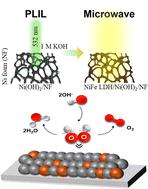
Advancements in laser-based material development have enabled precise engineering of catalysts, thus promoting efficient and sustainable water-splitting reactions. This study presents a green approach for synthesizing a layered double hydroxide (LDH)-based catalyst on nickel foam (NF) using pulse-laser irradiation in liquids and microwave processes. The enhanced catalytic efficiency of NiFe-based LDH compared to IrO2/NF is demonstrated by its low overpotential (η ∼ 292 mV), high current density, and enhanced charge transfer kinetics. Density functional theory calculations reveal the tailoring phenomenon of Fe on the material's electronic structure, significantly enhancing its performance in the oxygen evolution reaction (OER). Spin-polarized electrons contribute to spin-aligned oxygen generation via quantum spin–exchange interactions, accelerating the OER kinetics. Electrochemical and analytical techniques demonstrated that the surface of the NiFe LDH/Ni(OH)₂/NF transforms into high-valent Ni/FeOOH active species, optimizing the adsorption energy of *OH intermediates during OER. Furthermore, this study investigates the effective tuning of Fe incorporation on the structural, electronic, and catalytic properties of Ni(OH)2 and NiFe LDHs, demonstrating a change in the band gap (from 1.77 eV to 1.81 eV) and an increase in the intrinsic magnetic moment (from 8 μB to 20.3 μB). Additionally, catalytic assessments revealed superior OER performance, a reduction in η, and a 57% improvement in efficiency for NiFe LDH, consistent with experimental findings and confirming the enhanced catalytic effects of NiFe LDH/Ni(OH)2/NF in OER. These results highlight the promising potential of laser-mediated techniques in fabricating efficient and cost-effective OER catalysts for sustainable energy production.
期刊介绍:
The Journal of Materials Chemistry A, B & C covers a wide range of high-quality studies in the field of materials chemistry, with each section focusing on specific applications of the materials studied. Journal of Materials Chemistry A emphasizes applications in energy and sustainability, including topics such as artificial photosynthesis, batteries, and fuel cells. Journal of Materials Chemistry B focuses on applications in biology and medicine, while Journal of Materials Chemistry C covers applications in optical, magnetic, and electronic devices. Example topic areas within the scope of Journal of Materials Chemistry A include catalysis, green/sustainable materials, sensors, and water treatment, among others.



 京公网安备 11010802042870号
京ICP备2023020795号-1
京公网安备 11010802042870号
京ICP备2023020795号-1

 分享
分享
 求助内容:
求助内容: 应助结果提醒方式:
 扫码关注我们
