Liya Chen, Yang Liu, Prof. Wei You, Dr. Jiao Wang, Dr. Zejian He, Dr. Honggang Mei, Dr. Xue Yang, Prof. Wei Yu, Prof. Guangfeng Li, Prof. Feihe Huang
{"title":"Construction of Slide-Ring Polymers Based on Pillar[5]Arene/Alkyl Chain Host−Guest Interactions","authors":"Liya Chen, Yang Liu, Prof. Wei You, Dr. Jiao Wang, Dr. Zejian He, Dr. Honggang Mei, Dr. Xue Yang, Prof. Wei Yu, Prof. Guangfeng Li, Prof. Feihe Huang","doi":"10.1002/anie.202417713","DOIUrl":null,"url":null,"abstract":"<p>Slide-ring polymers exhibit distinctive mechanical properties, making them highly promising for applications in emerging fields such as energy storage devices and smart sensing. However, existing slide-ring polymer systems primarily rely on hydrophilic-hydrophobic interactions to achieve ring-axle interlocking in aqueous phases. This reliance limits the construction of slide-ring networks mainly to water-soluble polymers, excluding a diverse range of lipophilic polymers. Therefore, it is crucial to introduce efficient construction strategies that facilitate interpenetration in organic solvents, enabling the development of diverse slide-ring polymers and expanding their range and applications. Herein, by utilizing the pillar[5]arene/alkyl chain host−guest interactions, we successfully facilitated the interpenetration of a pillar[5]arene and poly(caprolactone), enabling the efficient construction of two slide-ring polymer networks in organic solvents. One of these two slide-ring polymers demonstrates a unique network deformation mechanism along with outstanding mechanical properties compared with the control covalently cross-linked polymer network, including maximum stress (4.43 vs 1.98 MPa), maximum strain (1285 vs 330 %), and toughness (35.4 vs 3.92 MJ/m<sup>3</sup>). More importantly, this strategy of making slide-ring polymers is highly versatile, given the wide range of macrocyclic arenes and alkyl chain-containing polymers it can accommodate.</p>","PeriodicalId":125,"journal":{"name":"Angewandte Chemie International Edition","volume":"64 5","pages":""},"PeriodicalIF":16.9000,"publicationDate":"2024-10-19","publicationTypes":"Journal Article","fieldsOfStudy":null,"isOpenAccess":false,"openAccessPdf":"","citationCount":"0","resultStr":null,"platform":"Semanticscholar","paperid":null,"PeriodicalName":"Angewandte Chemie International Edition","FirstCategoryId":"92","ListUrlMain":"https://onlinelibrary.wiley.com/doi/10.1002/anie.202417713","RegionNum":1,"RegionCategory":"化学","ArticlePicture":[],"TitleCN":null,"AbstractTextCN":null,"PMCID":null,"EPubDate":"","PubModel":"","JCR":"Q1","JCRName":"CHEMISTRY, MULTIDISCIPLINARY","Score":null,"Total":0}
引用次数: 0
Abstract
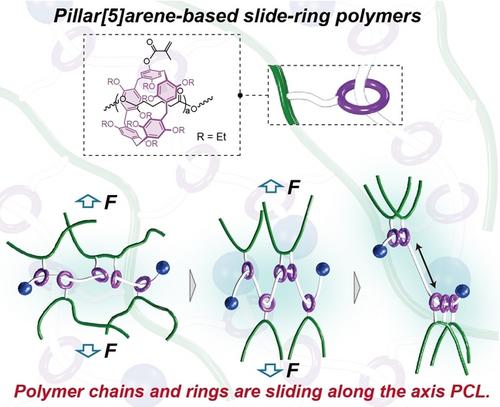
Slide-ring polymers exhibit distinctive mechanical properties, making them highly promising for applications in emerging fields such as energy storage devices and smart sensing. However, existing slide-ring polymer systems primarily rely on hydrophilic-hydrophobic interactions to achieve ring-axle interlocking in aqueous phases. This reliance limits the construction of slide-ring networks mainly to water-soluble polymers, excluding a diverse range of lipophilic polymers. Therefore, it is crucial to introduce efficient construction strategies that facilitate interpenetration in organic solvents, enabling the development of diverse slide-ring polymers and expanding their range and applications. Herein, by utilizing the pillar[5]arene/alkyl chain host−guest interactions, we successfully facilitated the interpenetration of a pillar[5]arene and poly(caprolactone), enabling the efficient construction of two slide-ring polymer networks in organic solvents. One of these two slide-ring polymers demonstrates a unique network deformation mechanism along with outstanding mechanical properties compared with the control covalently cross-linked polymer network, including maximum stress (4.43 vs 1.98 MPa), maximum strain (1285 vs 330 %), and toughness (35.4 vs 3.92 MJ/m3). More importantly, this strategy of making slide-ring polymers is highly versatile, given the wide range of macrocyclic arenes and alkyl chain-containing polymers it can accommodate.
期刊介绍:
Angewandte Chemie, a journal of the German Chemical Society (GDCh), maintains a leading position among scholarly journals in general chemistry with an impressive Impact Factor of 16.6 (2022 Journal Citation Reports, Clarivate, 2023). Published weekly in a reader-friendly format, it features new articles almost every day. Established in 1887, Angewandte Chemie is a prominent chemistry journal, offering a dynamic blend of Review-type articles, Highlights, Communications, and Research Articles on a weekly basis, making it unique in the field.




 京公网安备 11010802042870号
京ICP备2023020795号-1
京公网安备 11010802042870号
京ICP备2023020795号-1

 分享
分享
 求助内容:
求助内容: 应助结果提醒方式:
 扫码关注我们
