Cizhang Hui , Yi Li , Saiyu Yuan , Hongwu Tang , Wenlong Zhang
{"title":"Role of biogeochemical and hydrodynamic characteristics in simulating nitrogen dynamics in river confluence","authors":"Cizhang Hui , Yi Li , Saiyu Yuan , Hongwu Tang , Wenlong Zhang","doi":"10.1016/j.watres.2024.122647","DOIUrl":null,"url":null,"abstract":"<div><div>The confluence area is the link of different river systems, whose specific hydrodynamic characteristics can significantly influence mass transport and distribution, which can further make a difference to microorganism growth and biogeochemical processes. However, the specific influences of hydrodynamic characteristics in confluence on formation processes of microbial communities and the biogeochemical processes remain unclear. To this end, the present study established an indoor self-circulation confluence flume and conducted 28-day culture experiment to thoroughly investigate the characteristics of microbial communities and nitrogen dynamics in sediment of confluence area. Results illustrated that the initial homogenous microbial communities gradually emerged differences among varied hydrodynamic zones with experiment going on. Concentrations of nitrogenous materials also changed at different experiment period, NO<sub>3</sub><sup>−</sup> concentrations peaked at day 14, and then exhibited significant downtrend. The mean NO<sub>3</sub><sup>−</sup> concentrations decreased the most in flow separation zone, with a 62 % decrease from day 14 to day 28. A numerical model was further established following the thermodynamics of enzyme catalysis reactions to simulate nitrogen transformation rates based on abundances of associated functional genes (gene-centric model). The average relative deviation between simulated and measured N<sub>2</sub> production rates was 32 %. To further investigate the influence of hydrodynamic characteristics on nitrogen dynamics, DamKöhler numbers were calculated as the ratio of characteristic residence time to reaction time. DamKöhler numbers were better fitted with measured N<sub>2</sub> production rates than simulated results of gene-centric model, signifying the importance of hydrodynamic characteristics in simulating nitrogen dynamics in confluence area.</div></div>","PeriodicalId":443,"journal":{"name":"Water Research","volume":"268 ","pages":"Article 122647"},"PeriodicalIF":12.4000,"publicationDate":"2025-01-01","publicationTypes":"Journal Article","fieldsOfStudy":null,"isOpenAccess":false,"openAccessPdf":"","citationCount":"0","resultStr":null,"platform":"Semanticscholar","paperid":null,"PeriodicalName":"Water Research","FirstCategoryId":"93","ListUrlMain":"https://www.sciencedirect.com/science/article/pii/S004313542401546X","RegionNum":1,"RegionCategory":"环境科学与生态学","ArticlePicture":[],"TitleCN":null,"AbstractTextCN":null,"PMCID":null,"EPubDate":"2024/10/18 0:00:00","PubModel":"Epub","JCR":"Q1","JCRName":"ENGINEERING, ENVIRONMENTAL","Score":null,"Total":0}
引用次数: 0
Abstract
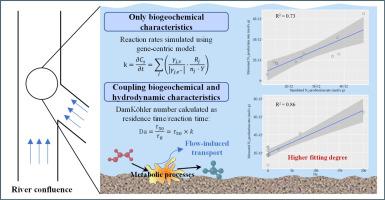
The confluence area is the link of different river systems, whose specific hydrodynamic characteristics can significantly influence mass transport and distribution, which can further make a difference to microorganism growth and biogeochemical processes. However, the specific influences of hydrodynamic characteristics in confluence on formation processes of microbial communities and the biogeochemical processes remain unclear. To this end, the present study established an indoor self-circulation confluence flume and conducted 28-day culture experiment to thoroughly investigate the characteristics of microbial communities and nitrogen dynamics in sediment of confluence area. Results illustrated that the initial homogenous microbial communities gradually emerged differences among varied hydrodynamic zones with experiment going on. Concentrations of nitrogenous materials also changed at different experiment period, NO3− concentrations peaked at day 14, and then exhibited significant downtrend. The mean NO3− concentrations decreased the most in flow separation zone, with a 62 % decrease from day 14 to day 28. A numerical model was further established following the thermodynamics of enzyme catalysis reactions to simulate nitrogen transformation rates based on abundances of associated functional genes (gene-centric model). The average relative deviation between simulated and measured N2 production rates was 32 %. To further investigate the influence of hydrodynamic characteristics on nitrogen dynamics, DamKöhler numbers were calculated as the ratio of characteristic residence time to reaction time. DamKöhler numbers were better fitted with measured N2 production rates than simulated results of gene-centric model, signifying the importance of hydrodynamic characteristics in simulating nitrogen dynamics in confluence area.
期刊介绍:
Water Research, along with its open access companion journal Water Research X, serves as a platform for publishing original research papers covering various aspects of the science and technology related to the anthropogenic water cycle, water quality, and its management worldwide. The audience targeted by the journal comprises biologists, chemical engineers, chemists, civil engineers, environmental engineers, limnologists, and microbiologists. The scope of the journal include:
•Treatment processes for water and wastewaters (municipal, agricultural, industrial, and on-site treatment), including resource recovery and residuals management;
•Urban hydrology including sewer systems, stormwater management, and green infrastructure;
•Drinking water treatment and distribution;
•Potable and non-potable water reuse;
•Sanitation, public health, and risk assessment;
•Anaerobic digestion, solid and hazardous waste management, including source characterization and the effects and control of leachates and gaseous emissions;
•Contaminants (chemical, microbial, anthropogenic particles such as nanoparticles or microplastics) and related water quality sensing, monitoring, fate, and assessment;
•Anthropogenic impacts on inland, tidal, coastal and urban waters, focusing on surface and ground waters, and point and non-point sources of pollution;
•Environmental restoration, linked to surface water, groundwater and groundwater remediation;
•Analysis of the interfaces between sediments and water, and between water and atmosphere, focusing specifically on anthropogenic impacts;
•Mathematical modelling, systems analysis, machine learning, and beneficial use of big data related to the anthropogenic water cycle;
•Socio-economic, policy, and regulations studies.



 京公网安备 11010802042870号
京ICP备2023020795号-1
京公网安备 11010802042870号
京ICP备2023020795号-1

 分享
分享
 求助内容:
求助内容: 应助结果提醒方式:
 扫码关注我们
