Yongsu An, Yongju Lee, Yujing Ji, Young Dok Kim, Hyun Ook Seo and Duk-Young Jung
{"title":"CO2 reduction efficiency through electrolyte immersion in hierarchical bismuth–nickel catalysts†","authors":"Yongsu An, Yongju Lee, Yujing Ji, Young Dok Kim, Hyun Ook Seo and Duk-Young Jung","doi":"10.1039/D4DT02441A","DOIUrl":null,"url":null,"abstract":"<p >Nanostructures are critical for improving the contact area with an electrolyte and catalytic efficiency for the CO<small><sub>2</sub></small> reduction reaction (CO<small><sub>2</sub></small>RR). However, their hydrophobicity conflicts with the intended increase in the contact area and complicates the determination of the active contact area. Here, bismuth–nickel (BiNi) micro–nano hierarchical catalysts for the CO<small><sub>2</sub></small>RR were studied to understand the effects of electrolyte–catalyst contact area variation with the immersion duration in an aqueous electrolyte. The immersed BiNi samples showed about 13.4-fold higher formate production compared to the pristine BiNi sample. The 2-day pre-immersed BiNi sample exhibited faradaic efficiencies (FE%) of ∼80.1% for formate and ∼10% for H<small><sub>2</sub></small> with a current density of 10.2 mA cm<small><sup>−2</sup></small> at −1.5 V <em>vs.</em> Ag/AgCl. In contrast, the pristine BiNi catalysts exhibited an FE% of ∼12.9% for formate and ∼76.3% for H<small><sub>2</sub></small> with a current density of 5.38 mA cm<small><sup>−2</sup></small>. Our experimental results reveal that the improved contact between the electrolyte and the catalyst surface through pre-immersion can lead to enhanced CO<small><sub>2</sub></small>RR efficiency for formate production using hierarchical BiNi catalysts.</p>","PeriodicalId":71,"journal":{"name":"Dalton Transactions","volume":" 45","pages":" 18346-18354"},"PeriodicalIF":3.3000,"publicationDate":"2024-10-22","publicationTypes":"Journal Article","fieldsOfStudy":null,"isOpenAccess":false,"openAccessPdf":"","citationCount":"0","resultStr":null,"platform":"Semanticscholar","paperid":null,"PeriodicalName":"Dalton Transactions","FirstCategoryId":"92","ListUrlMain":"https://pubs.rsc.org/en/content/articlelanding/2024/dt/d4dt02441a","RegionNum":3,"RegionCategory":"化学","ArticlePicture":[],"TitleCN":null,"AbstractTextCN":null,"PMCID":null,"EPubDate":"","PubModel":"","JCR":"Q2","JCRName":"CHEMISTRY, INORGANIC & NUCLEAR","Score":null,"Total":0}
引用次数: 0
Abstract
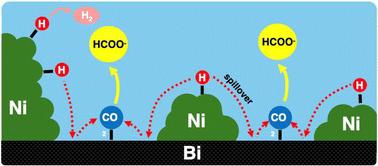
Nanostructures are critical for improving the contact area with an electrolyte and catalytic efficiency for the CO2 reduction reaction (CO2RR). However, their hydrophobicity conflicts with the intended increase in the contact area and complicates the determination of the active contact area. Here, bismuth–nickel (BiNi) micro–nano hierarchical catalysts for the CO2RR were studied to understand the effects of electrolyte–catalyst contact area variation with the immersion duration in an aqueous electrolyte. The immersed BiNi samples showed about 13.4-fold higher formate production compared to the pristine BiNi sample. The 2-day pre-immersed BiNi sample exhibited faradaic efficiencies (FE%) of ∼80.1% for formate and ∼10% for H2 with a current density of 10.2 mA cm−2 at −1.5 V vs. Ag/AgCl. In contrast, the pristine BiNi catalysts exhibited an FE% of ∼12.9% for formate and ∼76.3% for H2 with a current density of 5.38 mA cm−2. Our experimental results reveal that the improved contact between the electrolyte and the catalyst surface through pre-immersion can lead to enhanced CO2RR efficiency for formate production using hierarchical BiNi catalysts.
期刊介绍:
Dalton Transactions is a journal for all areas of inorganic chemistry, which encompasses the organometallic, bioinorganic and materials chemistry of the elements, with applications including synthesis, catalysis, energy conversion/storage, electrical devices and medicine. Dalton Transactions welcomes high-quality, original submissions in all of these areas and more, where the advancement of knowledge in inorganic chemistry is significant.



 京公网安备 11010802042870号
京ICP备2023020795号-1
京公网安备 11010802042870号
京ICP备2023020795号-1

 分享
分享
 求助内容:
求助内容: 应助结果提醒方式:
 扫码关注我们
