Yangrui Wang, Fenfen Yan, Qingxue Chen, Fei Liu, Baofeng Xu, Yuanyuan Liu, Guicheng Huo, Jinsheng Xu, Bailiang Li and Song Wang
{"title":"High-fat diet promotes type 2 diabetes mellitus by disrupting gut microbial rhythms and short-chain fatty acid synthesis†","authors":"Yangrui Wang, Fenfen Yan, Qingxue Chen, Fei Liu, Baofeng Xu, Yuanyuan Liu, Guicheng Huo, Jinsheng Xu, Bailiang Li and Song Wang","doi":"10.1039/D4FO02957G","DOIUrl":null,"url":null,"abstract":"<p >Diabetes ranks among the top 10 causes of death globally, with over 90% of individuals diagnosed with diabetes having type 2 diabetes mellitus (T2DM). It is acknowledged that a high-fat diet (HFD) poses a serious risk for T2DM. The imbalance of intestinal flora, mediated by HFD, can potentially exacerbate the onset and progression of T2DM. However, the impact of HFD on pathological indicators and the intestinal microbiome in the development of T2DM has not been systematically investigated. Therefore, a HFD mouse model and a T2DM mouse model were established, respectively, in this study. The role of HFD as a driving factor in the development of T2DM was assessed using various measures, including basic pathological indicators of T2DM, lipid metabolism, liver oxidative stress, intestinal permeability, levels of inflammatory factors, gut microbiota, and short-chain fatty acids (SCFAs). The findings indicated that HFD could influence the aforementioned measures to align with T2DM changes, but the contribution of HFD varied across different pathological metrics of T2DM. The impact of HFD on low-density lipoprotein cholesterol, glutathione peroxidase, malondialdehyde, and tumor necrosis factor-α did not show a statistically significant difference from those observed in T2DM during its development. In addition, regarding gut microbes, HFD primarily influenced the alterations in bacteria capable of synthesizing SCFAs. The notable decrease in SCFA content in both serum and cecal matter further underscored the effect of HFD on SCFA-synthesising bacteria in mice. Hence, this research provided a systematic assessment of HFD's propelling role in T2DM's progression. It was inferred that gut microbes, particularly those capable of synthesizing SCFAs, could serve as potential targets for the future prevention and treatment of T2DM instigated by HFD.</p>","PeriodicalId":77,"journal":{"name":"Food & Function","volume":" 21","pages":" 10838-10852"},"PeriodicalIF":5.4000,"publicationDate":"2024-10-15","publicationTypes":"Journal Article","fieldsOfStudy":null,"isOpenAccess":false,"openAccessPdf":"","citationCount":"0","resultStr":null,"platform":"Semanticscholar","paperid":null,"PeriodicalName":"Food & Function","FirstCategoryId":"97","ListUrlMain":"https://pubs.rsc.org/en/content/articlelanding/2024/fo/d4fo02957g","RegionNum":1,"RegionCategory":"农林科学","ArticlePicture":[],"TitleCN":null,"AbstractTextCN":null,"PMCID":null,"EPubDate":"","PubModel":"","JCR":"Q1","JCRName":"BIOCHEMISTRY & MOLECULAR BIOLOGY","Score":null,"Total":0}
引用次数: 0
Abstract
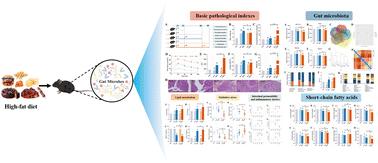
Diabetes ranks among the top 10 causes of death globally, with over 90% of individuals diagnosed with diabetes having type 2 diabetes mellitus (T2DM). It is acknowledged that a high-fat diet (HFD) poses a serious risk for T2DM. The imbalance of intestinal flora, mediated by HFD, can potentially exacerbate the onset and progression of T2DM. However, the impact of HFD on pathological indicators and the intestinal microbiome in the development of T2DM has not been systematically investigated. Therefore, a HFD mouse model and a T2DM mouse model were established, respectively, in this study. The role of HFD as a driving factor in the development of T2DM was assessed using various measures, including basic pathological indicators of T2DM, lipid metabolism, liver oxidative stress, intestinal permeability, levels of inflammatory factors, gut microbiota, and short-chain fatty acids (SCFAs). The findings indicated that HFD could influence the aforementioned measures to align with T2DM changes, but the contribution of HFD varied across different pathological metrics of T2DM. The impact of HFD on low-density lipoprotein cholesterol, glutathione peroxidase, malondialdehyde, and tumor necrosis factor-α did not show a statistically significant difference from those observed in T2DM during its development. In addition, regarding gut microbes, HFD primarily influenced the alterations in bacteria capable of synthesizing SCFAs. The notable decrease in SCFA content in both serum and cecal matter further underscored the effect of HFD on SCFA-synthesising bacteria in mice. Hence, this research provided a systematic assessment of HFD's propelling role in T2DM's progression. It was inferred that gut microbes, particularly those capable of synthesizing SCFAs, could serve as potential targets for the future prevention and treatment of T2DM instigated by HFD.
期刊介绍:
Food & Function provides a unique venue for physicists, chemists, biochemists, nutritionists and other food scientists to publish work at the interface of the chemistry, physics and biology of food. The journal focuses on food and the functions of food in relation to health.



 京公网安备 11010802042870号
京ICP备2023020795号-1
京公网安备 11010802042870号
京ICP备2023020795号-1

 分享
分享
 求助内容:
求助内容: 应助结果提醒方式:
 扫码关注我们
