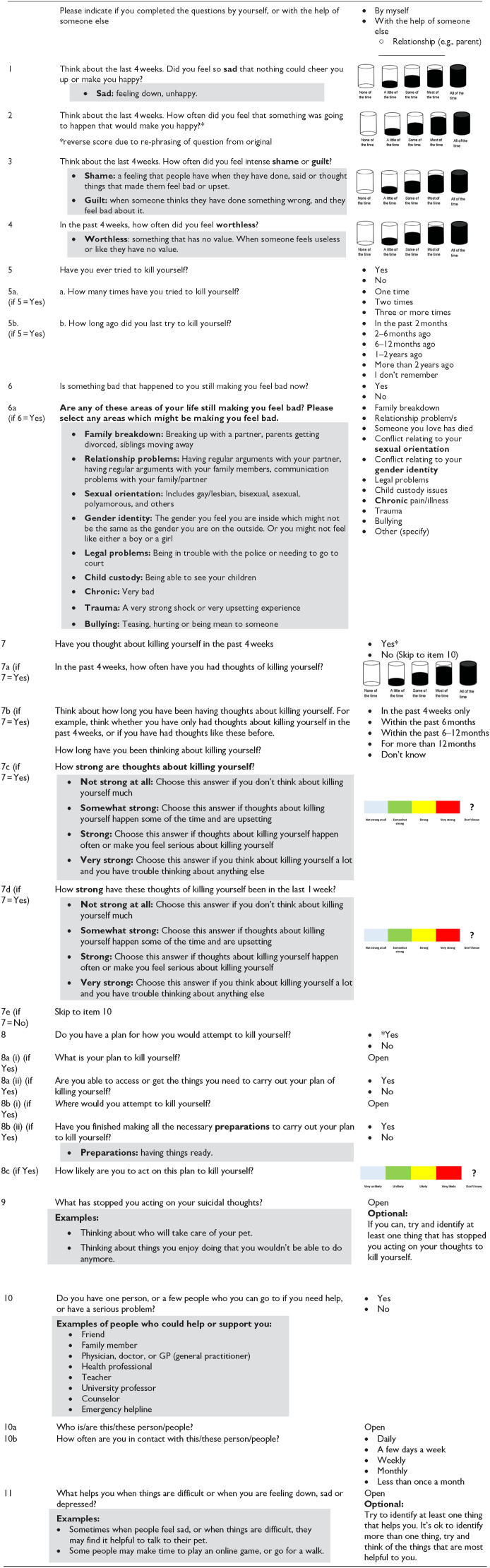
The Suicide Assessment Kit-Modified Interview: Development and preliminary validation of a modified clinical interview for the assessment of suicidal thoughts and behavior in autistic adults.
Darren Hedley, Zachary J Williams, Mark Deady, Philip J Batterham, Simon M Bury, Claire M Brown, Jo Robinson, Julian N Trollor, Mirko Uljarević, Mark A Stokes
{"title":"The Suicide Assessment Kit-Modified Interview: Development and preliminary validation of a modified clinical interview for the assessment of suicidal thoughts and behavior in autistic adults.","authors":"Darren Hedley, Zachary J Williams, Mark Deady, Philip J Batterham, Simon M Bury, Claire M Brown, Jo Robinson, Julian N Trollor, Mirko Uljarević, Mark A Stokes","doi":"10.1177/13623613241289493","DOIUrl":null,"url":null,"abstract":"<p><p>The increased prevalence of suicide among autistic people highlights the need for validated clinical suicide screening and assessment instruments that are accessible and meet the unique language and communication needs of this population. We describe the preliminary preregistered psychometric validation of the Suicide Assessment Kit-Modified Interview, in a sample of 98 autistic adults (58% women, 34% men, 7% nonbinary; <i>M</i><sub>AGE</sub> <i>=</i> 41.65, <i>SD</i> <i>=</i> 12.96). A four-item negative affect score derived from the Suicide Assessment Kit-Modified Interview demonstrated adequate reliability (ω = 0.796, BCa 95% confidence interval = [0.706, 0.857]), as well as good convergent validity with related measures. Ordinal Suicide Assessment Kit-Modified Interview \"categories\" (1-5) demonstrated divergent validity (<i>r</i>s = -0.067 to 0.081) and good convergent validity, strongly correlating with mental health (<i>r</i>s = 0.446 to 0.744) and suicide assessment instruments (<i>r</i>s = 0.576 to 0.696). Suicide Assessment Kit-Modified Interview categories showed strong ability to predict participants identified by clinicians as \"above low risk\" of future suicide attempt (area under the curve = 0.887, posterior <i>Mdn</i> = 0.889, 95% credible interval = [0.810, 0.954], <i>P</i><sub>AUC</sub> <sub>></sub> <sub>0.8</sub> = 0.976). Suicide Assessment Kit-Modified Interview classifications > \"Category 3\" provided an observed sensitivity of 0.750 (<i>Mdn</i> = 0.810, [0.669, 0.948], <i>P</i><sub>Se</sub> <sub>></sub> <sub>0.8</sub> = 0.544) and an observed specificity of 0.895 (<i>Mdn</i> = 0.899, [0.833, 0.956], <i>P</i><sub>Sp</sub> <sub>></sub> <sub>0.8</sub> = 0.995) for \"above low risk\" status. Our findings indicate that the Suicide Assessment Kit-Modified Interview is a psychometrically strong clinical assessment tool for suicidal behavior that can be validly administered to autistic adults without intellectual disability.Lay AbstractPeople with a diagnosis of autism are at increased risk of death by suicide. There is a need for clinical instruments that are adapted to the needs of autistic people. In this study, we modified and evaluated a clinical suicide interview (Suicide Assessment Kit-Modified Interview) for use with autistic people who do not have an intellectual disability. Autistic people helped us to modify the original version of the instrument by improving the questions, providing explanations for difficult terms or concepts, and recommending that we use different rating scales. Our results support the use of Suicide Assessment Kit-Modified Interview for assessing autistic adults without intellectual disability for suicidal thoughts and behavior. In the future, we will test how well Suicide Assessment Kit-Modified Interview works in clinical settings and with different clinical populations.</p>","PeriodicalId":8724,"journal":{"name":"Autism","volume":" ","pages":"766-787"},"PeriodicalIF":5.6000,"publicationDate":"2025-03-01","publicationTypes":"Journal Article","fieldsOfStudy":null,"isOpenAccess":false,"openAccessPdf":"https://www.ncbi.nlm.nih.gov/pmc/articles/PMC11894841/pdf/","citationCount":"0","resultStr":null,"platform":"Semanticscholar","paperid":null,"PeriodicalName":"Autism","FirstCategoryId":"102","ListUrlMain":"https://doi.org/10.1177/13623613241289493","RegionNum":2,"RegionCategory":"心理学","ArticlePicture":[],"TitleCN":null,"AbstractTextCN":null,"PMCID":null,"EPubDate":"2024/10/19 0:00:00","PubModel":"Epub","JCR":"Q1","JCRName":"PSYCHOLOGY, DEVELOPMENTAL","Score":null,"Total":0}
引用次数: 0
Abstract
The increased prevalence of suicide among autistic people highlights the need for validated clinical suicide screening and assessment instruments that are accessible and meet the unique language and communication needs of this population. We describe the preliminary preregistered psychometric validation of the Suicide Assessment Kit-Modified Interview, in a sample of 98 autistic adults (58% women, 34% men, 7% nonbinary; MAGE= 41.65, SD= 12.96). A four-item negative affect score derived from the Suicide Assessment Kit-Modified Interview demonstrated adequate reliability (ω = 0.796, BCa 95% confidence interval = [0.706, 0.857]), as well as good convergent validity with related measures. Ordinal Suicide Assessment Kit-Modified Interview "categories" (1-5) demonstrated divergent validity (rs = -0.067 to 0.081) and good convergent validity, strongly correlating with mental health (rs = 0.446 to 0.744) and suicide assessment instruments (rs = 0.576 to 0.696). Suicide Assessment Kit-Modified Interview categories showed strong ability to predict participants identified by clinicians as "above low risk" of future suicide attempt (area under the curve = 0.887, posterior Mdn = 0.889, 95% credible interval = [0.810, 0.954], PAUC>0.8 = 0.976). Suicide Assessment Kit-Modified Interview classifications > "Category 3" provided an observed sensitivity of 0.750 (Mdn = 0.810, [0.669, 0.948], PSe>0.8 = 0.544) and an observed specificity of 0.895 (Mdn = 0.899, [0.833, 0.956], PSp>0.8 = 0.995) for "above low risk" status. Our findings indicate that the Suicide Assessment Kit-Modified Interview is a psychometrically strong clinical assessment tool for suicidal behavior that can be validly administered to autistic adults without intellectual disability.Lay AbstractPeople with a diagnosis of autism are at increased risk of death by suicide. There is a need for clinical instruments that are adapted to the needs of autistic people. In this study, we modified and evaluated a clinical suicide interview (Suicide Assessment Kit-Modified Interview) for use with autistic people who do not have an intellectual disability. Autistic people helped us to modify the original version of the instrument by improving the questions, providing explanations for difficult terms or concepts, and recommending that we use different rating scales. Our results support the use of Suicide Assessment Kit-Modified Interview for assessing autistic adults without intellectual disability for suicidal thoughts and behavior. In the future, we will test how well Suicide Assessment Kit-Modified Interview works in clinical settings and with different clinical populations.
期刊介绍:
Autism is a major, peer-reviewed, international journal, published 8 times a year, publishing research of direct and practical relevance to help improve the quality of life for individuals with autism or autism-related disorders. It is interdisciplinary in nature, focusing on research in many areas, including: intervention; diagnosis; training; education; translational issues related to neuroscience, medical and genetic issues of practical import; psychological processes; evaluation of particular therapies; quality of life; family needs; and epidemiological research. Autism provides a major international forum for peer-reviewed research of direct and practical relevance to improving the quality of life for individuals with autism or autism-related disorders. The journal''s success and popularity reflect the recent worldwide growth in the research and understanding of autistic spectrum disorders, and the consequent impact on the provision of treatment and care. Autism is interdisciplinary in nature, focusing on evaluative research in all areas, including: intervention, diagnosis, training, education, neuroscience, psychological processes, evaluation of particular therapies, quality of life issues, family issues and family services, medical and genetic issues, epidemiological research.





 京公网安备 11010802042870号
京ICP备2023020795号-1
京公网安备 11010802042870号
京ICP备2023020795号-1

 分享
分享
 求助内容:
求助内容: 应助结果提醒方式:
 扫码关注我们
