Suneela Zaigham, Nils Oskar Jõgi, Robert Movérare, Anders Sjölander, Niclas Rydell, Magnus Molin, Christer Janson, Andrei Malinovschi
{"title":"Eosinophil-Derived Neurotoxin Determinants and Reference Values in a Swedish Middle-Aged General Population","authors":"Suneela Zaigham, Nils Oskar Jõgi, Robert Movérare, Anders Sjölander, Niclas Rydell, Magnus Molin, Christer Janson, Andrei Malinovschi","doi":"10.1111/cea.14579","DOIUrl":null,"url":null,"abstract":"<p>Eosinophilic inflammation in asthma is related to disease severity, lung function decline, disease control and response to corticosteroids during exacerbations [<span>1-3</span>]. Eosinophil activation leads to the release of cytokines, lipid mediators, chemotactic polypeptides and cytotoxic proteins that promote a pro-inflammatory host response and neutralises pathogens [<span>4</span>]. One of the cytotoxic granule proteins released during degranulation of activated eosinophils is the eosinophil-derived neurotoxin (EDN). Serum EDN is emerging as a novel marker of eosinophilic inflammation in patients with asthma [<span>4</span>]. In order to implement serum EDN as a marker in clinical practice, determinants and reference ranges for EDN need to be clearly established. Recently, EDN reference values were defined in early childhood [<span>5</span>]; however, further large studies defining values in older adults are needed. We aimed to study determinants of EDN using the Swedish CArdioPulmonary bioImage Study (SCAPIS), a general population study of middle-aged adults and propose reference values for EDN, including the lower (LLN) and upper limit of normal (ULN), in a healthy sub-population.</p><p>The Swedish CArdioPulmonary bioImage Study is a national, multicentred, population-based study of randomly selected men and women aged 50–64 years. Nationally, 30,154 men and women participated and from the Uppsala cohort 5036 subjects [<span>6</span>]. Serum EDN was an add-on measurement in the Uppsala cohort of SCAPIS (<i>n</i> = 4916) and was measured using an ImmunoCAP EDN research assay as described elsewhere [<span>7</span>]. EDN values were log-transformed for analysis. Univariate analyses were carried out to assess determinants of EDN, including age, sex, lifestyle, clinical conditions (assessed via questionnaire) and laboratory data. Independent sample <i>t</i>-tests were used to obtain mean values of EDN by each potential determining factor. The <i>p</i>-values were adjusted for false discovery rate (FDR) using the Benjamini–Hochberg method. Multiple linear regression models were used to assess the effect of determining factors on EDN. To define normal values of EDN, we selected a healthy population based on subjects free from EDN-modifying conditions. In this healthy sub-cohort, we used the 5<sup>th</sup> (LLN), 50<sup>th</sup> (median), 75<sup>th</sup>, 90<sup>th</sup> and 95<sup>th</sup> (ULN) percentiles to determine reference levels for serum EDN.</p><p>Male sex, body mass index (BMI) > 25, current smoking, presence of atopy, ever asthma, allergic rhinitis, angina pectoris, heart failure, hypertension, diabetes and impaired kidney function were all associated with higher mean EDN levels. Both pre-bronchodilatory FEV<sub>1</sub> < LLN and a post-bronchodilatory FEV<sub>1</sub>/FVC ratio < 0.70 were associated with higher mean EDN levels. After adjusting the <i>p</i>-values for FDR, these determining factors remained significantly associated with EDN. Angina pectoris was associated with a 27% increase in EDN vs. no angina. High creatinine was associated with an almost 14% increase in EDN vs. low creatinine. Ever asthma and allergic rhinitis were associated with an approximately 15% and 19% increase in EDN, respectively, vs. not having the condition (Figure 1).</p><p>The healthy sub-population included non-atopic, non-smokers, with BMI < 25, no asthma, no allergic rhinitis, no angina, no heart failure, no hypertension and no diabetes, and with normal kidney function and normal lung function (post-bronchodilatory FEV<sub>1</sub>/FVC ≥ 0.70). We further stratified this population by sex (240 men and 448 women). Median serum EDN values for men and women were 22.0 and 19.2 ng/mL, respectively. The LLN and ULN (5<sup>th</sup> and 95<sup>th</sup> percentile values) were 10.5 and 72.7 ng/mL, respectively, in men, and 8.7 and 44.1 ng/mL, respectively, in women. Additional information about study methods and findings are available in the following repository: https://osf.io/brwqs/?view_only=489045e3dfcd4326a70c34134cbe94c2.</p><p>Some of the EDN determinants we found are reported for the first time, such as cardiovascular comorbidity and kidney function impairment. Furthermore, we were able to define normal values for serum EDN in middle-aged people. The median EDN levels in serum are similar as previously reported by Morioka et al. [<span>8</span>] for healthy subjects using an enzyme-linked immunosorbent assay (ELISA) (19.1 ng/mL). However, our LLN and ULN values were considerably higher than the corresponding EDN values reported by Rutten et al. [<span>4</span>]. They used another EDN ELISA and found reference intervals for serum EDN in men and women to be 2.10–26.10 and 1.98–25.71 ng/mL, respectively. Lee et al. [<span>9</span>] reported reference values for EDN in 125 healthy individuals but found differences between two commercial EDN ELISAs. The differences in EDN reference values between studies might be due to the definition of healthy subjects and the different methodologies used to measure EDN, and possibly also due to variations in the sample handling procedure. Furthermore, since various immunoassays apparently measure EDN differently, and no internationally accepted reference preparation exists for EDN, it is recommended for each laboratory to validate any proposed EDN reference values taking into account methodological differences as well as known and unknown population-dependent variations.</p><p>Although we have a large sample size, the age range for the study subjects is narrow. However, as we currently have limited data on EDN reference ranges in the adult population, this study can still provide important information. We acknowledge that the ULN for men was quite high and quite a large difference was seen between the 90<sup>th</sup> and 95<sup>th</sup> percentiles in men. The reason for this is somewhat unclear so we can only speculate that some of the subjects might have unreported or subclinical disease (e.g., cardio-metabolic) affecting the EDN levels and thus the ULN.</p><p>In conclusion, we found new determinants associated with elevated EDN levels and defined reference values for serum EDN in healthy 50–64 year-old males and females. We believe that these findings will have clinical implications by increasing our understanding of serum EDN as a potential clinical marker to be used in asthma diagnosis and monitoring.</p><p><b>Suneela Zaigham:</b> methodology, writing – original draft preparation, formal analysis, writing – review & editing. visualisation. <b>Nils Oskar Jõgi:</b> methodology, writing – original draft, formal analysis. <b>Robert Movérare:</b> writing – review & editing, visualisation resources. <b>Magnus Molin:</b> writing – review & editing, resources. <b>Anders Sjölander:</b> writing – review & editing, resources. <b>Niclas Rydell:</b> writing – review & editing, resources. <b>Christer Janson:</b> writing – review & editing, resources. <b>Andrei Malinovschi:</b> conceptualisation, methodology, writing – original draft preparation, writing – review & editing, supervision, funding acquisition, resources.</p><p>The study was approved by the Regional Ethical Review Board in Umeå (2010-228-31 M), and the EDN analyses of the SCAPIS study were approved by the Regional Ethical Review Board in Uppsala (2018–272). The study participants gave their written and informed consent.</p><p>R.M., A.S., N.R. and M.M. are or were employed by Thermo Fisher Scientific. S.Z., N.O.J., C.J., A.M. have no conflicts of interest to declare.</p>","PeriodicalId":10207,"journal":{"name":"Clinical and Experimental Allergy","volume":"55 1","pages":"91-93"},"PeriodicalIF":5.2000,"publicationDate":"2024-10-21","publicationTypes":"Journal Article","fieldsOfStudy":null,"isOpenAccess":false,"openAccessPdf":"https://www.ncbi.nlm.nih.gov/pmc/articles/PMC11707308/pdf/","citationCount":"0","resultStr":null,"platform":"Semanticscholar","paperid":null,"PeriodicalName":"Clinical and Experimental Allergy","FirstCategoryId":"3","ListUrlMain":"https://onlinelibrary.wiley.com/doi/10.1111/cea.14579","RegionNum":2,"RegionCategory":"医学","ArticlePicture":[],"TitleCN":null,"AbstractTextCN":null,"PMCID":null,"EPubDate":"","PubModel":"","JCR":"Q1","JCRName":"ALLERGY","Score":null,"Total":0}
引用次数: 0
Abstract
Eosinophilic inflammation in asthma is related to disease severity, lung function decline, disease control and response to corticosteroids during exacerbations [1-3]. Eosinophil activation leads to the release of cytokines, lipid mediators, chemotactic polypeptides and cytotoxic proteins that promote a pro-inflammatory host response and neutralises pathogens [4]. One of the cytotoxic granule proteins released during degranulation of activated eosinophils is the eosinophil-derived neurotoxin (EDN). Serum EDN is emerging as a novel marker of eosinophilic inflammation in patients with asthma [4]. In order to implement serum EDN as a marker in clinical practice, determinants and reference ranges for EDN need to be clearly established. Recently, EDN reference values were defined in early childhood [5]; however, further large studies defining values in older adults are needed. We aimed to study determinants of EDN using the Swedish CArdioPulmonary bioImage Study (SCAPIS), a general population study of middle-aged adults and propose reference values for EDN, including the lower (LLN) and upper limit of normal (ULN), in a healthy sub-population.
The Swedish CArdioPulmonary bioImage Study is a national, multicentred, population-based study of randomly selected men and women aged 50–64 years. Nationally, 30,154 men and women participated and from the Uppsala cohort 5036 subjects [6]. Serum EDN was an add-on measurement in the Uppsala cohort of SCAPIS (n = 4916) and was measured using an ImmunoCAP EDN research assay as described elsewhere [7]. EDN values were log-transformed for analysis. Univariate analyses were carried out to assess determinants of EDN, including age, sex, lifestyle, clinical conditions (assessed via questionnaire) and laboratory data. Independent sample t-tests were used to obtain mean values of EDN by each potential determining factor. The p-values were adjusted for false discovery rate (FDR) using the Benjamini–Hochberg method. Multiple linear regression models were used to assess the effect of determining factors on EDN. To define normal values of EDN, we selected a healthy population based on subjects free from EDN-modifying conditions. In this healthy sub-cohort, we used the 5th (LLN), 50th (median), 75th, 90th and 95th (ULN) percentiles to determine reference levels for serum EDN.
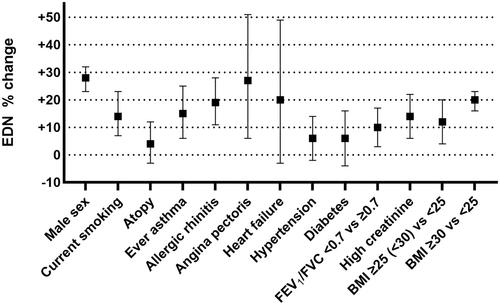
Male sex, body mass index (BMI) > 25, current smoking, presence of atopy, ever asthma, allergic rhinitis, angina pectoris, heart failure, hypertension, diabetes and impaired kidney function were all associated with higher mean EDN levels. Both pre-bronchodilatory FEV1 < LLN and a post-bronchodilatory FEV1/FVC ratio < 0.70 were associated with higher mean EDN levels. After adjusting the p-values for FDR, these determining factors remained significantly associated with EDN. Angina pectoris was associated with a 27% increase in EDN vs. no angina. High creatinine was associated with an almost 14% increase in EDN vs. low creatinine. Ever asthma and allergic rhinitis were associated with an approximately 15% and 19% increase in EDN, respectively, vs. not having the condition (Figure 1).
The healthy sub-population included non-atopic, non-smokers, with BMI < 25, no asthma, no allergic rhinitis, no angina, no heart failure, no hypertension and no diabetes, and with normal kidney function and normal lung function (post-bronchodilatory FEV1/FVC ≥ 0.70). We further stratified this population by sex (240 men and 448 women). Median serum EDN values for men and women were 22.0 and 19.2 ng/mL, respectively. The LLN and ULN (5th and 95th percentile values) were 10.5 and 72.7 ng/mL, respectively, in men, and 8.7 and 44.1 ng/mL, respectively, in women. Additional information about study methods and findings are available in the following repository: https://osf.io/brwqs/?view_only=489045e3dfcd4326a70c34134cbe94c2.
Some of the EDN determinants we found are reported for the first time, such as cardiovascular comorbidity and kidney function impairment. Furthermore, we were able to define normal values for serum EDN in middle-aged people. The median EDN levels in serum are similar as previously reported by Morioka et al. [8] for healthy subjects using an enzyme-linked immunosorbent assay (ELISA) (19.1 ng/mL). However, our LLN and ULN values were considerably higher than the corresponding EDN values reported by Rutten et al. [4]. They used another EDN ELISA and found reference intervals for serum EDN in men and women to be 2.10–26.10 and 1.98–25.71 ng/mL, respectively. Lee et al. [9] reported reference values for EDN in 125 healthy individuals but found differences between two commercial EDN ELISAs. The differences in EDN reference values between studies might be due to the definition of healthy subjects and the different methodologies used to measure EDN, and possibly also due to variations in the sample handling procedure. Furthermore, since various immunoassays apparently measure EDN differently, and no internationally accepted reference preparation exists for EDN, it is recommended for each laboratory to validate any proposed EDN reference values taking into account methodological differences as well as known and unknown population-dependent variations.
Although we have a large sample size, the age range for the study subjects is narrow. However, as we currently have limited data on EDN reference ranges in the adult population, this study can still provide important information. We acknowledge that the ULN for men was quite high and quite a large difference was seen between the 90th and 95th percentiles in men. The reason for this is somewhat unclear so we can only speculate that some of the subjects might have unreported or subclinical disease (e.g., cardio-metabolic) affecting the EDN levels and thus the ULN.
In conclusion, we found new determinants associated with elevated EDN levels and defined reference values for serum EDN in healthy 50–64 year-old males and females. We believe that these findings will have clinical implications by increasing our understanding of serum EDN as a potential clinical marker to be used in asthma diagnosis and monitoring.
Suneela Zaigham: methodology, writing – original draft preparation, formal analysis, writing – review & editing. visualisation. Nils Oskar Jõgi: methodology, writing – original draft, formal analysis. Robert Movérare: writing – review & editing, visualisation resources. Magnus Molin: writing – review & editing, resources. Anders Sjölander: writing – review & editing, resources. Niclas Rydell: writing – review & editing, resources. Christer Janson: writing – review & editing, resources. Andrei Malinovschi: conceptualisation, methodology, writing – original draft preparation, writing – review & editing, supervision, funding acquisition, resources.
The study was approved by the Regional Ethical Review Board in Umeå (2010-228-31 M), and the EDN analyses of the SCAPIS study were approved by the Regional Ethical Review Board in Uppsala (2018–272). The study participants gave their written and informed consent.
R.M., A.S., N.R. and M.M. are or were employed by Thermo Fisher Scientific. S.Z., N.O.J., C.J., A.M. have no conflicts of interest to declare.
期刊介绍:
Clinical & Experimental Allergy strikes an excellent balance between clinical and scientific articles and carries regular reviews and editorials written by leading authorities in their field.
In response to the increasing number of quality submissions, since 1996 the journals size has increased by over 30%. Clinical & Experimental Allergy is essential reading for allergy practitioners and research scientists with an interest in allergic diseases and mechanisms. Truly international in appeal, Clinical & Experimental Allergy publishes clinical and experimental observations in disease in all fields of medicine in which allergic hypersensitivity plays a part.



 京公网安备 11010802042870号
京ICP备2023020795号-1
京公网安备 11010802042870号
京ICP备2023020795号-1

 分享
分享
 求助内容:
求助内容: 应助结果提醒方式:
 扫码关注我们
