{"title":"The public health challenges of female migration: the Venezuelan diaspora in Andean countries.","authors":"Sarahí Rueda-Salazar, Jenny García","doi":"10.1186/s12939-024-02296-z","DOIUrl":null,"url":null,"abstract":"<p><strong>Background: </strong>Venezuelan migration has experienced an unprecedented increase in the last decade, with approximately 7.7 million Venezuelan-born individuals residing in other countries as of 2024. Our study aims to identify the potential and actual demand for healthcare services (SRH) in the Venezuelan diaspora's four primary destinations within the Andean Countries: Colombia, Ecuador, Peru, and Chile.</p><p><strong>Methods: </strong>Using official data from administrative records, censuses, and sample surveys reported by the host countries and international agencies, we estimate the annual evolution of Venezuelan-born women of reproductive age (WRA) and their offspring. Additionally, we conduct two case studies focusing on Colombia and Chile to analyse the groups most vulnerable to unmet health needs.</p><p><strong>Results: </strong>The population of WRA has increased to between 5 and 6.8%, and births have risen to approximately 3-8% in host countries due to Venezuelan migration. Yet, we found a general decrease in health coverage for certain age groups of Venezuelan female migrants in host countries for the period 2017-2022, particularly in Chile. By 2022, an estimated 20% of healthcare needs remained unmet among children, girls, and younger Venezuelan women, contributing to greater health inequalities between Venezuelan-born adolescents and those from other countries of birth.</p><p><strong>Conclusions: </strong>Our findings highlight the escalating demand for and limited access to healthcare services among Venezuelan WRA in their destinations. Unmet healthcare needs are particularly prevalent among younger women by 2022, underscoring the urgency for health system to incorporate gender-responsive, equitable interventions and ensuring health rights for high-risk migrant groups such as infants, children, adolescents, and younger women. Addressing these challenges remains a critical task for the regional public health agenda in Latin America.</p>","PeriodicalId":13745,"journal":{"name":"International Journal for Equity in Health","volume":"23 1","pages":"210"},"PeriodicalIF":4.1000,"publicationDate":"2024-10-14","publicationTypes":"Journal Article","fieldsOfStudy":null,"isOpenAccess":false,"openAccessPdf":"https://www.ncbi.nlm.nih.gov/pmc/articles/PMC11472551/pdf/","citationCount":"0","resultStr":null,"platform":"Semanticscholar","paperid":null,"PeriodicalName":"International Journal for Equity in Health","FirstCategoryId":"3","ListUrlMain":"https://doi.org/10.1186/s12939-024-02296-z","RegionNum":2,"RegionCategory":"医学","ArticlePicture":[],"TitleCN":null,"AbstractTextCN":null,"PMCID":null,"EPubDate":"","PubModel":"","JCR":"Q1","JCRName":"PUBLIC, ENVIRONMENTAL & OCCUPATIONAL HEALTH","Score":null,"Total":0}
引用次数: 0
Abstract
Background: Venezuelan migration has experienced an unprecedented increase in the last decade, with approximately 7.7 million Venezuelan-born individuals residing in other countries as of 2024. Our study aims to identify the potential and actual demand for healthcare services (SRH) in the Venezuelan diaspora's four primary destinations within the Andean Countries: Colombia, Ecuador, Peru, and Chile.
Methods: Using official data from administrative records, censuses, and sample surveys reported by the host countries and international agencies, we estimate the annual evolution of Venezuelan-born women of reproductive age (WRA) and their offspring. Additionally, we conduct two case studies focusing on Colombia and Chile to analyse the groups most vulnerable to unmet health needs.
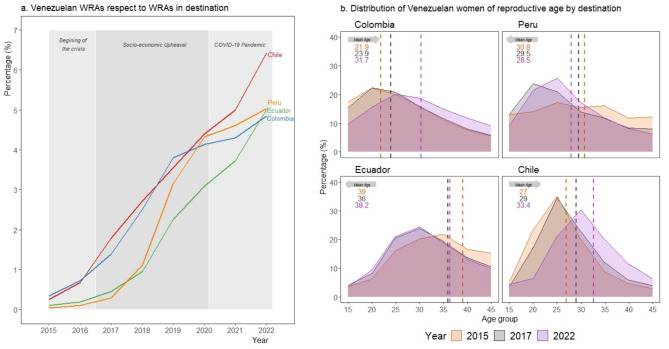
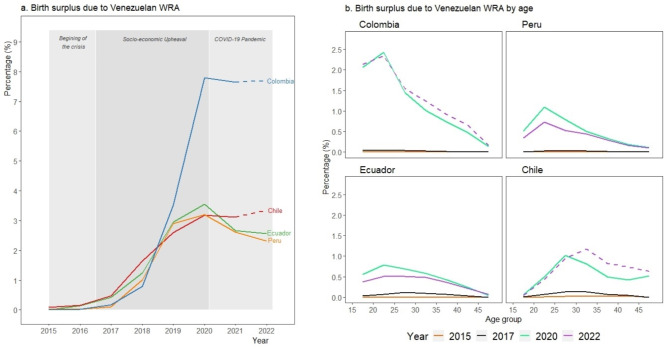
Results: The population of WRA has increased to between 5 and 6.8%, and births have risen to approximately 3-8% in host countries due to Venezuelan migration. Yet, we found a general decrease in health coverage for certain age groups of Venezuelan female migrants in host countries for the period 2017-2022, particularly in Chile. By 2022, an estimated 20% of healthcare needs remained unmet among children, girls, and younger Venezuelan women, contributing to greater health inequalities between Venezuelan-born adolescents and those from other countries of birth.
Conclusions: Our findings highlight the escalating demand for and limited access to healthcare services among Venezuelan WRA in their destinations. Unmet healthcare needs are particularly prevalent among younger women by 2022, underscoring the urgency for health system to incorporate gender-responsive, equitable interventions and ensuring health rights for high-risk migrant groups such as infants, children, adolescents, and younger women. Addressing these challenges remains a critical task for the regional public health agenda in Latin America.
期刊介绍:
International Journal for Equity in Health is an Open Access, peer-reviewed, online journal presenting evidence relevant to the search for, and attainment of, equity in health across and within countries. International Journal for Equity in Health aims to improve the understanding of issues that influence the health of populations. This includes the discussion of political, policy-related, economic, social and health services-related influences, particularly with regard to systematic differences in distributions of one or more aspects of health in population groups defined demographically, geographically, or socially.






 京公网安备 11010802042870号
京ICP备2023020795号-1
京公网安备 11010802042870号
京ICP备2023020795号-1

 分享
分享
 求助内容:
求助内容: 应助结果提醒方式:
 扫码关注我们
