Kazuki Yatsuzuka, Jun Muto, Nobushige Kohri, Satoshi Yoshida, Ken Shiraishi, Yasuhiro Fujisawa
{"title":"The use of upadacitinib to successfully treat eczematized psoriasis","authors":"Kazuki Yatsuzuka, Jun Muto, Nobushige Kohri, Satoshi Yoshida, Ken Shiraishi, Yasuhiro Fujisawa","doi":"10.1111/ijd.17528","DOIUrl":null,"url":null,"abstract":"<p>Psoriasis and atopic dermatitis (AD) are common inflammatory skin diseases that rarely coexist in the same individual. Eczematized psoriasis is a prototypical example of such an overlapping phenotype, defined by Lauffer et al.<span><sup>1</sup></span> as psoriasis with clinical, histological, and immunological overlap with AD. This variant, which occurs in approximately 5%–10% of patients with psoriasis, is often overlooked.<span><sup>1</sup></span> To our knowledge, this is the first reported case of eczematized psoriasis successfully treated with upadacitinib (UPA).</p><p>A 58-year-old man presented with widespread erythematous plaques and serous papules accompanied by severe itching. He had a 3-year history of psoriatic arthritis, untreated at the time, along with a history of hypertension, dyslipidemia, and diabetes. He had no family history of psoriasis or AD. Physical examination revealed peripheral arthritis and multiple erythematous plaques on his head, trunk, elbows, and knees (Figure 1a–c), with a Psoriasis Area and Severity Index score of 22. Additionally, the patient presented with multiple serous papules, crusts, and scratch marks on both the extensor and flexor sides of his lower legs (Figure 1c,d), as well as lichenifications in the cubital fossa, axilla, neck, and inguinal area, accompanied by severe itching (Figure 1a,e,f). His nonspecific IgE and thymus and activation-regulated chemokine levels were within the normal range, and blood tests showed positive specific IgE to Candida and wheat. A biopsy from an erythematous plaque on his elbow revealed psoriasiform hyperplasia with hyperkeratosis and parakeratosis, loss of the granular layer, dilated capillaries, and infiltration of lymphocytes with a few eosinophils in the dermis (Figure 1g,h).</p><p>Initially, we diagnosed psoriatic arthritis with secondary chronic eczema and prescribed steroid ointments and secukinumab. The psoriatic skin lesions rapidly improved (Figure 2a), but the pruritic eczematous lesions on his lower legs and the inguinal area remained refractory (Figure 2b,c). A subsequent biopsy from the lower leg revealed chronic dermatitis without psoriasiform change (Figure 2d). These eczematous lesions were also resistant to risankizumab and tildrakizumab. Given the resistance to various biologics for psoriasis, we ultimately diagnosed eczematized psoriasis according to the diagnostic criteria proposed by Lauffer et al.<span><sup>1</sup></span> We then switched to UPA; this led to an immediate improvement in both the itching and skin lesions, including the lichenifications in the inguinal area, within 2 months (Figure 2e).</p><p>In recent years, treatments for psoriasis and AD have significantly advanced, with UPA emerging as an innovative drug effective against both conditions.<span><sup>2, 3</sup></span> However, biologics for psoriasis are also well known to induce AD-like eruptions.<span><sup>4</sup></span> Therefore, it is crucial to clearly identify patients exhibiting psoriasis and AD characteristics and select drugs, such as UPA, that are effective against both conditions. From this perspective, we strongly agree with the proposal put forward by Lauffer et al.<span><sup>1</sup></span> to recognize a subtype of psoriasis called eczematized psoriasis. Instead of Th17 dominant immune response activation seen in plaque psoriasis, they suggested that in eczematous psoriasis, additional pathways, such as enhanced itch perception via IL-17C and Th2 pathway activation by IL-17E, contribute to the distinct clinical presentation.<span><sup>1</sup></span> Treating this variant is challenging because of the presence of immunological alterations characteristic of both psoriasis and AD.<span><sup>1</sup></span> Lauffer et al.<span><sup>1</sup></span> recommend therapies targeting both type 2 and 3 immune pathways, such as cyclosporine, methotrexate, apremilast, brodalumab, and JAK inhibitors. Several studies have demonstrated the effectiveness of UPA in patients with coexisting psoriasiform and spongiotic dermatitis.<span><sup>5</sup></span> To our knowledge, however, this is the first reported case of eczematized psoriasis successfully treated with UPA. We believe that the term “eczematized psoriasis” should be widely accepted and that further studies should examine the efficacy and prognosis of each treatment in real-world settings.</p>","PeriodicalId":13950,"journal":{"name":"International Journal of Dermatology","volume":"64 3","pages":"582-583"},"PeriodicalIF":3.2000,"publicationDate":"2024-10-14","publicationTypes":"Journal Article","fieldsOfStudy":null,"isOpenAccess":false,"openAccessPdf":"https://onlinelibrary.wiley.com/doi/epdf/10.1111/ijd.17528","citationCount":"0","resultStr":null,"platform":"Semanticscholar","paperid":null,"PeriodicalName":"International Journal of Dermatology","FirstCategoryId":"3","ListUrlMain":"https://onlinelibrary.wiley.com/doi/10.1111/ijd.17528","RegionNum":4,"RegionCategory":"医学","ArticlePicture":[],"TitleCN":null,"AbstractTextCN":null,"PMCID":null,"EPubDate":"","PubModel":"","JCR":"Q1","JCRName":"DERMATOLOGY","Score":null,"Total":0}
引用次数: 0
Abstract
Psoriasis and atopic dermatitis (AD) are common inflammatory skin diseases that rarely coexist in the same individual. Eczematized psoriasis is a prototypical example of such an overlapping phenotype, defined by Lauffer et al.1 as psoriasis with clinical, histological, and immunological overlap with AD. This variant, which occurs in approximately 5%–10% of patients with psoriasis, is often overlooked.1 To our knowledge, this is the first reported case of eczematized psoriasis successfully treated with upadacitinib (UPA).
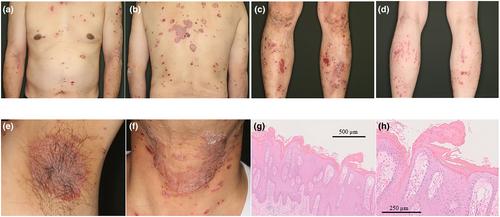
A 58-year-old man presented with widespread erythematous plaques and serous papules accompanied by severe itching. He had a 3-year history of psoriatic arthritis, untreated at the time, along with a history of hypertension, dyslipidemia, and diabetes. He had no family history of psoriasis or AD. Physical examination revealed peripheral arthritis and multiple erythematous plaques on his head, trunk, elbows, and knees (Figure 1a–c), with a Psoriasis Area and Severity Index score of 22. Additionally, the patient presented with multiple serous papules, crusts, and scratch marks on both the extensor and flexor sides of his lower legs (Figure 1c,d), as well as lichenifications in the cubital fossa, axilla, neck, and inguinal area, accompanied by severe itching (Figure 1a,e,f). His nonspecific IgE and thymus and activation-regulated chemokine levels were within the normal range, and blood tests showed positive specific IgE to Candida and wheat. A biopsy from an erythematous plaque on his elbow revealed psoriasiform hyperplasia with hyperkeratosis and parakeratosis, loss of the granular layer, dilated capillaries, and infiltration of lymphocytes with a few eosinophils in the dermis (Figure 1g,h).
Initially, we diagnosed psoriatic arthritis with secondary chronic eczema and prescribed steroid ointments and secukinumab. The psoriatic skin lesions rapidly improved (Figure 2a), but the pruritic eczematous lesions on his lower legs and the inguinal area remained refractory (Figure 2b,c). A subsequent biopsy from the lower leg revealed chronic dermatitis without psoriasiform change (Figure 2d). These eczematous lesions were also resistant to risankizumab and tildrakizumab. Given the resistance to various biologics for psoriasis, we ultimately diagnosed eczematized psoriasis according to the diagnostic criteria proposed by Lauffer et al.1 We then switched to UPA; this led to an immediate improvement in both the itching and skin lesions, including the lichenifications in the inguinal area, within 2 months (Figure 2e).
In recent years, treatments for psoriasis and AD have significantly advanced, with UPA emerging as an innovative drug effective against both conditions.2, 3 However, biologics for psoriasis are also well known to induce AD-like eruptions.4 Therefore, it is crucial to clearly identify patients exhibiting psoriasis and AD characteristics and select drugs, such as UPA, that are effective against both conditions. From this perspective, we strongly agree with the proposal put forward by Lauffer et al.1 to recognize a subtype of psoriasis called eczematized psoriasis. Instead of Th17 dominant immune response activation seen in plaque psoriasis, they suggested that in eczematous psoriasis, additional pathways, such as enhanced itch perception via IL-17C and Th2 pathway activation by IL-17E, contribute to the distinct clinical presentation.1 Treating this variant is challenging because of the presence of immunological alterations characteristic of both psoriasis and AD.1 Lauffer et al.1 recommend therapies targeting both type 2 and 3 immune pathways, such as cyclosporine, methotrexate, apremilast, brodalumab, and JAK inhibitors. Several studies have demonstrated the effectiveness of UPA in patients with coexisting psoriasiform and spongiotic dermatitis.5 To our knowledge, however, this is the first reported case of eczematized psoriasis successfully treated with UPA. We believe that the term “eczematized psoriasis” should be widely accepted and that further studies should examine the efficacy and prognosis of each treatment in real-world settings.
期刊介绍:
Published monthly, the International Journal of Dermatology is specifically designed to provide dermatologists around the world with a regular, up-to-date source of information on all aspects of the diagnosis and management of skin diseases. Accepted articles regularly cover clinical trials; education; morphology; pharmacology and therapeutics; case reports, and reviews. Additional features include tropical medical reports, news, correspondence, proceedings and transactions, and education.
The International Journal of Dermatology is guided by a distinguished, international editorial board and emphasizes a global approach to continuing medical education for physicians and other providers of health care with a specific interest in problems relating to the skin.



 京公网安备 11010802042870号
京ICP备2023020795号-1
京公网安备 11010802042870号
京ICP备2023020795号-1

 分享
分享
 求助内容:
求助内容: 应助结果提醒方式:
 扫码关注我们
