{"title":"Cecelia Stokes","authors":"","doi":"10.1111/nph.20177","DOIUrl":null,"url":null,"abstract":"<p>The southern Appalachian Mountains inspired my pursuit of science. When I was 9 years old, I lived in rural western North Carolina (USA). I spent my days jumping into mountain creeks, capturing salamanders and swinging on vines. My memories endured through time, and as a young adult, I moved back to Appalachia. I became fascinated with identifying the plants I encountered. Learning names also introduced me to the biology and natural history of the mountains. The southern Appalachian landscape is an old one with a diverse assemblage of native plants and high rates of endemism, but I also found many stubborn invasive species. I was witnessing my home change right before my eyes. I felt inspired to make a difference and decided to re-enroll in classes at the University of North Carolina-Asheville (UNCA; USA), with the aim of conserving plant biodiversity. In the remaining years of my undergraduate degree, I began focusing my attention on identifying the fungi instead. As I began to unravel the vast diversity of fungi in Appalachia and their ‘hidden’ influence on the forests I loved, I found the path to my current PhD research in fungal ecology and evolution.</p><p>Honestly, it was a windy road with a few detours. I was originally drawn to environmental policy but struggled with the categories we, as humans, had created and were using to simplify and sort complex natural systems. During an internship with the Southern Appalachian Highlands Conservancy (SAHC; USA), I found purpose in the more applied pursuit of land management and conservation. But although the hands-on work of invasive species removal was rewarding, I needed to explore the inner workings of the landscapes I was tending. Ultimately, my introduction to fungi is what inspired me to pursue a PhD. I was captivated by the countless ways in which fungi interact with other organisms and drive the functions of the forest. My decision to pursue mycology was also rooted in frustration. I had taken countless plant and animal courses while the entire kingdom of fungi was sequestered to one field class. This frustration has since turned into determination to help usher fungi to the forefront of ecology and evolution. In my PhD, I have had the opportunity to pursue fascinating questions and create a project I am passionate about, but I also get to contribute to the discourse surrounding fungi and the integral roles they play in ecosystems on Earth. Another wonderful aspect of mycology is the tradition of building long-lasting collaborations and relationships based on the exchange of knowledge, creativity, and support. As my work has taken me around the world, I have met many young scientists and nonacademic mycologists who have made my science stronger. I am excited about what the current and next generation of mycologists will accomplish as the field continues to grow and our tools become more accessible.</p><p>My motivations often change because I wear so many hats as a PhD student. But at its root, my motivation is curiosity. Science gives me the ability to continually learn and there is something remarkable and privileged about a lifelong quest for knowledge. I find purpose in applying my curiosity to issues of global biodiversity loss and ecological dynamics within our rapidly changing forests. For much of history, fungi have been left out of conversations about ecology, evolution, and invasion biology. Through my research, I am demystifying fungal ecology and, hopefully, enabling us to understand the mechanisms of spread and impacts of nonpathogenic fungal invasions. If I can contribute to the inclusion of fungi in the development of realistic and sustainable conservation frameworks, then my time will have been well spent.</p><p>Another motivation is creating an approachable and inclusive science community within which different backgrounds are not only considered but celebrated. As a first-generation student, I began my undergraduate degree already understanding that higher education is not an accessible option for most, and I eventually had to take a step away from school to tend to my mental health. I now know my unique perspective and life are invaluable to my science and mentoring, but for years I thought the opposite. I hope to spend my career creating spaces for my students and fellow scientists to generate their own excellent science, regardless of their background.</p><p>I am lucky to have had wonderful advisors and mentors who have substantially contributed to my growth as a scientist and human. My undergraduate research advisor, Dr Jonathan Horton, taught me how to integrate natural history into how we think about management and change in threatened ecosystems. Our work together showed that remaining a student regardless of career stage is the key to keeping science joyful. The leadership of Marquette Crockett, Roan Stewardship Director at SAHC, and my first female supervisor, inspired me to be confident as I stepped into an unfamiliar field as a returning student filled with self-doubt. I was also impassioned by her unmatched commitment to protecting Appalachia's landscapes. I am beyond grateful for the examples of my PhD advisors, Dr Anne Pringle and Dr Michelle Jusino. The inclusive and international community Anne facilitates is now my standard of integrating compassion and incredible science. Michelle has taught me the importance of intensive and thoughtful work, as well as the value of always remembering my foundational questions. Finally, I am a part of a supportive and dynamic lab full of people I greatly admire and draw inspiration from daily.</p><p><i>New Phytologist</i> has a long history of publishing excellent mycological research, much of it focused on fungal–plant interactions. I will highlight just a few of <i>New Phytologist</i>'s fascinating and impactful papers on ectomycorrhizal (ECM) fungi. First, Bogar <i>et al</i>. (<span>2022</span>) conducted an elegant microcosm experiment demonstrating how the maintenance of the reciprocal reward system between a plant and its ECM partner can depend on nutrient availability and the identity of the fungus. Understanding the diversity and complexities of nutrient exchange strategies in ECM species is essential to predicting how our forests will respond to global change, as well as to understand how certain ECM species may impact local nutrient cycling if they continue to spread around the globe. Second, Golan <i>et al</i>. (<span>2023</span>) demonstrated that Californian <i>Amanita phalloides</i> can reproduce frequently and spread via spore dispersal while also investing in large, perennial underground hyphal bodies. The multiple life history strategies of the death cap have clear implications for its success as an invasive fungus and emerge as a key characteristic of ECM invaders. Third, Policelli <i>et al</i>. (<span>2019</span>) describe the major biological traits of Suilloid fungal symbionts and their active contribution to the invasiveness of <i>Pinus</i> spp. in the southern hemisphere. This extensive review outlines the importance of considering the identity of fungal symbionts and belowground ecology in above ground processes.</p><p>This question was an unsurprisingly difficult one to answer. I have had countless memorable experiences with fungi, for example, finding my first species of cordyceps, <i>Cordyceps militaris</i>, and then digging down into the soil to find the colonized larva still attached to the ascocarp. There is the first species I ever identified correctly, <i>Cortinarius iodeoides</i>, a beautiful lilac mushroom with a bitter tasting slime (don't ask how I know). Of course, I am captivated by my study system, <i>Amanita phalloides</i>, but I spend enough time talking about the death cap. Ultimately, I landed on <i>Pseudoboletus parasiticus</i> (Fig. 1). This species parasitizes puffballs in the genus <i>Scleroderma</i>. Unlike other mycoparasites (e.g. <i>Hypomyces</i>), it does not appear as a nondescript mold layer on the basidiocarp, but instead looks as if a fully formed mushroom was glued to the side of a puffball. The life cycle and ecology of <i>P. parasiticus</i> is not well understood. The parasitism may be maintained within the vegetative <i>Scleroderma</i> mycelium growing in soil, because the parasite appears annually on the same puffballs while neighbouring individuals remain untouched. But <i>P. parasiticus</i> can also develop mycorrhizal associations, suggesting it may not be restricted to one niche. There are several other fungi I could talk about, but generally, I am drawn to the species which inspire more questions than answers.</p>","PeriodicalId":214,"journal":{"name":"New Phytologist","volume":"245 4","pages":"1366-1368"},"PeriodicalIF":8.1000,"publicationDate":"2024-10-21","publicationTypes":"Journal Article","fieldsOfStudy":null,"isOpenAccess":false,"openAccessPdf":"https://onlinelibrary.wiley.com/doi/epdf/10.1111/nph.20177","citationCount":"0","resultStr":null,"platform":"Semanticscholar","paperid":null,"PeriodicalName":"New Phytologist","FirstCategoryId":"99","ListUrlMain":"https://nph.onlinelibrary.wiley.com/doi/10.1111/nph.20177","RegionNum":1,"RegionCategory":"生物学","ArticlePicture":[],"TitleCN":null,"AbstractTextCN":null,"PMCID":null,"EPubDate":"","PubModel":"","JCR":"Q1","JCRName":"PLANT SCIENCES","Score":null,"Total":0}
引用次数: 0
Abstract
The southern Appalachian Mountains inspired my pursuit of science. When I was 9 years old, I lived in rural western North Carolina (USA). I spent my days jumping into mountain creeks, capturing salamanders and swinging on vines. My memories endured through time, and as a young adult, I moved back to Appalachia. I became fascinated with identifying the plants I encountered. Learning names also introduced me to the biology and natural history of the mountains. The southern Appalachian landscape is an old one with a diverse assemblage of native plants and high rates of endemism, but I also found many stubborn invasive species. I was witnessing my home change right before my eyes. I felt inspired to make a difference and decided to re-enroll in classes at the University of North Carolina-Asheville (UNCA; USA), with the aim of conserving plant biodiversity. In the remaining years of my undergraduate degree, I began focusing my attention on identifying the fungi instead. As I began to unravel the vast diversity of fungi in Appalachia and their ‘hidden’ influence on the forests I loved, I found the path to my current PhD research in fungal ecology and evolution.
Honestly, it was a windy road with a few detours. I was originally drawn to environmental policy but struggled with the categories we, as humans, had created and were using to simplify and sort complex natural systems. During an internship with the Southern Appalachian Highlands Conservancy (SAHC; USA), I found purpose in the more applied pursuit of land management and conservation. But although the hands-on work of invasive species removal was rewarding, I needed to explore the inner workings of the landscapes I was tending. Ultimately, my introduction to fungi is what inspired me to pursue a PhD. I was captivated by the countless ways in which fungi interact with other organisms and drive the functions of the forest. My decision to pursue mycology was also rooted in frustration. I had taken countless plant and animal courses while the entire kingdom of fungi was sequestered to one field class. This frustration has since turned into determination to help usher fungi to the forefront of ecology and evolution. In my PhD, I have had the opportunity to pursue fascinating questions and create a project I am passionate about, but I also get to contribute to the discourse surrounding fungi and the integral roles they play in ecosystems on Earth. Another wonderful aspect of mycology is the tradition of building long-lasting collaborations and relationships based on the exchange of knowledge, creativity, and support. As my work has taken me around the world, I have met many young scientists and nonacademic mycologists who have made my science stronger. I am excited about what the current and next generation of mycologists will accomplish as the field continues to grow and our tools become more accessible.
My motivations often change because I wear so many hats as a PhD student. But at its root, my motivation is curiosity. Science gives me the ability to continually learn and there is something remarkable and privileged about a lifelong quest for knowledge. I find purpose in applying my curiosity to issues of global biodiversity loss and ecological dynamics within our rapidly changing forests. For much of history, fungi have been left out of conversations about ecology, evolution, and invasion biology. Through my research, I am demystifying fungal ecology and, hopefully, enabling us to understand the mechanisms of spread and impacts of nonpathogenic fungal invasions. If I can contribute to the inclusion of fungi in the development of realistic and sustainable conservation frameworks, then my time will have been well spent.
Another motivation is creating an approachable and inclusive science community within which different backgrounds are not only considered but celebrated. As a first-generation student, I began my undergraduate degree already understanding that higher education is not an accessible option for most, and I eventually had to take a step away from school to tend to my mental health. I now know my unique perspective and life are invaluable to my science and mentoring, but for years I thought the opposite. I hope to spend my career creating spaces for my students and fellow scientists to generate their own excellent science, regardless of their background.
I am lucky to have had wonderful advisors and mentors who have substantially contributed to my growth as a scientist and human. My undergraduate research advisor, Dr Jonathan Horton, taught me how to integrate natural history into how we think about management and change in threatened ecosystems. Our work together showed that remaining a student regardless of career stage is the key to keeping science joyful. The leadership of Marquette Crockett, Roan Stewardship Director at SAHC, and my first female supervisor, inspired me to be confident as I stepped into an unfamiliar field as a returning student filled with self-doubt. I was also impassioned by her unmatched commitment to protecting Appalachia's landscapes. I am beyond grateful for the examples of my PhD advisors, Dr Anne Pringle and Dr Michelle Jusino. The inclusive and international community Anne facilitates is now my standard of integrating compassion and incredible science. Michelle has taught me the importance of intensive and thoughtful work, as well as the value of always remembering my foundational questions. Finally, I am a part of a supportive and dynamic lab full of people I greatly admire and draw inspiration from daily.
New Phytologist has a long history of publishing excellent mycological research, much of it focused on fungal–plant interactions. I will highlight just a few of New Phytologist's fascinating and impactful papers on ectomycorrhizal (ECM) fungi. First, Bogar et al. (2022) conducted an elegant microcosm experiment demonstrating how the maintenance of the reciprocal reward system between a plant and its ECM partner can depend on nutrient availability and the identity of the fungus. Understanding the diversity and complexities of nutrient exchange strategies in ECM species is essential to predicting how our forests will respond to global change, as well as to understand how certain ECM species may impact local nutrient cycling if they continue to spread around the globe. Second, Golan et al. (2023) demonstrated that Californian Amanita phalloides can reproduce frequently and spread via spore dispersal while also investing in large, perennial underground hyphal bodies. The multiple life history strategies of the death cap have clear implications for its success as an invasive fungus and emerge as a key characteristic of ECM invaders. Third, Policelli et al. (2019) describe the major biological traits of Suilloid fungal symbionts and their active contribution to the invasiveness of Pinus spp. in the southern hemisphere. This extensive review outlines the importance of considering the identity of fungal symbionts and belowground ecology in above ground processes.
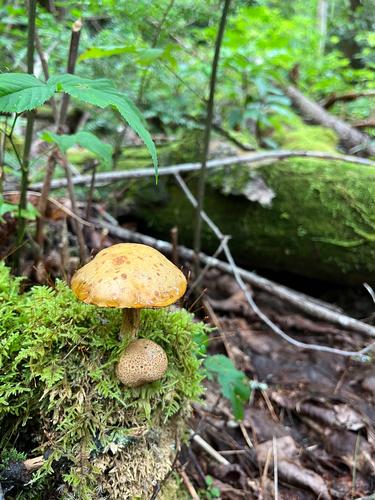
This question was an unsurprisingly difficult one to answer. I have had countless memorable experiences with fungi, for example, finding my first species of cordyceps, Cordyceps militaris, and then digging down into the soil to find the colonized larva still attached to the ascocarp. There is the first species I ever identified correctly, Cortinarius iodeoides, a beautiful lilac mushroom with a bitter tasting slime (don't ask how I know). Of course, I am captivated by my study system, Amanita phalloides, but I spend enough time talking about the death cap. Ultimately, I landed on Pseudoboletus parasiticus (Fig. 1). This species parasitizes puffballs in the genus Scleroderma. Unlike other mycoparasites (e.g. Hypomyces), it does not appear as a nondescript mold layer on the basidiocarp, but instead looks as if a fully formed mushroom was glued to the side of a puffball. The life cycle and ecology of P. parasiticus is not well understood. The parasitism may be maintained within the vegetative Scleroderma mycelium growing in soil, because the parasite appears annually on the same puffballs while neighbouring individuals remain untouched. But P. parasiticus can also develop mycorrhizal associations, suggesting it may not be restricted to one niche. There are several other fungi I could talk about, but generally, I am drawn to the species which inspire more questions than answers.
期刊介绍:
New Phytologist is an international electronic journal published 24 times a year. It is owned by the New Phytologist Foundation, a non-profit-making charitable organization dedicated to promoting plant science. The journal publishes excellent, novel, rigorous, and timely research and scholarship in plant science and its applications. The articles cover topics in five sections: Physiology & Development, Environment, Interaction, Evolution, and Transformative Plant Biotechnology. These sections encompass intracellular processes, global environmental change, and encourage cross-disciplinary approaches. The journal recognizes the use of techniques from molecular and cell biology, functional genomics, modeling, and system-based approaches in plant science. Abstracting and Indexing Information for New Phytologist includes Academic Search, AgBiotech News & Information, Agroforestry Abstracts, Biochemistry & Biophysics Citation Index, Botanical Pesticides, CAB Abstracts®, Environment Index, Global Health, and Plant Breeding Abstracts, and others.






 京公网安备 11010802042870号
京ICP备2023020795号-1
京公网安备 11010802042870号
京ICP备2023020795号-1

 分享
分享
 求助内容:
求助内容: 应助结果提醒方式:
 扫码关注我们
