Lucia Massolo, Matilde Ogliastro, Peter Postma, Oriana Ferrante, Rosa Amato, Elvira Massaro, Dorotea Bellina, Roberto Ziferro, Alberto Borneto, Alessandra Morando, Andrea Orsi
{"title":"Environmental Surveillance of <i>Legionella spp</i>. in an Italian University Hospital: results of 7 years of analysis.","authors":"Lucia Massolo, Matilde Ogliastro, Peter Postma, Oriana Ferrante, Rosa Amato, Elvira Massaro, Dorotea Bellina, Roberto Ziferro, Alberto Borneto, Alessandra Morando, Andrea Orsi","doi":"10.15167/2421-4248/jpmh2024.65.2.3195","DOIUrl":null,"url":null,"abstract":"<p><strong>Introduction: </strong>Nosocomial structures pose a high risk of <i>Legionella spp</i>. contamination due to complex water systems with challenging disinfection; moreover, the risk of severe legionellosis as a consequence of nosocomial exposure is very high in settings characterized by vulnerable patient conditions.</p><p><strong>Methods: </strong>In the present work, we described the results of 7 years of environmental surveillance in a reference hospital in Liguria, in which a specific water safety plan (WSP) has been implemented in 2017, including data collected during the COVID-19 pandemic.</p><p><strong>Results: </strong>During the study period, 1190 water samples were collected, of which 277 (23.3%) tested positive for <i>Legionella spp</i>. Positive samples with concentration values above 1,000 CFU/l were 184 (66.4%). Based on the new structure categorization contained in the WSP, hospital buildings classified as at \"very high\" risk resulted the most affected structures over the entire study period; however, the absolute number of positive samples greatly decreased over time, from 61 contaminated water samples in 2017 to only 9 in 2023.</p><p><strong>Conclusions: </strong>Our findings prompted the reinforcement of control and prevention measures, affirming the appropriateness of risk-category classification. Indeed, the majority of contamination cases were associated with the water networks of buildings classified as \"very high\" risk.</p>","PeriodicalId":94106,"journal":{"name":"Journal of preventive medicine and hygiene","volume":"65 2","pages":"E166-E171"},"PeriodicalIF":0.0000,"publicationDate":"2024-08-31","publicationTypes":"Journal Article","fieldsOfStudy":null,"isOpenAccess":false,"openAccessPdf":"https://www.ncbi.nlm.nih.gov/pmc/articles/PMC11487725/pdf/","citationCount":"0","resultStr":null,"platform":"Semanticscholar","paperid":null,"PeriodicalName":"Journal of preventive medicine and hygiene","FirstCategoryId":"1085","ListUrlMain":"https://doi.org/10.15167/2421-4248/jpmh2024.65.2.3195","RegionNum":0,"RegionCategory":null,"ArticlePicture":[],"TitleCN":null,"AbstractTextCN":null,"PMCID":null,"EPubDate":"2024/6/1 0:00:00","PubModel":"eCollection","JCR":"","JCRName":"","Score":null,"Total":0}
引用次数: 0
Abstract
Introduction: Nosocomial structures pose a high risk of Legionella spp. contamination due to complex water systems with challenging disinfection; moreover, the risk of severe legionellosis as a consequence of nosocomial exposure is very high in settings characterized by vulnerable patient conditions.
Methods: In the present work, we described the results of 7 years of environmental surveillance in a reference hospital in Liguria, in which a specific water safety plan (WSP) has been implemented in 2017, including data collected during the COVID-19 pandemic.
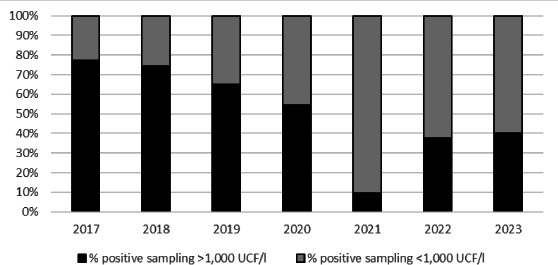
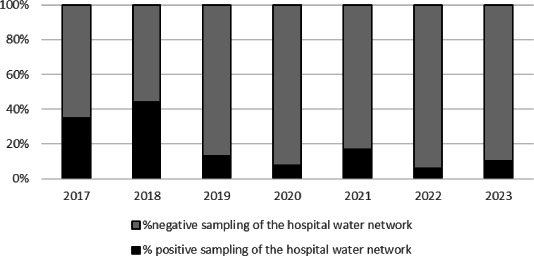
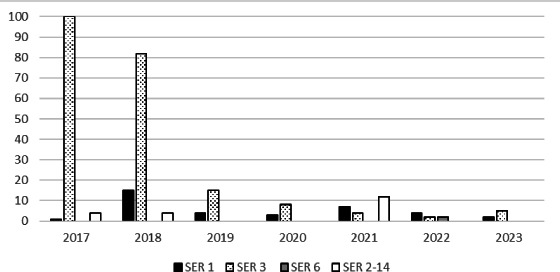
Results: During the study period, 1190 water samples were collected, of which 277 (23.3%) tested positive for Legionella spp. Positive samples with concentration values above 1,000 CFU/l were 184 (66.4%). Based on the new structure categorization contained in the WSP, hospital buildings classified as at "very high" risk resulted the most affected structures over the entire study period; however, the absolute number of positive samples greatly decreased over time, from 61 contaminated water samples in 2017 to only 9 in 2023.
Conclusions: Our findings prompted the reinforcement of control and prevention measures, affirming the appropriateness of risk-category classification. Indeed, the majority of contamination cases were associated with the water networks of buildings classified as "very high" risk.



 京公网安备 11010802042870号
京ICP备2023020795号-1
京公网安备 11010802042870号
京ICP备2023020795号-1

 分享
分享

 求助内容:
求助内容: 应助结果提醒方式:
 扫码关注我们
