Angus H Pegler, Shivshankar Thanigaimani, Siddharth S Pai, Dylan Morris, Jonathan Golledge
{"title":"Meta-Analysis of Randomised Controlled Trials Comparing Bypass and Endovascular Revascularisation for Peripheral Artery Disease.","authors":"Angus H Pegler, Shivshankar Thanigaimani, Siddharth S Pai, Dylan Morris, Jonathan Golledge","doi":"10.1177/15385744241292123","DOIUrl":null,"url":null,"abstract":"<p><strong>Objective: </strong>Peripheral artery disease affects approximately 250 million people globally. Multiple randomised controlled trials have compared bypass and endovascular interventions but the optimum revascularisation approach remains unclear. The recently published BEST-CLI and BASIL-2 trials provide current and robust data addressing this question, however their findings are not concordant. This systematic review and meta-analysis provides an overview of the worldwide randomised evidence comparing bypass surgery and endovascular revascularisation in lower limb peripheral artery disease.</p><p><strong>Methods: </strong>A comprehensive literature search of MEDLINE, Embase and CENTRAL databases was performed of all time periods up to 7 May 2023 to identify randomised controlled trials comparing bypass and endovascular revascularisation for treating lower limb peripheral artery disease. The primary outcome was major amputation. Secondary outcomes were mortality, re-intervention, 30-day adverse events and 30-day mortality. Odds ratios were calculated and pooled using the random-effects model. Risk of bias was assessed using the Cochrane risk of bias 2 tool.</p><p><strong>Results: </strong>Fourteen cohorts were identified across thirteen studies, enrolling 3840 patients. There was no significant difference in major amputation (OR 1.12; 95% CI 0.80-1.57) or mortality (OR 0.96; 95% CI 0.79-1.17) between the bypass and endovascular groups. Bypass was associated with a significant reduction in re-intervention compared with endovascular treatment (OR 0.57, 95% CI 0.40-0.82).</p><p><strong>Conclusions: </strong>These findings suggest that rates of major amputation and mortality are similar following bypass and endovascular interventions. Patients who undergo bypass surgery have a significantly lower re-intervention rate post-operatively.</p>","PeriodicalId":94265,"journal":{"name":"Vascular and endovascular surgery","volume":" ","pages":"277-287"},"PeriodicalIF":0.7000,"publicationDate":"2025-04-01","publicationTypes":"Journal Article","fieldsOfStudy":null,"isOpenAccess":false,"openAccessPdf":"https://www.ncbi.nlm.nih.gov/pmc/articles/PMC11804153/pdf/","citationCount":"0","resultStr":null,"platform":"Semanticscholar","paperid":null,"PeriodicalName":"Vascular and endovascular surgery","FirstCategoryId":"1085","ListUrlMain":"https://doi.org/10.1177/15385744241292123","RegionNum":0,"RegionCategory":null,"ArticlePicture":[],"TitleCN":null,"AbstractTextCN":null,"PMCID":null,"EPubDate":"2024/10/10 0:00:00","PubModel":"Epub","JCR":"","JCRName":"","Score":null,"Total":0}
引用次数: 0
Abstract
Objective: Peripheral artery disease affects approximately 250 million people globally. Multiple randomised controlled trials have compared bypass and endovascular interventions but the optimum revascularisation approach remains unclear. The recently published BEST-CLI and BASIL-2 trials provide current and robust data addressing this question, however their findings are not concordant. This systematic review and meta-analysis provides an overview of the worldwide randomised evidence comparing bypass surgery and endovascular revascularisation in lower limb peripheral artery disease.
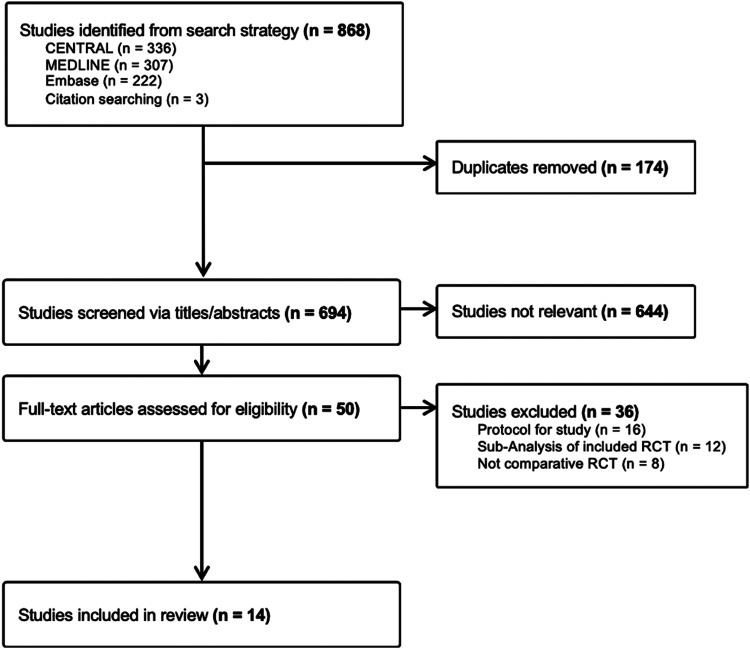
Methods: A comprehensive literature search of MEDLINE, Embase and CENTRAL databases was performed of all time periods up to 7 May 2023 to identify randomised controlled trials comparing bypass and endovascular revascularisation for treating lower limb peripheral artery disease. The primary outcome was major amputation. Secondary outcomes were mortality, re-intervention, 30-day adverse events and 30-day mortality. Odds ratios were calculated and pooled using the random-effects model. Risk of bias was assessed using the Cochrane risk of bias 2 tool.
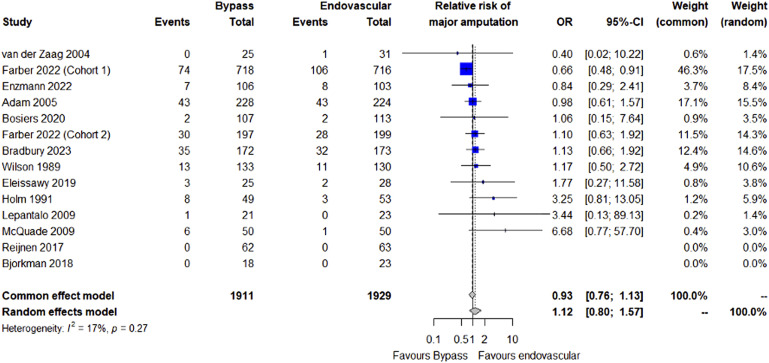
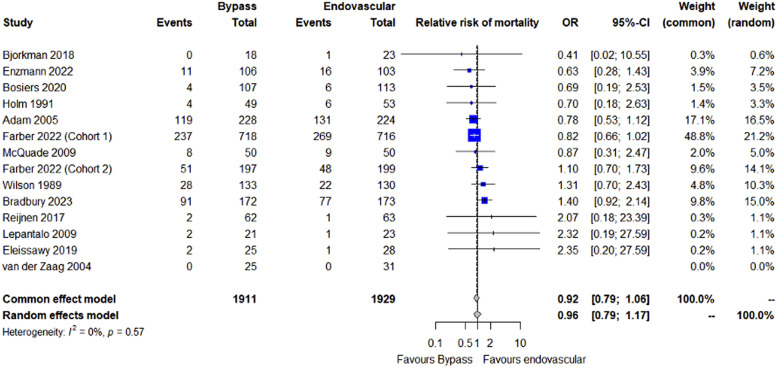
Results: Fourteen cohorts were identified across thirteen studies, enrolling 3840 patients. There was no significant difference in major amputation (OR 1.12; 95% CI 0.80-1.57) or mortality (OR 0.96; 95% CI 0.79-1.17) between the bypass and endovascular groups. Bypass was associated with a significant reduction in re-intervention compared with endovascular treatment (OR 0.57, 95% CI 0.40-0.82).
Conclusions: These findings suggest that rates of major amputation and mortality are similar following bypass and endovascular interventions. Patients who undergo bypass surgery have a significantly lower re-intervention rate post-operatively.
比较外周动脉疾病搭桥术和血管内再通术的随机对照试验的元分析》(Meta-Analysis of Randomised Controlled Trials Comparing Bypass and Endovascular Revascularisation for Peripheral Artery Disease)。
目的:全球约有 2.5 亿人患有外周动脉疾病。多项随机对照试验对搭桥术和血管内介入术进行了比较,但最佳的血管再通方法仍不明确。最近发表的 BEST-CLI 和 BASIL-2 试验针对这一问题提供了最新的可靠数据,但它们的研究结果并不一致。本系统综述和荟萃分析概述了全球范围内比较下肢外周动脉疾病搭桥手术和血管内再通术的随机证据:在MEDLINE、Embase和CENTRAL数据库中对截至2023年5月7日的所有时间段进行了全面的文献检索,以确定比较搭桥手术和血管内再通术治疗下肢外周动脉疾病的随机对照试验。主要结果是大截肢。次要结果为死亡率、再次介入、30 天不良事件和 30 天死亡率。采用随机效应模型计算并汇总了风险比。使用Cochrane偏倚风险2工具评估偏倚风险:13项研究中确定了14个队列,共招募了3840名患者。搭桥组和血管内治疗组在大截肢率(OR 1.12;95% CI 0.80-1.57)或死亡率(OR 0.96;95% CI 0.79-1.17)方面无明显差异。与血管内治疗相比,搭桥治疗可显著减少再次介入治疗(OR 0.57,95% CI 0.40-0.82):这些研究结果表明,搭桥手术和血管内介入治疗的主要截肢率和死亡率相似。接受搭桥手术的患者术后再介入率明显较低。



 京公网安备 11010802042870号
京ICP备2023020795号-1
京公网安备 11010802042870号
京ICP备2023020795号-1

 分享
分享

 求助内容:
求助内容: 应助结果提醒方式:
 扫码关注我们
