A. Brunelli, A. Serrano-Lotina, M. A. Bañares, V. Alcolea-Rodriguez, M. Blosi, A. Costa, S. Ortelli, W. Peijnenburg, C. Fito, E. G. Fernandez, J. S. Hermosilla, L. G. Soeteman-Hernández, I. Garmendia Aguirre, H. Rauscher, F. Murphy, V. Stone, J. Balbuena, J. M. L. Cormano, L. Pizzol, D. Hristozov, A. Marcomini and E. Badetti
{"title":"Safe-by-design assessment of an SiO2@ZnO multi-component nanomaterial used in construction†","authors":"A. Brunelli, A. Serrano-Lotina, M. A. Bañares, V. Alcolea-Rodriguez, M. Blosi, A. Costa, S. Ortelli, W. Peijnenburg, C. Fito, E. G. Fernandez, J. S. Hermosilla, L. G. Soeteman-Hernández, I. Garmendia Aguirre, H. Rauscher, F. Murphy, V. Stone, J. Balbuena, J. M. L. Cormano, L. Pizzol, D. Hristozov, A. Marcomini and E. Badetti","doi":"10.1039/D4EN00352G","DOIUrl":null,"url":null,"abstract":"<p >Safety aspects of chemicals/materials are transversal in all sustainability dimensions, representing a pillar at the early innovation stages of the European Commission's “safe and sustainable by design” (SSbD) framework for chemicals and materials. The first three of the five SSbD framework steps cover different safety aspects, namely, hazard assessment based on intrinsic properties (step 1), occupational health and safety (including exposure) assessment during the production/processing phase (step 2) and exposure in the final application phase (step 3). The goal of this work was to identify a set of characterization tools/procedures to support the operationalization of the first three safety steps in multi-component nanomaterials (MCNMs), applying the findings to an SiO<small><sub>2</sub></small> core–ZnO shell MCNM. The safety of this MCNM, which is used as an additive to silicate/calcium hydroxide mortar to improve air quality through photocatalytic NO<small><sub><em>x</em></sub></small> removal, was investigated from different perspectives along its value chain. Existing and newly generated data on its hazard profile were collected, the exposure of workers during its synthesis was assessed, and potential exposure to hazardous substances during its final application phase was investigated. In step 1, physico-chemical properties, hazard classification and cytotoxicity assays were considered. In step 2, a three-tiered established methodology for evaluating occupational exposure assessment was performed. Lastly, in step 3, the release of inorganic substances from MCNM-based mortars in the final application phase was investigated. Safety assessment according to the SSbD framework was performed by selecting tools and procedures suitable for application in the early innovation stage, resulting in a preliminary hazard assessment of MCNMs and a suggestion for redesigning a step in the process.</p>","PeriodicalId":73,"journal":{"name":"Environmental Science: Nano","volume":" 1","pages":" 762-776"},"PeriodicalIF":5.1000,"publicationDate":"2024-10-23","publicationTypes":"Journal Article","fieldsOfStudy":null,"isOpenAccess":false,"openAccessPdf":"https://pubs.rsc.org/en/content/articlepdf/2025/en/d4en00352g?page=search","citationCount":"0","resultStr":null,"platform":"Semanticscholar","paperid":null,"PeriodicalName":"Environmental Science: Nano","FirstCategoryId":"6","ListUrlMain":"https://pubs.rsc.org/en/content/articlelanding/2025/en/d4en00352g","RegionNum":2,"RegionCategory":"环境科学与生态学","ArticlePicture":[],"TitleCN":null,"AbstractTextCN":null,"PMCID":null,"EPubDate":"","PubModel":"","JCR":"Q1","JCRName":"CHEMISTRY, MULTIDISCIPLINARY","Score":null,"Total":0}
引用次数: 0
Abstract
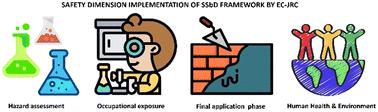
Safety aspects of chemicals/materials are transversal in all sustainability dimensions, representing a pillar at the early innovation stages of the European Commission's “safe and sustainable by design” (SSbD) framework for chemicals and materials. The first three of the five SSbD framework steps cover different safety aspects, namely, hazard assessment based on intrinsic properties (step 1), occupational health and safety (including exposure) assessment during the production/processing phase (step 2) and exposure in the final application phase (step 3). The goal of this work was to identify a set of characterization tools/procedures to support the operationalization of the first three safety steps in multi-component nanomaterials (MCNMs), applying the findings to an SiO2 core–ZnO shell MCNM. The safety of this MCNM, which is used as an additive to silicate/calcium hydroxide mortar to improve air quality through photocatalytic NOx removal, was investigated from different perspectives along its value chain. Existing and newly generated data on its hazard profile were collected, the exposure of workers during its synthesis was assessed, and potential exposure to hazardous substances during its final application phase was investigated. In step 1, physico-chemical properties, hazard classification and cytotoxicity assays were considered. In step 2, a three-tiered established methodology for evaluating occupational exposure assessment was performed. Lastly, in step 3, the release of inorganic substances from MCNM-based mortars in the final application phase was investigated. Safety assessment according to the SSbD framework was performed by selecting tools and procedures suitable for application in the early innovation stage, resulting in a preliminary hazard assessment of MCNMs and a suggestion for redesigning a step in the process.
期刊介绍:
Environmental Science: Nano serves as a comprehensive and high-impact peer-reviewed source of information on the design and demonstration of engineered nanomaterials for environment-based applications. It also covers the interactions between engineered, natural, and incidental nanomaterials with biological and environmental systems. This scope includes, but is not limited to, the following topic areas:
Novel nanomaterial-based applications for water, air, soil, food, and energy sustainability
Nanomaterial interactions with biological systems and nanotoxicology
Environmental fate, reactivity, and transformations of nanoscale materials
Nanoscale processes in the environment
Sustainable nanotechnology including rational nanomaterial design, life cycle assessment, risk/benefit analysis



 京公网安备 11010802042870号
京ICP备2023020795号-1
京公网安备 11010802042870号
京ICP备2023020795号-1

 分享
分享
 求助内容:
求助内容: 应助结果提醒方式:
 扫码关注我们
