{"title":"Selection bias obfuscates the discovery of fast radio burst sources","authors":"Mohit Bhardwaj, Jimin Lee, Kevin Ji","doi":"10.1038/s41586-024-08065-w","DOIUrl":null,"url":null,"abstract":"Fast radio bursts (FRBs) are a newly discovered class of extragalactic radio transients characterized by their high energy and short duration (from microseconds to milliseconds)1. The physical origin of these FRBs remains unknown and is a subject of ongoing research, with magnetars emerging as leading candidates2,3. Previous studies have used various methodologies to address the problem of FRB origin, including demographic analyses of FRB host galaxies and their local environments4–6, assessments of FRB rate evolution with redshift7–9 and searches for proposed multi-messenger FRB counterparts10. However, these studies are susceptible to substantial biases stemming from unaccounted radio and optical selection effects. Here we present empirical evidence for a substantial selection bias against detecting FRBs in galaxies with large inclination angles (edge-on) using a sample of hosts identified for FRBs discovered by untargeted surveys. This inclination-related bias probably leads to a significant underestimation (by about a factor of two) of the FRB rates reported in the literature and disfavours globular clusters as the dominant origin of FRB sources, as previously speculated6. These conclusions have important implications for FRB progenitor models and targeted FRB follow-up strategies. We further investigate the impact of this bias on the relative rate of FRBs in different host environments. Our analysis suggests that scattering in FRB hosts is probably responsible for the observed bias11,12. However, a larger sample of localized FRBs is required to robustly quantify the contribution of scattering to the inclination-related selection bias. The chances of detecting fast radio bursts from a galaxy may be affected by its inclination angle, showing a potential selection bias in determining the sources of the bursts.","PeriodicalId":18787,"journal":{"name":"Nature","volume":"634 8036","pages":"1065-1069"},"PeriodicalIF":48.5000,"publicationDate":"2024-10-23","publicationTypes":"Journal Article","fieldsOfStudy":null,"isOpenAccess":false,"openAccessPdf":"","citationCount":"0","resultStr":null,"platform":"Semanticscholar","paperid":null,"PeriodicalName":"Nature","FirstCategoryId":"103","ListUrlMain":"https://www.nature.com/articles/s41586-024-08065-w","RegionNum":1,"RegionCategory":"综合性期刊","ArticlePicture":[],"TitleCN":null,"AbstractTextCN":null,"PMCID":null,"EPubDate":"","PubModel":"","JCR":"Q1","JCRName":"MULTIDISCIPLINARY SCIENCES","Score":null,"Total":0}
引用次数: 0
Abstract
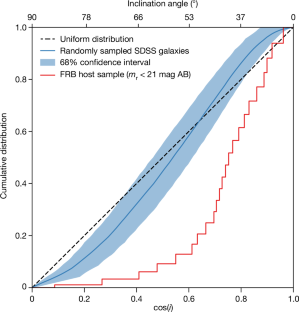
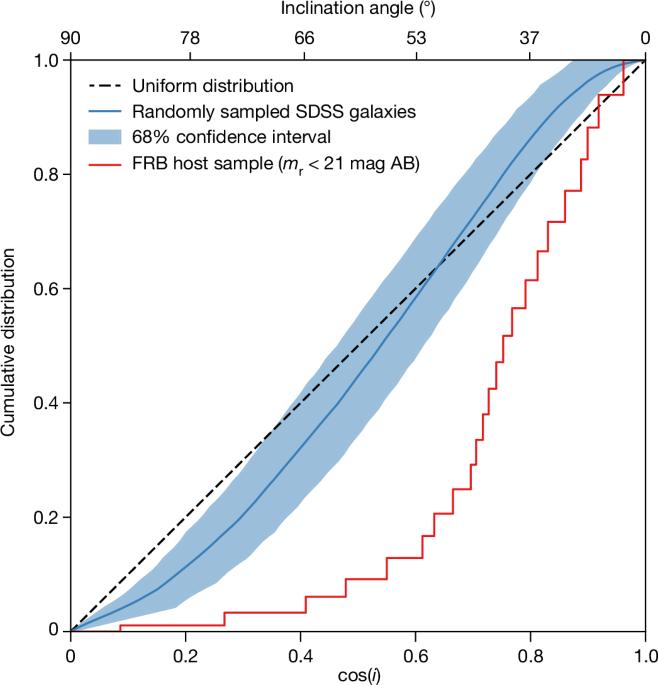
Fast radio bursts (FRBs) are a newly discovered class of extragalactic radio transients characterized by their high energy and short duration (from microseconds to milliseconds)1. The physical origin of these FRBs remains unknown and is a subject of ongoing research, with magnetars emerging as leading candidates2,3. Previous studies have used various methodologies to address the problem of FRB origin, including demographic analyses of FRB host galaxies and their local environments4–6, assessments of FRB rate evolution with redshift7–9 and searches for proposed multi-messenger FRB counterparts10. However, these studies are susceptible to substantial biases stemming from unaccounted radio and optical selection effects. Here we present empirical evidence for a substantial selection bias against detecting FRBs in galaxies with large inclination angles (edge-on) using a sample of hosts identified for FRBs discovered by untargeted surveys. This inclination-related bias probably leads to a significant underestimation (by about a factor of two) of the FRB rates reported in the literature and disfavours globular clusters as the dominant origin of FRB sources, as previously speculated6. These conclusions have important implications for FRB progenitor models and targeted FRB follow-up strategies. We further investigate the impact of this bias on the relative rate of FRBs in different host environments. Our analysis suggests that scattering in FRB hosts is probably responsible for the observed bias11,12. However, a larger sample of localized FRBs is required to robustly quantify the contribution of scattering to the inclination-related selection bias. The chances of detecting fast radio bursts from a galaxy may be affected by its inclination angle, showing a potential selection bias in determining the sources of the bursts.
期刊介绍:
Nature is a prestigious international journal that publishes peer-reviewed research in various scientific and technological fields. The selection of articles is based on criteria such as originality, importance, interdisciplinary relevance, timeliness, accessibility, elegance, and surprising conclusions. In addition to showcasing significant scientific advances, Nature delivers rapid, authoritative, insightful news, and interpretation of current and upcoming trends impacting science, scientists, and the broader public. The journal serves a dual purpose: firstly, to promptly share noteworthy scientific advances and foster discussions among scientists, and secondly, to ensure the swift dissemination of scientific results globally, emphasizing their significance for knowledge, culture, and daily life.




 京公网安备 11010802042870号
京ICP备2023020795号-1
京公网安备 11010802042870号
京ICP备2023020795号-1

 分享
分享
 求助内容:
求助内容: 应助结果提醒方式:
 扫码关注我们
