{"title":"High-Accuracy Adaptive Robust Fault-Tolerant Control for Quadrotor With Actuator Uncertainties and Aerodynamic Drag Compensation","authors":"Weisheng Liang;Zheng Chen;Bin Yao","doi":"10.1109/TASE.2024.3479294","DOIUrl":null,"url":null,"abstract":"With the expansion of application range of quadrotors, high-performance safety flight is getting more attention, where the health of actuators is critical. However, based on the commonly used loss of efficiency models, such fault-tolerant control methods are limited in performance to deal with different types of actuator faults in targeted ways. In this paper, by fully utilizing the more detailed and accurate models, the proposed adaptive robust fault-tolerant control has strong fault tolerance ability while maintaining excellent trajectory tracking accuracy. Firstly, the actuator model is established including motor dynamics and propeller model, which can reflect different types of actuator faults to the changes in different physical parameters instead of single-type efficiency factors. Additionally, aerodynamic drag is explicitly considered in quadrotor dynamics for improving control accuracy. Then, adaptive robust control is developed on these bases with comprehensive adaptation mechanism. To be specific, actuator parameters are actively estimated by recursive least square, so that actuator faults can be compensated directly in a targeted way without fault diagnosis. Subsequently, aerodynamic drag is effectively compensated through gradient-type adaptation, while the remaining uncompensated uncertainties are further suppressed by robust feedback. Finally, the comparative experiments demonstrate that the proposed method achieves much higher control accuracy than other compared methods, and it can maintain the same level of accuracy in faulty and fault-free case. Upon sudden faults, the proposed method exhibits the fastest response speed with minimal positional overshoot. Note to Practitioners—This paper aims to improve the flight safety of quadrotors while maintaining good trajectory tracking accuracy. Considering the most critical factor, i.e., actuator faults, it is usually modeled as loss of efficiency in most of literature on fault-tolerant control. However, the causes of faults are diverse, and it is not possible to effectively compensate for all kinds of faults through single-type efficiency coefficients. In fact, the occurrence of faults is associated with a change in a certain parameter of the system. Based on this, by fully utilizing the dynamics model of quadrotor and actuator, the effective online adaptive estimation algorithm is designed specifically for key actuator parameters related to faults. Therefore, more targeted compensation can be achieved for actuator faults caused by different reasons. In addition, those parameters that cannot be identified in advance but has great impact on accuracy, such as aerodynamic drag coefficients, are also explicitly considered and adaptively compensated. As for the remaining uncompensated uncertainties including external disturbances, robust feedback is introduced to ensure stability against them. The experimental results indicate that, for different types of actuator faults, the proposed method can achieve excellent trajectory tracking accuracy comparable to the fault-free cases. The proposed method can also be applied to other kinds of autonomous vehicles, such as underwater vehicles and aerospace vehicles.","PeriodicalId":51060,"journal":{"name":"IEEE Transactions on Automation Science and Engineering","volume":"22 ","pages":"8123-8136"},"PeriodicalIF":6.4000,"publicationDate":"2024-10-22","publicationTypes":"Journal Article","fieldsOfStudy":null,"isOpenAccess":false,"openAccessPdf":"","citationCount":"0","resultStr":null,"platform":"Semanticscholar","paperid":null,"PeriodicalName":"IEEE Transactions on Automation Science and Engineering","FirstCategoryId":"94","ListUrlMain":"https://ieeexplore.ieee.org/document/10729650/","RegionNum":2,"RegionCategory":"计算机科学","ArticlePicture":[],"TitleCN":null,"AbstractTextCN":null,"PMCID":null,"EPubDate":"","PubModel":"","JCR":"Q1","JCRName":"AUTOMATION & CONTROL SYSTEMS","Score":null,"Total":0}
引用次数: 0
Abstract
With the expansion of application range of quadrotors, high-performance safety flight is getting more attention, where the health of actuators is critical. However, based on the commonly used loss of efficiency models, such fault-tolerant control methods are limited in performance to deal with different types of actuator faults in targeted ways. In this paper, by fully utilizing the more detailed and accurate models, the proposed adaptive robust fault-tolerant control has strong fault tolerance ability while maintaining excellent trajectory tracking accuracy. Firstly, the actuator model is established including motor dynamics and propeller model, which can reflect different types of actuator faults to the changes in different physical parameters instead of single-type efficiency factors. Additionally, aerodynamic drag is explicitly considered in quadrotor dynamics for improving control accuracy. Then, adaptive robust control is developed on these bases with comprehensive adaptation mechanism. To be specific, actuator parameters are actively estimated by recursive least square, so that actuator faults can be compensated directly in a targeted way without fault diagnosis. Subsequently, aerodynamic drag is effectively compensated through gradient-type adaptation, while the remaining uncompensated uncertainties are further suppressed by robust feedback. Finally, the comparative experiments demonstrate that the proposed method achieves much higher control accuracy than other compared methods, and it can maintain the same level of accuracy in faulty and fault-free case. Upon sudden faults, the proposed method exhibits the fastest response speed with minimal positional overshoot. Note to Practitioners—This paper aims to improve the flight safety of quadrotors while maintaining good trajectory tracking accuracy. Considering the most critical factor, i.e., actuator faults, it is usually modeled as loss of efficiency in most of literature on fault-tolerant control. However, the causes of faults are diverse, and it is not possible to effectively compensate for all kinds of faults through single-type efficiency coefficients. In fact, the occurrence of faults is associated with a change in a certain parameter of the system. Based on this, by fully utilizing the dynamics model of quadrotor and actuator, the effective online adaptive estimation algorithm is designed specifically for key actuator parameters related to faults. Therefore, more targeted compensation can be achieved for actuator faults caused by different reasons. In addition, those parameters that cannot be identified in advance but has great impact on accuracy, such as aerodynamic drag coefficients, are also explicitly considered and adaptively compensated. As for the remaining uncompensated uncertainties including external disturbances, robust feedback is introduced to ensure stability against them. The experimental results indicate that, for different types of actuator faults, the proposed method can achieve excellent trajectory tracking accuracy comparable to the fault-free cases. The proposed method can also be applied to other kinds of autonomous vehicles, such as underwater vehicles and aerospace vehicles.
期刊介绍:
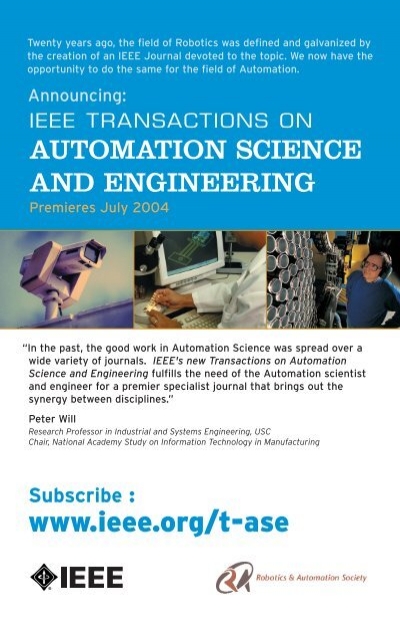
The IEEE Transactions on Automation Science and Engineering (T-ASE) publishes fundamental papers on Automation, emphasizing scientific results that advance efficiency, quality, productivity, and reliability. T-ASE encourages interdisciplinary approaches from computer science, control systems, electrical engineering, mathematics, mechanical engineering, operations research, and other fields. T-ASE welcomes results relevant to industries such as agriculture, biotechnology, healthcare, home automation, maintenance, manufacturing, pharmaceuticals, retail, security, service, supply chains, and transportation. T-ASE addresses a research community willing to integrate knowledge across disciplines and industries. For this purpose, each paper includes a Note to Practitioners that summarizes how its results can be applied or how they might be extended to apply in practice.




 京公网安备 11010802042870号
京ICP备2023020795号-1
京公网安备 11010802042870号
京ICP备2023020795号-1

 分享
分享
 求助内容:
求助内容: 应助结果提醒方式:
 扫码关注我们
