Cheng Zhang, Ranfeng Wu, Fajia Sun, Yisheng Lin, Yuan Liang, Jiongjiong Teng, Na Liu, Qi Ouyang, Long Qian, Hao Yan
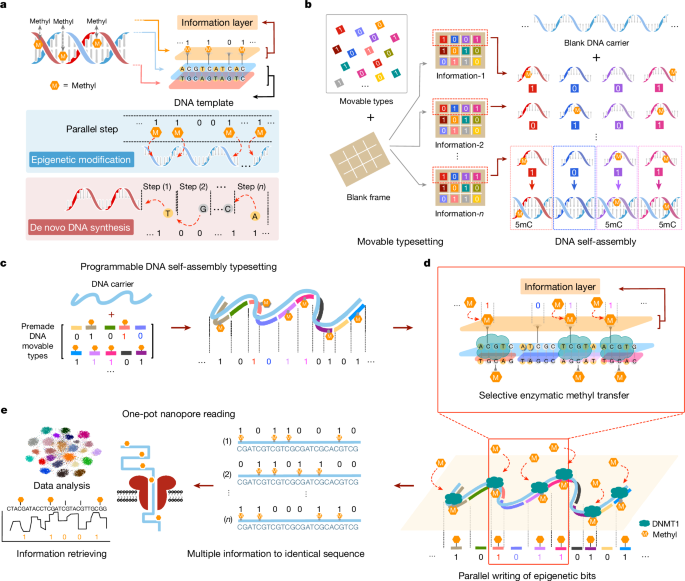
{"title":"Parallel molecular data storage by printing epigenetic bits on DNA","authors":"Cheng Zhang, Ranfeng Wu, Fajia Sun, Yisheng Lin, Yuan Liang, Jiongjiong Teng, Na Liu, Qi Ouyang, Long Qian, Hao Yan","doi":"10.1038/s41586-024-08040-5","DOIUrl":null,"url":null,"abstract":"DNA storage has shown potential to transcend current silicon-based data storage technologies in storage density, longevity and energy consumption1–3. However, writing large-scale data directly into DNA sequences by de novo synthesis remains uneconomical in time and cost4. We present an alternative, parallel strategy that enables the writing of arbitrary data on DNA using premade nucleic acids. Through self-assembly guided enzymatic methylation, epigenetic modifications, as information bits, can be introduced precisely onto universal DNA templates to enact molecular movable-type printing. By programming with a finite set of 700 DNA movable types and five templates, we achieved the synthesis-free writing of approximately 275,000 bits on an automated platform with 350 bits written per reaction. The data encoded in complex epigenetic patterns were retrieved high-throughput by nanopore sequencing, and algorithms were developed to finely resolve 240 modification patterns per sequencing reaction. With the epigenetic information bits framework, distributed and bespoke DNA storage was implemented by 60 volunteers lacking professional biolab experience. Our framework presents a new modality of DNA data storage that is parallel, programmable, stable and scalable. Such an unconventional modality opens up avenues towards practical data storage and dual-mode data functions in biomolecular systems. We present a DNA self-assembly based molecular data writing strategy to enable parallel movable-type printing for scalable DNA storage.","PeriodicalId":18787,"journal":{"name":"Nature","volume":"634 8035","pages":"824-832"},"PeriodicalIF":48.5000,"publicationDate":"2024-10-23","publicationTypes":"Journal Article","fieldsOfStudy":null,"isOpenAccess":false,"openAccessPdf":"https://www.nature.com/articles/s41586-024-08040-5.pdf","citationCount":"0","resultStr":null,"platform":"Semanticscholar","paperid":null,"PeriodicalName":"Nature","FirstCategoryId":"103","ListUrlMain":"https://www.nature.com/articles/s41586-024-08040-5","RegionNum":1,"RegionCategory":"综合性期刊","ArticlePicture":[],"TitleCN":null,"AbstractTextCN":null,"PMCID":null,"EPubDate":"","PubModel":"","JCR":"Q1","JCRName":"MULTIDISCIPLINARY SCIENCES","Score":null,"Total":0}
引用次数: 0
Abstract
DNA storage has shown potential to transcend current silicon-based data storage technologies in storage density, longevity and energy consumption1–3. However, writing large-scale data directly into DNA sequences by de novo synthesis remains uneconomical in time and cost4. We present an alternative, parallel strategy that enables the writing of arbitrary data on DNA using premade nucleic acids. Through self-assembly guided enzymatic methylation, epigenetic modifications, as information bits, can be introduced precisely onto universal DNA templates to enact molecular movable-type printing. By programming with a finite set of 700 DNA movable types and five templates, we achieved the synthesis-free writing of approximately 275,000 bits on an automated platform with 350 bits written per reaction. The data encoded in complex epigenetic patterns were retrieved high-throughput by nanopore sequencing, and algorithms were developed to finely resolve 240 modification patterns per sequencing reaction. With the epigenetic information bits framework, distributed and bespoke DNA storage was implemented by 60 volunteers lacking professional biolab experience. Our framework presents a new modality of DNA data storage that is parallel, programmable, stable and scalable. Such an unconventional modality opens up avenues towards practical data storage and dual-mode data functions in biomolecular systems. We present a DNA self-assembly based molecular data writing strategy to enable parallel movable-type printing for scalable DNA storage.
DNA 存储已显示出在存储密度、寿命和能耗方面超越当前硅基数据存储技术的潜力1,2,3。然而,通过从头合成将大规模数据直接写入 DNA 序列在时间和成本上仍不经济4。我们提出了另一种并行策略,利用预制核酸在 DNA 上写入任意数据。通过自组装引导的酶甲基化,表观遗传修饰(作为信息位)可以被精确地引入通用 DNA 模板,从而实现分子可移动印刷。通过使用一组有限的 700 个 DNA 可移动类型和五个模板进行编程,我们在一个自动化平台上实现了约 275,000 个比特的无合成写入,每个反应写入 350 个比特。复杂的表观遗传模式中编码的数据通过纳米孔测序进行高通量检索,并开发了算法来精细解析每个测序反应中的 240 种修饰模式。利用表观遗传信息比特框架,60 名缺乏专业生物实验室经验的志愿者实现了分布式定制 DNA 存储。我们的框架提供了一种并行、可编程、稳定和可扩展的 DNA 数据存储新模式。这种非常规模式为生物分子系统中的实用数据存储和双模式数据功能开辟了道路。
期刊介绍:
Nature is a prestigious international journal that publishes peer-reviewed research in various scientific and technological fields. The selection of articles is based on criteria such as originality, importance, interdisciplinary relevance, timeliness, accessibility, elegance, and surprising conclusions. In addition to showcasing significant scientific advances, Nature delivers rapid, authoritative, insightful news, and interpretation of current and upcoming trends impacting science, scientists, and the broader public. The journal serves a dual purpose: firstly, to promptly share noteworthy scientific advances and foster discussions among scientists, and secondly, to ensure the swift dissemination of scientific results globally, emphasizing their significance for knowledge, culture, and daily life.




 京公网安备 11010802042870号
京ICP备2023020795号-1
京公网安备 11010802042870号
京ICP备2023020795号-1

 分享
分享
 求助内容:
求助内容: 应助结果提醒方式:
 扫码关注我们
