{"title":"A subcortical feeding circuit linking an interoceptive node to jaw movement","authors":"Christin Kosse, Jessica Ivanov, Zachary Knight, Kyle Pellegrino, Jeffrey Friedman","doi":"10.1038/s41586-024-08098-1","DOIUrl":null,"url":null,"abstract":"The brain processes an array of stimuli, enabling the selection of appropriate behavioural responses, but the neural pathways linking interoceptive inputs to outputs for feeding are poorly understood1–3. Here we delineate a subcortical circuit in which brain-derived neurotrophic factor (BDNF)-expressing neurons in the ventromedial hypothalamus (VMH) directly connect interoceptive inputs to motor centres, controlling food consumption and jaw movements. VMHBDNF neuron inhibition increases food intake by gating motor sequences of feeding through projections to premotor areas of the jaw. When food is unavailable, VMHBDNF inhibition elicits consummatory behaviours directed at inanimate objects such as wooden blocks, and inhibition of perimesencephalic trigeminal area (pMe5) projections evokes rhythmic jaw movements. The activity of these neurons is decreased during food consumption and increases when food is in proximity but not consumed. Activity is also increased in obese animals and after leptin treatment. VMHBDNF neurons receive monosynaptic inputs from both agouti-related peptide (AgRP) and proopiomelanocortin neurons in the arcuate nucleus (Arc), and constitutive VMHBDNF activation blocks the orexigenic effect of AgRP activation. These data indicate an Arc → VMHBDNF → pMe5 circuit that senses the energy state of an animal and regulates consummatory behaviours in a state-dependent manner. A subcortical circuit that regulates food consumption in mice is described, involving neurons in the ventromedial hypothalamus that are directly linked to motor centres that regulate feeding and jaw movements.","PeriodicalId":18787,"journal":{"name":"Nature","volume":"636 8041","pages":"151-161"},"PeriodicalIF":48.5000,"publicationDate":"2024-10-23","publicationTypes":"Journal Article","fieldsOfStudy":null,"isOpenAccess":false,"openAccessPdf":"https://www.nature.com/articles/s41586-024-08098-1.pdf","citationCount":"0","resultStr":null,"platform":"Semanticscholar","paperid":null,"PeriodicalName":"Nature","FirstCategoryId":"103","ListUrlMain":"https://www.nature.com/articles/s41586-024-08098-1","RegionNum":1,"RegionCategory":"综合性期刊","ArticlePicture":[],"TitleCN":null,"AbstractTextCN":null,"PMCID":null,"EPubDate":"","PubModel":"","JCR":"Q1","JCRName":"MULTIDISCIPLINARY SCIENCES","Score":null,"Total":0}
引用次数: 0
Abstract
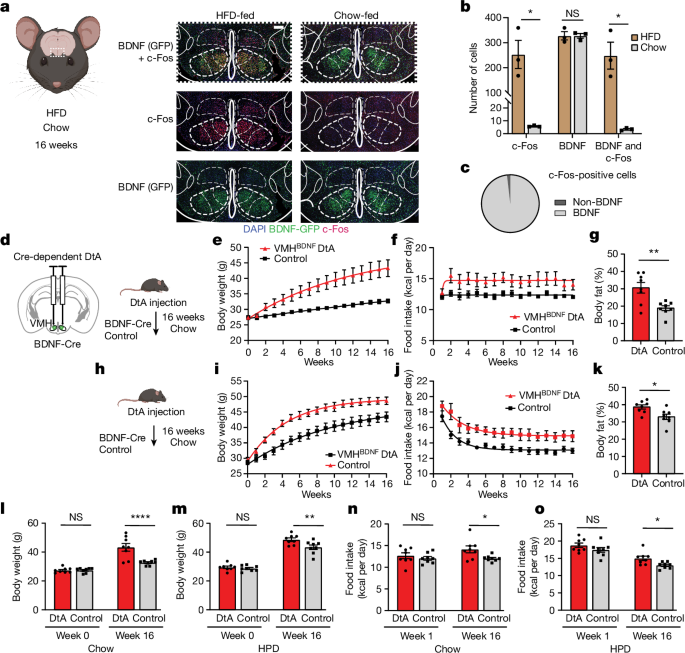
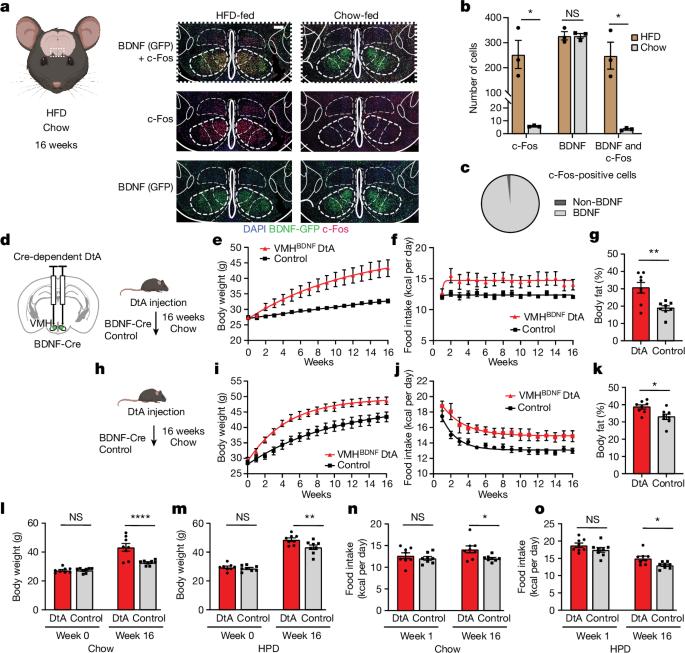
The brain processes an array of stimuli, enabling the selection of appropriate behavioural responses, but the neural pathways linking interoceptive inputs to outputs for feeding are poorly understood1–3. Here we delineate a subcortical circuit in which brain-derived neurotrophic factor (BDNF)-expressing neurons in the ventromedial hypothalamus (VMH) directly connect interoceptive inputs to motor centres, controlling food consumption and jaw movements. VMHBDNF neuron inhibition increases food intake by gating motor sequences of feeding through projections to premotor areas of the jaw. When food is unavailable, VMHBDNF inhibition elicits consummatory behaviours directed at inanimate objects such as wooden blocks, and inhibition of perimesencephalic trigeminal area (pMe5) projections evokes rhythmic jaw movements. The activity of these neurons is decreased during food consumption and increases when food is in proximity but not consumed. Activity is also increased in obese animals and after leptin treatment. VMHBDNF neurons receive monosynaptic inputs from both agouti-related peptide (AgRP) and proopiomelanocortin neurons in the arcuate nucleus (Arc), and constitutive VMHBDNF activation blocks the orexigenic effect of AgRP activation. These data indicate an Arc → VMHBDNF → pMe5 circuit that senses the energy state of an animal and regulates consummatory behaviours in a state-dependent manner. A subcortical circuit that regulates food consumption in mice is described, involving neurons in the ventromedial hypothalamus that are directly linked to motor centres that regulate feeding and jaw movements.
期刊介绍:
Nature is a prestigious international journal that publishes peer-reviewed research in various scientific and technological fields. The selection of articles is based on criteria such as originality, importance, interdisciplinary relevance, timeliness, accessibility, elegance, and surprising conclusions. In addition to showcasing significant scientific advances, Nature delivers rapid, authoritative, insightful news, and interpretation of current and upcoming trends impacting science, scientists, and the broader public. The journal serves a dual purpose: firstly, to promptly share noteworthy scientific advances and foster discussions among scientists, and secondly, to ensure the swift dissemination of scientific results globally, emphasizing their significance for knowledge, culture, and daily life.



 京公网安备 11010802042870号
京ICP备2023020795号-1
京公网安备 11010802042870号
京ICP备2023020795号-1

 分享
分享
 求助内容:
求助内容: 应助结果提醒方式:
 扫码关注我们
