Michael Alexanian, Arun Padmanabhan, Tomohiro Nishino, Joshua G. Travers, Lin Ye, Angelo Pelonero, Clara Youngna Lee, Nandhini Sadagopan, Yu Huang, Kirsten Auclair, Ada Zhu, Yuqian An, Christina A. Ekstrand, Cassandra Martinez, Barbara Gonzalez Teran, Will R. Flanigan, Charis Kee-Seon Kim, Koya Lumbao-Conradson, Zachary Gardner, Li Li, Mauro W. Costa, Rajan Jain, Israel Charo, Alexis J. Combes, Saptarsi M. Haldar, Katherine S. Pollard, Ronald J. Vagnozzi, Timothy A. McKinsey, Pawel F. Przytycki, Deepak Srivastava
{"title":"Chromatin remodelling drives immune cell–fibroblast communication in heart failure","authors":"Michael Alexanian, Arun Padmanabhan, Tomohiro Nishino, Joshua G. Travers, Lin Ye, Angelo Pelonero, Clara Youngna Lee, Nandhini Sadagopan, Yu Huang, Kirsten Auclair, Ada Zhu, Yuqian An, Christina A. Ekstrand, Cassandra Martinez, Barbara Gonzalez Teran, Will R. Flanigan, Charis Kee-Seon Kim, Koya Lumbao-Conradson, Zachary Gardner, Li Li, Mauro W. Costa, Rajan Jain, Israel Charo, Alexis J. Combes, Saptarsi M. Haldar, Katherine S. Pollard, Ronald J. Vagnozzi, Timothy A. McKinsey, Pawel F. Przytycki, Deepak Srivastava","doi":"10.1038/s41586-024-08085-6","DOIUrl":null,"url":null,"abstract":"Chronic inflammation and tissue fibrosis are common responses that worsen organ function, yet the molecular mechanisms governing their cross-talk are poorly understood. In diseased organs, stress-induced gene expression changes fuel maladaptive cell state transitions1 and pathological interaction between cellular compartments. Although chronic fibroblast activation worsens dysfunction in the lungs, liver, kidneys and heart, and exacerbates many cancers2, the stress-sensing mechanisms initiating transcriptional activation of fibroblasts are poorly understood. Here we show that conditional deletion of the transcriptional co-activator Brd4 in infiltrating Cx3cr1+ macrophages ameliorates heart failure in mice and significantly reduces fibroblast activation. Analysis of single-cell chromatin accessibility and BRD4 occupancy in vivo in Cx3cr1+ cells identified a large enhancer proximal to interleukin-1β (IL-1β, encoded by Il1b), and a series of CRISPR-based deletions revealed the precise stress-dependent regulatory element that controls Il1b expression. Secreted IL-1β activated a fibroblast RELA-dependent (also known as p65) enhancer near the transcription factor MEOX1, resulting in a profibrotic response in human cardiac fibroblasts. In vivo, antibody-mediated IL-1β neutralization improved cardiac function and tissue fibrosis in heart failure. Systemic IL-1β inhibition or targeted Il1b deletion in Cx3cr1+ cells prevented stress-induced Meox1 expression and fibroblast activation. The elucidation of BRD4-dependent cross-talk between a specific immune cell subset and fibroblasts through IL-1β reveals how inflammation drives profibrotic cell states and supports strategies that modulate this process in heart disease and other chronic inflammatory disorders featuring tissue remodelling. Conditional deletion of the transcriptional co-activator Brd4 in infiltrating Cx3cr1+ mouse macrophages ameliorates heart failure and substantially reduces fibroblast activation.","PeriodicalId":18787,"journal":{"name":"Nature","volume":"635 8038","pages":"434-443"},"PeriodicalIF":48.5000,"publicationDate":"2024-10-23","publicationTypes":"Journal Article","fieldsOfStudy":null,"isOpenAccess":false,"openAccessPdf":"","citationCount":"0","resultStr":null,"platform":"Semanticscholar","paperid":null,"PeriodicalName":"Nature","FirstCategoryId":"103","ListUrlMain":"https://www.nature.com/articles/s41586-024-08085-6","RegionNum":1,"RegionCategory":"综合性期刊","ArticlePicture":[],"TitleCN":null,"AbstractTextCN":null,"PMCID":null,"EPubDate":"","PubModel":"","JCR":"Q1","JCRName":"MULTIDISCIPLINARY SCIENCES","Score":null,"Total":0}
引用次数: 0
Abstract
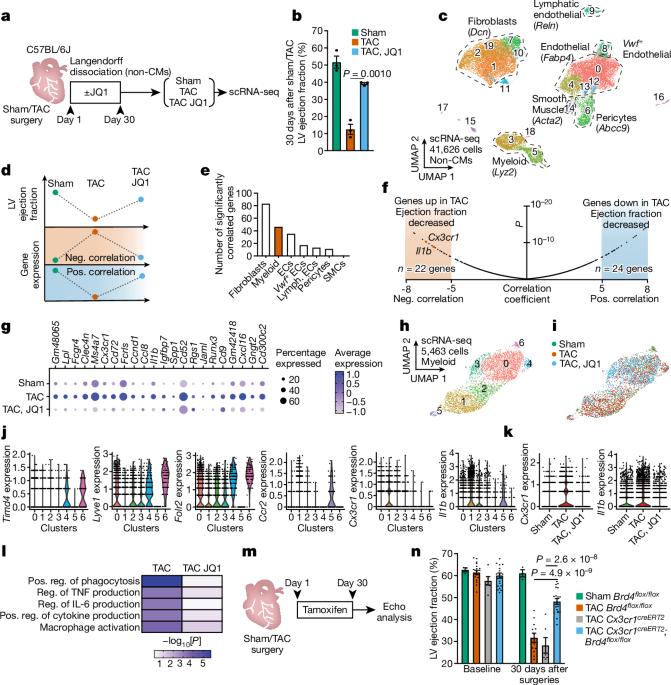
Chronic inflammation and tissue fibrosis are common responses that worsen organ function, yet the molecular mechanisms governing their cross-talk are poorly understood. In diseased organs, stress-induced gene expression changes fuel maladaptive cell state transitions1 and pathological interaction between cellular compartments. Although chronic fibroblast activation worsens dysfunction in the lungs, liver, kidneys and heart, and exacerbates many cancers2, the stress-sensing mechanisms initiating transcriptional activation of fibroblasts are poorly understood. Here we show that conditional deletion of the transcriptional co-activator Brd4 in infiltrating Cx3cr1+ macrophages ameliorates heart failure in mice and significantly reduces fibroblast activation. Analysis of single-cell chromatin accessibility and BRD4 occupancy in vivo in Cx3cr1+ cells identified a large enhancer proximal to interleukin-1β (IL-1β, encoded by Il1b), and a series of CRISPR-based deletions revealed the precise stress-dependent regulatory element that controls Il1b expression. Secreted IL-1β activated a fibroblast RELA-dependent (also known as p65) enhancer near the transcription factor MEOX1, resulting in a profibrotic response in human cardiac fibroblasts. In vivo, antibody-mediated IL-1β neutralization improved cardiac function and tissue fibrosis in heart failure. Systemic IL-1β inhibition or targeted Il1b deletion in Cx3cr1+ cells prevented stress-induced Meox1 expression and fibroblast activation. The elucidation of BRD4-dependent cross-talk between a specific immune cell subset and fibroblasts through IL-1β reveals how inflammation drives profibrotic cell states and supports strategies that modulate this process in heart disease and other chronic inflammatory disorders featuring tissue remodelling. Conditional deletion of the transcriptional co-activator Brd4 in infiltrating Cx3cr1+ mouse macrophages ameliorates heart failure and substantially reduces fibroblast activation.
期刊介绍:
Nature is a prestigious international journal that publishes peer-reviewed research in various scientific and technological fields. The selection of articles is based on criteria such as originality, importance, interdisciplinary relevance, timeliness, accessibility, elegance, and surprising conclusions. In addition to showcasing significant scientific advances, Nature delivers rapid, authoritative, insightful news, and interpretation of current and upcoming trends impacting science, scientists, and the broader public. The journal serves a dual purpose: firstly, to promptly share noteworthy scientific advances and foster discussions among scientists, and secondly, to ensure the swift dissemination of scientific results globally, emphasizing their significance for knowledge, culture, and daily life.



 京公网安备 11010802042870号
京ICP备2023020795号-1
京公网安备 11010802042870号
京ICP备2023020795号-1

 分享
分享
 求助内容:
求助内容: 应助结果提醒方式:
 扫码关注我们
