A. B. Kuznetsov, A. Y. Jamous, M. I. Rakhmanova, E. A. Simonova, V. A. Svetlichnyi, A. E. Kokh, V. N. Yudin, S. F. Solodovnikov, V. S. Shevchenko and K. A. Kokh
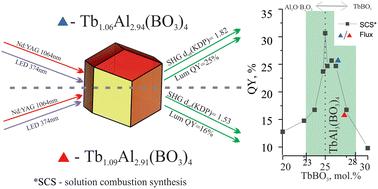
{"title":"Nonstoichiometry as a hidden aspect of TbAl3(BO3)4 optical properties†","authors":"A. B. Kuznetsov, A. Y. Jamous, M. I. Rakhmanova, E. A. Simonova, V. A. Svetlichnyi, A. E. Kokh, V. N. Yudin, S. F. Solodovnikov, V. S. Shevchenko and K. A. Kokh","doi":"10.1039/D4DT02695K","DOIUrl":null,"url":null,"abstract":"<p >TbAl<small><sub>3</sub></small>(BO<small><sub>3</sub></small>)<small><sub>4</sub></small> should not be considered as a strictly stoichiometric compound. A variety of Tb<small><sub>1+<em>x</em></sub></small>Al<small><sub>3−<em>x</em></sub></small>(BO<small><sub>3</sub></small>)<small><sub>4</sub></small> (<em>x</em> = −0.1–0.15) single phase compositions with the <em>R</em>32 space group were synthesized in the TbBO<small><sub>3</sub></small>–(Al<small><sub>2</sub></small>O<small><sub>3</sub></small>·B<small><sub>2</sub></small>O<small><sub>3</sub></small>) system. The K<small><sub>2</sub></small>Mo<small><sub>3</sub></small>O<small><sub>10</sub></small>–B<small><sub>2</sub></small>O<small><sub>3</sub></small>–Al<small><sub>2</sub></small>O<small><sub>3</sub></small> flux was used to grow Tb<small><sub>1+<em>x</em></sub></small>Al<small><sub>3−<em>x</em></sub></small>(BO<small><sub>3</sub></small>)<small><sub>4</sub></small> (<em>x</em> = 0.06 and 0.09) crystals. The orthoborates have typical luminescence in the green range which correlated with the <small><sup>5</sup></small>D<small><sub>3</sub></small> → <small><sup>7</sup></small>F<small><sub>6</sub></small> electron transition of Tb<small><sup>3+</sup></small>. However, deviating from stoichiometry can result in halving the quantum efficiency of luminescence. The SHG efficiency from 1064 nm radiation for Tb<small><sub>1+<em>x</em></sub></small>Al<small><sub>3−<em>x</em></sub></small>(BO<small><sub>3</sub></small>)<small><sub>4</sub></small> crystals (<em>x</em> = 0.06 and 0.09) was found to be 1.82 and 1.53 times higher than that of KDP, respectively.</p>","PeriodicalId":71,"journal":{"name":"Dalton Transactions","volume":" 46","pages":" 18653-18661"},"PeriodicalIF":3.3000,"publicationDate":"2024-10-24","publicationTypes":"Journal Article","fieldsOfStudy":null,"isOpenAccess":false,"openAccessPdf":"","citationCount":"0","resultStr":null,"platform":"Semanticscholar","paperid":null,"PeriodicalName":"Dalton Transactions","FirstCategoryId":"92","ListUrlMain":"https://pubs.rsc.org/en/content/articlelanding/2024/dt/d4dt02695k","RegionNum":3,"RegionCategory":"化学","ArticlePicture":[],"TitleCN":null,"AbstractTextCN":null,"PMCID":null,"EPubDate":"","PubModel":"","JCR":"Q2","JCRName":"CHEMISTRY, INORGANIC & NUCLEAR","Score":null,"Total":0}
引用次数: 0
Abstract
TbAl3(BO3)4 should not be considered as a strictly stoichiometric compound. A variety of Tb1+xAl3−x(BO3)4 (x = −0.1–0.15) single phase compositions with the R32 space group were synthesized in the TbBO3–(Al2O3·B2O3) system. The K2Mo3O10–B2O3–Al2O3 flux was used to grow Tb1+xAl3−x(BO3)4 (x = 0.06 and 0.09) crystals. The orthoborates have typical luminescence in the green range which correlated with the 5D3 → 7F6 electron transition of Tb3+. However, deviating from stoichiometry can result in halving the quantum efficiency of luminescence. The SHG efficiency from 1064 nm radiation for Tb1+xAl3−x(BO3)4 crystals (x = 0.06 and 0.09) was found to be 1.82 and 1.53 times higher than that of KDP, respectively.
期刊介绍:
Dalton Transactions is a journal for all areas of inorganic chemistry, which encompasses the organometallic, bioinorganic and materials chemistry of the elements, with applications including synthesis, catalysis, energy conversion/storage, electrical devices and medicine. Dalton Transactions welcomes high-quality, original submissions in all of these areas and more, where the advancement of knowledge in inorganic chemistry is significant.




 京公网安备 11010802042870号
京ICP备2023020795号-1
京公网安备 11010802042870号
京ICP备2023020795号-1

 分享
分享
 求助内容:
求助内容: 应助结果提醒方式:
 扫码关注我们
