Vanessa Sciacca, Christian Sohns, Harry J.G.M. Crijns, Nassir F. Marrouche, Rene Schramm, Maximilian Moersdorf, Thomas Fink, Leonard Bergau, Gerhard Hindricks, Nikolaos Dagres, Samuel Sossalla, Angelika Costard-Jaeckle, Henrik Fox, Mustapha El Hamriti, Frank Konietschke, Volker Rudolph, Jan Gummert, Jan G.P. Tijssen, Philipp Sommer, for the CASTLE HTx Investigators
{"title":"Effects of atrial fibrillation ablation on arrhythmia burden and ventricular function in end-stage heart failure: Lessons from CASTLE-HTx","authors":"Vanessa Sciacca, Christian Sohns, Harry J.G.M. Crijns, Nassir F. Marrouche, Rene Schramm, Maximilian Moersdorf, Thomas Fink, Leonard Bergau, Gerhard Hindricks, Nikolaos Dagres, Samuel Sossalla, Angelika Costard-Jaeckle, Henrik Fox, Mustapha El Hamriti, Frank Konietschke, Volker Rudolph, Jan Gummert, Jan G.P. Tijssen, Philipp Sommer, for the CASTLE HTx Investigators","doi":"10.1002/ejhf.3505","DOIUrl":null,"url":null,"abstract":"<div>\n \n \n <section>\n \n <h3> Aims</h3>\n \n <p>The CASTLE-HTx trial showed the benefit of atrial fibrillation (AF) ablation compared to medical therapy in decreasing mortality, need for left ventricular assist device implantation or heart transplantation (HTx) in patients with end-stage heart failure (HF). Herein we describe the effects of catheter ablation on AF burden, arrhythmia recurrences, and ventricular function in end-stage HF.</p>\n </section>\n \n <section>\n \n <h3> Methods and results</h3>\n \n <p>The CASTLE-HTx protocol randomized 194 patients in end-stage HF with AF to catheter ablation and medical therapy or medical therapy alone. AF burden, left ventricular ejection fraction (LVEF), and type of AF were assessed at baseline and at each follow-up visit. Overall, 97 patients received ablation; 66 patients (68%) underwent pulmonary vein isolation (PVI) and 31 patients (32%) were treated with PVI and additional ablation. Electroanatomic mapping showed the extent of left atrial low voltage (cardiomyopathy) >10% in 31 (31.9%) patients. At 12 months post-ablation, persistent AF was present in 31/89 patients (34.8%), which was significantly less frequent compared to baseline (<i>p</i> = 0.0001). Median AF burden reduction was 36.3 (interquartile range 13.6–63.3) percentage points at 12 months and LVEF improved from 29.2 ± 6.2% to 39.1 ± 8.3% (<i>p</i> < 0.001) following ablation. AF burden reduction <50% was significantly associated with LVEF improvement ≥5% at 12 months after ablation (<i>p</i> = 0.017).</p>\n </section>\n \n <section>\n \n <h3> Conclusion</h3>\n \n <p>Atrial fibrillation ablation in end-stage HF leads to a substantial decrease in AF burden, a regression from persistent to paroxysmal AF and notably improved LVEF. Favourable ablation outcomes were observed in patients regardless of the presence or absence of signs indicating left atrial cardiomyopathy.</p>\n </section>\n </div>","PeriodicalId":164,"journal":{"name":"European Journal of Heart Failure","volume":"27 2","pages":"255-263"},"PeriodicalIF":10.8000,"publicationDate":"2024-10-24","publicationTypes":"Journal Article","fieldsOfStudy":null,"isOpenAccess":false,"openAccessPdf":"https://onlinelibrary.wiley.com/doi/epdf/10.1002/ejhf.3505","citationCount":"0","resultStr":null,"platform":"Semanticscholar","paperid":null,"PeriodicalName":"European Journal of Heart Failure","FirstCategoryId":"3","ListUrlMain":"https://onlinelibrary.wiley.com/doi/10.1002/ejhf.3505","RegionNum":1,"RegionCategory":"医学","ArticlePicture":[],"TitleCN":null,"AbstractTextCN":null,"PMCID":null,"EPubDate":"","PubModel":"","JCR":"Q1","JCRName":"CARDIAC & CARDIOVASCULAR SYSTEMS","Score":null,"Total":0}
引用次数: 0
Abstract
Aims
The CASTLE-HTx trial showed the benefit of atrial fibrillation (AF) ablation compared to medical therapy in decreasing mortality, need for left ventricular assist device implantation or heart transplantation (HTx) in patients with end-stage heart failure (HF). Herein we describe the effects of catheter ablation on AF burden, arrhythmia recurrences, and ventricular function in end-stage HF.
Methods and results
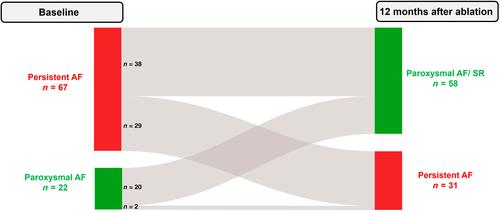
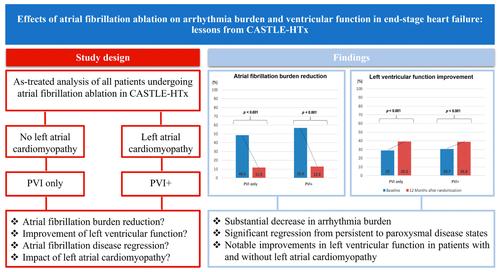
The CASTLE-HTx protocol randomized 194 patients in end-stage HF with AF to catheter ablation and medical therapy or medical therapy alone. AF burden, left ventricular ejection fraction (LVEF), and type of AF were assessed at baseline and at each follow-up visit. Overall, 97 patients received ablation; 66 patients (68%) underwent pulmonary vein isolation (PVI) and 31 patients (32%) were treated with PVI and additional ablation. Electroanatomic mapping showed the extent of left atrial low voltage (cardiomyopathy) >10% in 31 (31.9%) patients. At 12 months post-ablation, persistent AF was present in 31/89 patients (34.8%), which was significantly less frequent compared to baseline (p = 0.0001). Median AF burden reduction was 36.3 (interquartile range 13.6–63.3) percentage points at 12 months and LVEF improved from 29.2 ± 6.2% to 39.1 ± 8.3% (p < 0.001) following ablation. AF burden reduction <50% was significantly associated with LVEF improvement ≥5% at 12 months after ablation (p = 0.017).
Conclusion
Atrial fibrillation ablation in end-stage HF leads to a substantial decrease in AF burden, a regression from persistent to paroxysmal AF and notably improved LVEF. Favourable ablation outcomes were observed in patients regardless of the presence or absence of signs indicating left atrial cardiomyopathy.
期刊介绍:
European Journal of Heart Failure is an international journal dedicated to advancing knowledge in the field of heart failure management. The journal publishes reviews and editorials aimed at improving understanding, prevention, investigation, and treatment of heart failure. It covers various disciplines such as molecular and cellular biology, pathology, physiology, electrophysiology, pharmacology, clinical sciences, social sciences, and population sciences. The journal welcomes submissions of manuscripts on basic, clinical, and population sciences, as well as original contributions on nursing, care of the elderly, primary care, health economics, and other related specialist fields. It is published monthly and has a readership that includes cardiologists, emergency room physicians, intensivists, internists, general physicians, cardiac nurses, diabetologists, epidemiologists, basic scientists focusing on cardiovascular research, and those working in rehabilitation. The journal is abstracted and indexed in various databases such as Academic Search, Embase, MEDLINE/PubMed, and Science Citation Index.



 京公网安备 11010802042870号
京ICP备2023020795号-1
京公网安备 11010802042870号
京ICP备2023020795号-1

 分享
分享
 求助内容:
求助内容: 应助结果提醒方式:
 扫码关注我们
