Chunjing Zhang, Chenyang Song, Yuyan Ma, Li Chen, Yutao Niu, Liming Zhao, Ping Li, Yongyi Zhang, Zhengpeng Yang
{"title":"Phase change-mediated core-sheath 3D printing of hollow microlattice pseudocapacitive aerogel electrode with favorable electrochemical properties","authors":"Chunjing Zhang, Chenyang Song, Yuyan Ma, Li Chen, Yutao Niu, Liming Zhao, Ping Li, Yongyi Zhang, Zhengpeng Yang","doi":"10.1016/j.cej.2024.157014","DOIUrl":null,"url":null,"abstract":"Channel-interconnected regulation within 3D-printed pseudocapacitive electrode architecture to generate high active material loading/utilization and fast ion transport is pivotal but challenging for implementing high-performance pseudocapacitance system. Herein, we demonstrated an innovative phase change-mediated core-sheath direct ink writing (DIW) 3D printing strategy for controllably constructing pseudocapacitive hollow-microlattice graphene/NiCo<sub>2</sub>O<sub>4</sub> aerogel (HGNA) electrode, with regular hollow channels in printed filaments and abundant well-interconnected hierarchical pores built by jointing tortuous pseudocapacitive graphene nanosheets. The unique architectural features facilitated highly efficient diffusion and infiltration of substance throughout the entire thick filaments from both “interior-exterior” and “exterior-interior” directions, thereby enabling high-level yet effective loading of active materials as well as unimpeded ion transport across the printed bulk-structured electrode. Kinetics analysis revealed that the capacitance of pseudocapacitive HGNA electrode was primarily contributed from fast kinetic process. An asymmetric device assembled with DIW-printed HGNA electrode boasted a high energy storage performance with capacitance of 3.43 F cm<sup>−2</sup> and energy density of 1.01 mWh cm<sup>−2</sup>, while featuring remarkable cycling stability (87% after 8000 cycles) and superior capacity even at large electrode thickness. This work opens a promising route for processing rational pseudocapacitive electrode architectures toward high-capacity, fast-kinetics devices.","PeriodicalId":270,"journal":{"name":"Chemical Engineering Journal","volume":"3 1","pages":""},"PeriodicalIF":13.2000,"publicationDate":"2024-10-24","publicationTypes":"Journal Article","fieldsOfStudy":null,"isOpenAccess":false,"openAccessPdf":"","citationCount":"0","resultStr":null,"platform":"Semanticscholar","paperid":null,"PeriodicalName":"Chemical Engineering Journal","FirstCategoryId":"5","ListUrlMain":"https://doi.org/10.1016/j.cej.2024.157014","RegionNum":1,"RegionCategory":"工程技术","ArticlePicture":[],"TitleCN":null,"AbstractTextCN":null,"PMCID":null,"EPubDate":"","PubModel":"","JCR":"Q1","JCRName":"ENGINEERING, CHEMICAL","Score":null,"Total":0}
引用次数: 0
Abstract
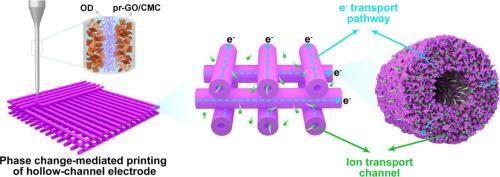
Channel-interconnected regulation within 3D-printed pseudocapacitive electrode architecture to generate high active material loading/utilization and fast ion transport is pivotal but challenging for implementing high-performance pseudocapacitance system. Herein, we demonstrated an innovative phase change-mediated core-sheath direct ink writing (DIW) 3D printing strategy for controllably constructing pseudocapacitive hollow-microlattice graphene/NiCo2O4 aerogel (HGNA) electrode, with regular hollow channels in printed filaments and abundant well-interconnected hierarchical pores built by jointing tortuous pseudocapacitive graphene nanosheets. The unique architectural features facilitated highly efficient diffusion and infiltration of substance throughout the entire thick filaments from both “interior-exterior” and “exterior-interior” directions, thereby enabling high-level yet effective loading of active materials as well as unimpeded ion transport across the printed bulk-structured electrode. Kinetics analysis revealed that the capacitance of pseudocapacitive HGNA electrode was primarily contributed from fast kinetic process. An asymmetric device assembled with DIW-printed HGNA electrode boasted a high energy storage performance with capacitance of 3.43 F cm−2 and energy density of 1.01 mWh cm−2, while featuring remarkable cycling stability (87% after 8000 cycles) and superior capacity even at large electrode thickness. This work opens a promising route for processing rational pseudocapacitive electrode architectures toward high-capacity, fast-kinetics devices.
期刊介绍:
The Chemical Engineering Journal is an international research journal that invites contributions of original and novel fundamental research. It aims to provide an international platform for presenting original fundamental research, interpretative reviews, and discussions on new developments in chemical engineering. The journal welcomes papers that describe novel theory and its practical application, as well as those that demonstrate the transfer of techniques from other disciplines. It also welcomes reports on carefully conducted experimental work that is soundly interpreted. The main focus of the journal is on original and rigorous research results that have broad significance. The Catalysis section within the Chemical Engineering Journal focuses specifically on Experimental and Theoretical studies in the fields of heterogeneous catalysis, molecular catalysis, and biocatalysis. These studies have industrial impact on various sectors such as chemicals, energy, materials, foods, healthcare, and environmental protection.




 京公网安备 11010802042870号
京ICP备2023020795号-1
京公网安备 11010802042870号
京ICP备2023020795号-1

 分享
分享
 求助内容:
求助内容: 应助结果提醒方式:
 扫码关注我们
