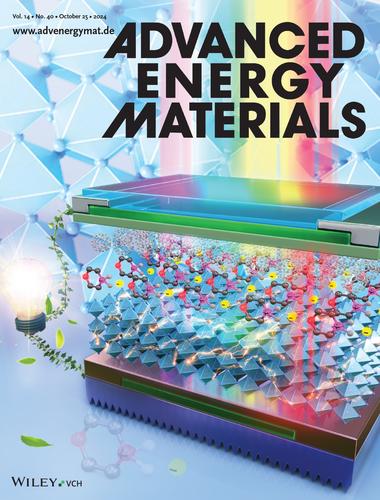
Reducing Voltage Loss via Dipole Tuning for Electron-Transport in Efficient and Stable Perovskite-Silicon Tandem Solar Cells (Adv. Energy Mater. 40/2024)
Guoliang Wang, Weiyuan Duan, Qing Lian, Md Arafat Mahmud, Tik Lun Leung, Chwenhaw Liao, Jueming Bing, Christopher Bailey, Jianpeng Yi, Runmin Tao, Jiong Yang, Xin Cui, Shuai Nie, Yan Zhu, Andreas Lambertz, Marko Jankovec, Marko Topič, Dane R. McCamey, Stephen Bremner, Ziv Hameiri, Kaining Ding, David Mckenzie, Jianghui Zheng, Anita Ho-Baillie
{"title":"Reducing Voltage Loss via Dipole Tuning for Electron-Transport in Efficient and Stable Perovskite-Silicon Tandem Solar Cells (Adv. Energy Mater. 40/2024)","authors":"Guoliang Wang, Weiyuan Duan, Qing Lian, Md Arafat Mahmud, Tik Lun Leung, Chwenhaw Liao, Jueming Bing, Christopher Bailey, Jianpeng Yi, Runmin Tao, Jiong Yang, Xin Cui, Shuai Nie, Yan Zhu, Andreas Lambertz, Marko Jankovec, Marko Topič, Dane R. McCamey, Stephen Bremner, Ziv Hameiri, Kaining Ding, David Mckenzie, Jianghui Zheng, Anita Ho-Baillie","doi":"10.1002/aenm.202470175","DOIUrl":null,"url":null,"abstract":"<p><b>Tandem Solar Cells</b></p><p>A dipole layer, morpholinium bromide (MLBr), at the perovskite/C<sub>60</sub> interface not only improves charge extraction but provides defect passivation and hydrophobicity improving cell stability. An encapsulated tandem experienced no degradation after 1000 hours of maximum power point tracking and retained 97% of initial power conversion efficiency after 400 Thermal Cycles (between −40 °C and 85 °C), twice the number recommended by the IEC61215 standard. More in article number 2401029, Kaining Ding, Jianghui Zheng, Anita Ho-Baillie, and co-workers.\n\n <figure>\n <div><picture>\n <source></source></picture><p></p>\n </div>\n </figure></p>","PeriodicalId":111,"journal":{"name":"Advanced Energy Materials","volume":"14 40","pages":""},"PeriodicalIF":26.0000,"publicationDate":"2024-10-24","publicationTypes":"Journal Article","fieldsOfStudy":null,"isOpenAccess":false,"openAccessPdf":"https://onlinelibrary.wiley.com/doi/epdf/10.1002/aenm.202470175","citationCount":"0","resultStr":null,"platform":"Semanticscholar","paperid":null,"PeriodicalName":"Advanced Energy Materials","FirstCategoryId":"88","ListUrlMain":"https://advanced.onlinelibrary.wiley.com/doi/10.1002/aenm.202470175","RegionNum":1,"RegionCategory":"材料科学","ArticlePicture":[],"TitleCN":null,"AbstractTextCN":null,"PMCID":null,"EPubDate":"","PubModel":"","JCR":"Q1","JCRName":"CHEMISTRY, PHYSICAL","Score":null,"Total":0}
引用次数: 0
Abstract
Tandem Solar Cells
A dipole layer, morpholinium bromide (MLBr), at the perovskite/C60 interface not only improves charge extraction but provides defect passivation and hydrophobicity improving cell stability. An encapsulated tandem experienced no degradation after 1000 hours of maximum power point tracking and retained 97% of initial power conversion efficiency after 400 Thermal Cycles (between −40 °C and 85 °C), twice the number recommended by the IEC61215 standard. More in article number 2401029, Kaining Ding, Jianghui Zheng, Anita Ho-Baillie, and co-workers.
期刊介绍:
Established in 2011, Advanced Energy Materials is an international, interdisciplinary, English-language journal that focuses on materials used in energy harvesting, conversion, and storage. It is regarded as a top-quality journal alongside Advanced Materials, Advanced Functional Materials, and Small.
With a 2022 Impact Factor of 27.8, Advanced Energy Materials is considered a prime source for the best energy-related research. The journal covers a wide range of topics in energy-related research, including organic and inorganic photovoltaics, batteries and supercapacitors, fuel cells, hydrogen generation and storage, thermoelectrics, water splitting and photocatalysis, solar fuels and thermosolar power, magnetocalorics, and piezoelectronics.
The readership of Advanced Energy Materials includes materials scientists, chemists, physicists, and engineers in both academia and industry. The journal is indexed in various databases and collections, such as Advanced Technologies & Aerospace Database, FIZ Karlsruhe, INSPEC (IET), Science Citation Index Expanded, Technology Collection, and Web of Science, among others.





 京公网安备 11010802042870号
京ICP备2023020795号-1
京公网安备 11010802042870号
京ICP备2023020795号-1

 分享
分享
 求助内容:
求助内容: 应助结果提醒方式:
 扫码关注我们
