{"title":"COL3a simultaneously regulates flowering and branching to improve grain yield in soybean","authors":"Chaosheng Gao, Jiazhi Yuan, Jianwei Lu, Wei Ye, Jianyi Zhi, Yongli Li, Weiwei Li, Mingming Sun, Fanjiang Kong, Baohui Liu, Qun Cheng, Lidong Dong","doi":"10.1111/pbi.14489","DOIUrl":null,"url":null,"abstract":"<p>Soybean production in low-latitude regions is more than 50 per cent of the total worldwide production (United States Department of Agriculture, 2023). Therefore, it is very important to increase soybean yield in low-latitude regions. The branching number and flowering time are the major factors affecting soybean grain yield (Fang <i>et al</i>., <span>2024</span>). Delaying flowering and maturity, and increasing the branch number can improve the final soybean yield by increasing the number of pods per plant (Dong <i>et al</i>., <span>2021</span>; Sun <i>et al</i>., <span>2019</span>). For example, the branch number was significantly increased and flowering time was delayed in the <i>ap1</i> quadruple mutant and <i>dt2</i> mutant, improving grain yield in soybean (Chen <i>et al</i>., <span>2020</span>; Liang <i>et al</i>., <span>2022</span>). Therefore, modulating the branch number and maturity are crucial for high-yield soybean breeding. However, only a few genes that regulating both branch number and flowering time have been identified.</p><p>In total, 26 CONSTANS (CO) homologues have been identified in soybean, but only the functions of <i>COL1a</i>, <i>COL1b</i>, <i>COL2a</i> and <i>COL2b</i> have been reported (Wu <i>et al</i>., <span>2014</span>). In this study, two independent T<sub>5</sub>-generations of transgenic soybean lines that homozygous <i>COL3a</i>-overexpressing (<i>COL3a</i>-OE) were obtained (Figure 1a,b), and used to examine the agronomic traits under natural short-day (SD) and long-day (LD) field conditions in Guangzhou and Shijiazhuang, respectively. The results showed that <i>COL3a</i>-OE transgenic lines flowered and matured significantly later than the wild-type Williams 82 (W82) in the field of Guangzhou (Figure 1c–e) and Shijiazhuang (Figure 1f,g). In addition, <i>COL3a</i>-OE transgenic lines exhibited significantly increased branch numbers and improved overall grain yields compared to that of wild-type W82 (Figure 1d–g). We generated loss-of-function mutants of <i>COL3a</i> (named <i>col3a</i><sup><i>CR</i></sup>) on a W82 background using the CRISPR/Cas9-mediated gene editing (Figure S1a–c) to further investigate the function of <i>COL3a</i>. DNA sequencing identified a <i>col3a</i><sup><i>CR</i></sup> mutant carrying a 76-bp nucleotide deletion between targets 1 and 2, and a frameshift mutation was introduced (Figure S1a–c). There was no significant difference between the <i>col3a</i><sup><i>CR</i></sup> mutant and wild-type W82 under SD or LD conditions in the growth chamber (Figure S1d–g). We speculated that the functionally redundant of duplicated homologous genes are one of the main reasons why the <i>col3a</i><sup><i>CR</i></sup> mutant has no phenotype. These results showed that the overexpression of <i>COL3a</i> significantly enhanced grain yield by increasing branch number and delaying maturity in soybean.</p><p>The expression pattern of <i>COL3a</i> was firstly investigated in different soybean organs to understand the molecular mechanism of how COL3a regulate flowering and branching in soybeans. The results showed that <i>COL3a</i> was constitutively expressed in flowers, leaves, stems, roots and shoot apexes, but it was highly expressed in the leaves (Figure S2a). The subcellular localization of the COL3a protein was also determined in Arabidopsis protoplasts. We found that the COL3a-GFP fusion protein was located in the nucleus, whereas the GFP control was located primarily in the nucleus and cytoplasm (Figure S2b).</p><p>Previous studies have shown that the legume-specific <i>E1</i> gene plays a central role in photoperiod-regulated flowering and maturity (Xia <i>et al</i>., <span>2012</span>) by regulating the expression of <i>FT</i>2a and <i>FT5a</i> genes in soybean. We first investigated <i>E1</i> expression in <i>COL3a</i>-OE and W82 soybean plants to test whether COL3a can regulate the expression of <i>E1</i>. The transcription level of <i>E1</i> was higher in the <i>COL3a</i>-OE than in W82 plants (Figure 1h), and <i>FT2a</i> and <i>FT5a</i> expression levels were lower in <i>COL3a</i>-OE plants than in W82 plants (Figure S3a,b). Transient expression assays also showed that COL3a induced the expression of the <i>pE1::LUC</i> reporter gene (Figure 1i). Chromatin immunoprecipitation (ChIP)-qPCR revealed that COL3a was directly associated with the <i>E1</i> promoter regions containing a core-like-motif (CCACA, Figure 1j). We crossed <i>COL3a-</i>OE2 with <i>e1</i><sup><i>CR</i></sup> mutant in W82 background to develop <i>COL3a-</i>OE2<i>/e1</i><sup><i>CR</i></sup> lines and subjected them to phenotypic evaluation to further explore the genetic interaction of <i>COL3a</i> and <i>E1</i>. The <i>COL3a</i>-OE2 plants showed delayed flowering in both the <i>e1</i><sup><i>as</i></sup> and <i>e1</i><sup><i>CR</i></sup> genetic backgrounds; however, the effect was weaker in the <i>e1</i><sup><i>CR</i></sup> background, implying that the full effect of COL3a on flowering mainly depends on <i>E1</i> (Figure 1k). These results combined indicated that COL3a directly binds to the promoter of <i>E1</i> and activates its expression. Notably, this is the first gene to be identified that directly activates <i>E1</i> expression in soybeans.</p><p>SQUAMOSA PROMOTER BINDING PROTEIN-LIKE (SPL) transcription factors play a critical role in regulating the number of soybean branches (Bao <i>et al</i>., <span>2019</span>; Sun <i>et al</i>., <span>2019</span>). We performed RT-qPCR assay on <i>COL3a-</i>OE2 and W82 soybean plants to test whether COL3a can regulate expression <i>SPL</i> genes to control branch number in soybean shoot apex. The results showed that a large number of <i>SPL</i> genes were down-regulated in <i>COL3a-</i>OE2 transgenic soybean plants compared to wild-type W82 (Figure 1l), including <i>SPL9a</i> and <i>SPL9b</i>, which have been confirmed to increase branching in soybeans (Bao <i>et al</i>., <span>2019</span>).</p><p>The natural variation of the <i>COL3a</i> coding sequence was analysed in 617 previously resequenced soybean accessions, including 177 wild, 28 landrace and 412 cultivar soybeans (Dong <i>et al</i>., <span>2022</span>; Kou <i>et al</i>., <span>2022</span>) to explore the evolutionary origin of the different alleles in <i>COL3a</i>. Two unique, high-confidence haplotypes were identified in <i>COL3a</i> gene. The 6-bp deletion in haplotype 2 (<i>COL3a</i><sup><i>H2</i></sup>) was identical to that of all other COL3 homologues in legumes, suggesting that <i>COL3a</i><sup><i>H2</i></sup> is the original haplotype in soybean (Figure 1m,n). A dual-luciferase transient expression assay showed that <i>COL3a</i><sup><i>H2</i></sup> has a stronger ability to activate the expression of <i>E1</i> than <i>COL3a</i><sup><i>H1</i></sup> (Figure S4). Varieties carrying <i>COL3a</i><sup><i>H2</i></sup> showed delayed flowering compared to that of <i>COL3a</i><sup><i>H1</i></sup> (Figure 1o,p). Next, we examined the percentages of the different alleles in the improved cultivars, landraces and wild soybeans in our panel of 617 resequenced accessions. The <i>COL3a</i><sup><i>H1</i></sup> allele was present in 43.7% of the wild soybeans, whereas <i>COL3a</i><sup><i>H2</i></sup> was present in 56.3%, indicating that the <i>COL3a</i><sup><i>H2</i></sup> allele is a major genetic variant in wild soybeans (Figure 1m). The frequency of <i>COL3a</i><sup><i>H1</i></sup> increased to 96.4% and 99.8% in the landraces and cultivars, respectively, suggesting that <i>COL3a</i><sup><i>H1</i></sup> have been underwent strong artificial selection during post-domestication (Figure 1m). We further identified strong evidence of selection in a region of 108 kb that contains <i>COL3a</i> gene and 17 other genes (Figure 1p and Table S1). These results suggested that the <i>COL3a</i><sup><i>H1</i></sup> allele is targeted by selection, thereby causing its rapid accumulation in domesticated soybeans.</p><p>In conclusion, we identified that the <i>COL3a</i> gene play a key role in regulating maturity and branch number to control grain yield in soybean and that the earlier flowering alleles of <i>COL3a</i><sup><i>HI</i></sup> have undergone artificial selection in modern cultivar soybean in high-latitude regions. Our findings also provide a biotechnological strategy for introducing <i>COL3a</i><sup><i>H2</i></sup> allele into modern soybean to create high-yielding soybean in low latitude by delaying flowering and increasing branch number.</p><p>The authors declare that they have no competing interests.</p><p>LD and QC designed the research; CG, JL, WY, JZ, JY, YL and WL performed the experiments; MS, FK, LD and QC performed data analyses; LD and BH wrote the manuscript.</p>","PeriodicalId":221,"journal":{"name":"Plant Biotechnology Journal","volume":"23 1","pages":"201-203"},"PeriodicalIF":10.5000,"publicationDate":"2024-10-24","publicationTypes":"Journal Article","fieldsOfStudy":null,"isOpenAccess":false,"openAccessPdf":"https://onlinelibrary.wiley.com/doi/epdf/10.1111/pbi.14489","citationCount":"0","resultStr":null,"platform":"Semanticscholar","paperid":null,"PeriodicalName":"Plant Biotechnology Journal","FirstCategoryId":"5","ListUrlMain":"https://onlinelibrary.wiley.com/doi/10.1111/pbi.14489","RegionNum":1,"RegionCategory":"生物学","ArticlePicture":[],"TitleCN":null,"AbstractTextCN":null,"PMCID":null,"EPubDate":"","PubModel":"","JCR":"Q1","JCRName":"BIOTECHNOLOGY & APPLIED MICROBIOLOGY","Score":null,"Total":0}
引用次数: 0
Abstract
Soybean production in low-latitude regions is more than 50 per cent of the total worldwide production (United States Department of Agriculture, 2023). Therefore, it is very important to increase soybean yield in low-latitude regions. The branching number and flowering time are the major factors affecting soybean grain yield (Fang et al., 2024). Delaying flowering and maturity, and increasing the branch number can improve the final soybean yield by increasing the number of pods per plant (Dong et al., 2021; Sun et al., 2019). For example, the branch number was significantly increased and flowering time was delayed in the ap1 quadruple mutant and dt2 mutant, improving grain yield in soybean (Chen et al., 2020; Liang et al., 2022). Therefore, modulating the branch number and maturity are crucial for high-yield soybean breeding. However, only a few genes that regulating both branch number and flowering time have been identified.
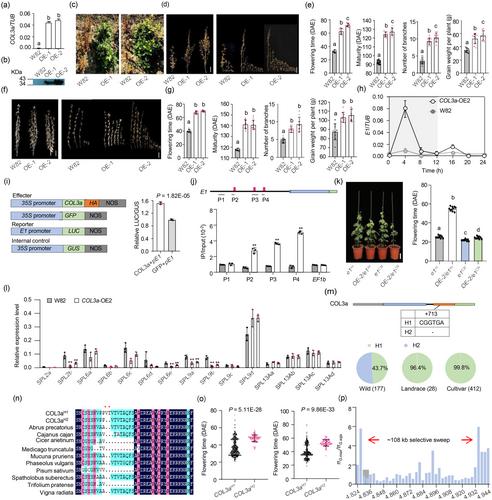
In total, 26 CONSTANS (CO) homologues have been identified in soybean, but only the functions of COL1a, COL1b, COL2a and COL2b have been reported (Wu et al., 2014). In this study, two independent T5-generations of transgenic soybean lines that homozygous COL3a-overexpressing (COL3a-OE) were obtained (Figure 1a,b), and used to examine the agronomic traits under natural short-day (SD) and long-day (LD) field conditions in Guangzhou and Shijiazhuang, respectively. The results showed that COL3a-OE transgenic lines flowered and matured significantly later than the wild-type Williams 82 (W82) in the field of Guangzhou (Figure 1c–e) and Shijiazhuang (Figure 1f,g). In addition, COL3a-OE transgenic lines exhibited significantly increased branch numbers and improved overall grain yields compared to that of wild-type W82 (Figure 1d–g). We generated loss-of-function mutants of COL3a (named col3aCR) on a W82 background using the CRISPR/Cas9-mediated gene editing (Figure S1a–c) to further investigate the function of COL3a. DNA sequencing identified a col3aCR mutant carrying a 76-bp nucleotide deletion between targets 1 and 2, and a frameshift mutation was introduced (Figure S1a–c). There was no significant difference between the col3aCR mutant and wild-type W82 under SD or LD conditions in the growth chamber (Figure S1d–g). We speculated that the functionally redundant of duplicated homologous genes are one of the main reasons why the col3aCR mutant has no phenotype. These results showed that the overexpression of COL3a significantly enhanced grain yield by increasing branch number and delaying maturity in soybean.
The expression pattern of COL3a was firstly investigated in different soybean organs to understand the molecular mechanism of how COL3a regulate flowering and branching in soybeans. The results showed that COL3a was constitutively expressed in flowers, leaves, stems, roots and shoot apexes, but it was highly expressed in the leaves (Figure S2a). The subcellular localization of the COL3a protein was also determined in Arabidopsis protoplasts. We found that the COL3a-GFP fusion protein was located in the nucleus, whereas the GFP control was located primarily in the nucleus and cytoplasm (Figure S2b).
Previous studies have shown that the legume-specific E1 gene plays a central role in photoperiod-regulated flowering and maturity (Xia et al., 2012) by regulating the expression of FT2a and FT5a genes in soybean. We first investigated E1 expression in COL3a-OE and W82 soybean plants to test whether COL3a can regulate the expression of E1. The transcription level of E1 was higher in the COL3a-OE than in W82 plants (Figure 1h), and FT2a and FT5a expression levels were lower in COL3a-OE plants than in W82 plants (Figure S3a,b). Transient expression assays also showed that COL3a induced the expression of the pE1::LUC reporter gene (Figure 1i). Chromatin immunoprecipitation (ChIP)-qPCR revealed that COL3a was directly associated with the E1 promoter regions containing a core-like-motif (CCACA, Figure 1j). We crossed COL3a-OE2 with e1CR mutant in W82 background to develop COL3a-OE2/e1CR lines and subjected them to phenotypic evaluation to further explore the genetic interaction of COL3a and E1. The COL3a-OE2 plants showed delayed flowering in both the e1as and e1CR genetic backgrounds; however, the effect was weaker in the e1CR background, implying that the full effect of COL3a on flowering mainly depends on E1 (Figure 1k). These results combined indicated that COL3a directly binds to the promoter of E1 and activates its expression. Notably, this is the first gene to be identified that directly activates E1 expression in soybeans.
SQUAMOSA PROMOTER BINDING PROTEIN-LIKE (SPL) transcription factors play a critical role in regulating the number of soybean branches (Bao et al., 2019; Sun et al., 2019). We performed RT-qPCR assay on COL3a-OE2 and W82 soybean plants to test whether COL3a can regulate expression SPL genes to control branch number in soybean shoot apex. The results showed that a large number of SPL genes were down-regulated in COL3a-OE2 transgenic soybean plants compared to wild-type W82 (Figure 1l), including SPL9a and SPL9b, which have been confirmed to increase branching in soybeans (Bao et al., 2019).
The natural variation of the COL3a coding sequence was analysed in 617 previously resequenced soybean accessions, including 177 wild, 28 landrace and 412 cultivar soybeans (Dong et al., 2022; Kou et al., 2022) to explore the evolutionary origin of the different alleles in COL3a. Two unique, high-confidence haplotypes were identified in COL3a gene. The 6-bp deletion in haplotype 2 (COL3aH2) was identical to that of all other COL3 homologues in legumes, suggesting that COL3aH2 is the original haplotype in soybean (Figure 1m,n). A dual-luciferase transient expression assay showed that COL3aH2 has a stronger ability to activate the expression of E1 than COL3aH1 (Figure S4). Varieties carrying COL3aH2 showed delayed flowering compared to that of COL3aH1 (Figure 1o,p). Next, we examined the percentages of the different alleles in the improved cultivars, landraces and wild soybeans in our panel of 617 resequenced accessions. The COL3aH1 allele was present in 43.7% of the wild soybeans, whereas COL3aH2 was present in 56.3%, indicating that the COL3aH2 allele is a major genetic variant in wild soybeans (Figure 1m). The frequency of COL3aH1 increased to 96.4% and 99.8% in the landraces and cultivars, respectively, suggesting that COL3aH1 have been underwent strong artificial selection during post-domestication (Figure 1m). We further identified strong evidence of selection in a region of 108 kb that contains COL3a gene and 17 other genes (Figure 1p and Table S1). These results suggested that the COL3aH1 allele is targeted by selection, thereby causing its rapid accumulation in domesticated soybeans.
In conclusion, we identified that the COL3a gene play a key role in regulating maturity and branch number to control grain yield in soybean and that the earlier flowering alleles of COL3aHI have undergone artificial selection in modern cultivar soybean in high-latitude regions. Our findings also provide a biotechnological strategy for introducing COL3aH2 allele into modern soybean to create high-yielding soybean in low latitude by delaying flowering and increasing branch number.
The authors declare that they have no competing interests.
LD and QC designed the research; CG, JL, WY, JZ, JY, YL and WL performed the experiments; MS, FK, LD and QC performed data analyses; LD and BH wrote the manuscript.
期刊介绍:
Plant Biotechnology Journal aspires to publish original research and insightful reviews of high impact, authored by prominent researchers in applied plant science. The journal places a special emphasis on molecular plant sciences and their practical applications through plant biotechnology. Our goal is to establish a platform for showcasing significant advances in the field, encompassing curiosity-driven studies with potential applications, strategic research in plant biotechnology, scientific analysis of crucial issues for the beneficial utilization of plant sciences, and assessments of the performance of plant biotechnology products in practical applications.



 京公网安备 11010802042870号
京ICP备2023020795号-1
京公网安备 11010802042870号
京ICP备2023020795号-1

 分享
分享
 求助内容:
求助内容: 应助结果提醒方式:
 扫码关注我们
