Si Chen, Zhengyan Pan, Jose R. Peralta-Videa and Lijuan Zhao
{"title":"Multi-omics revealed the mechanisms of AgNP-priming enhanced rice salinity tolerance†","authors":"Si Chen, Zhengyan Pan, Jose R. Peralta-Videa and Lijuan Zhao","doi":"10.1039/D4EN00685B","DOIUrl":null,"url":null,"abstract":"<p >Rice is highly susceptible to salt stress. Increasing the salt tolerance of rice is critical to reduce yield loss. Herein, we investigated the possibility of using an AgNP-based priming method (seed soaking (SP) and leaf spraying (LP)) to enhance rice salt tolerance. Under saline conditions, both SP (40 mg L<small><sup>−1</sup></small>) and LP (∼0.15 mg per plant) significantly increased the biomass (10.4–13.4%) and height (6.6–6.9%) of 6-week-old rice seedlings. In addition, SP significantly increased chlorophyll a (7.3%) and carotenoid (7.9%) content as well as total antioxidant capacity (10.5%), whereas it decreased malondialdehyde (MDA) content (16.9%) in rice leaves. These findings indicate that AgNP priming, especially SP, improved the salt tolerance of rice seedlings. A life cycle field study conducted in a real saline land revealed that SP significantly increased the rice grain yield by 25.8% compared to hydropriming. Multi-omics analyses demonstrated that AgNP priming induced metabolic and transcriptional reprogramming in both seeds and leaves. Notably, both SP and LP upregulated osmoprotectants in seeds and leaves. Furthermore, several transcriptional factors (TFs), such as WRKY and NAC, and salt-tolerance related genes, including the high-affinity K<small><sup>+</sup></small> channel gene (OsHKT2;4, OsHAK5), the Ca<small><sup>2+</sup></small>/proton exchanger (CAX4), and the cation/Ca<small><sup>2+</sup></small> exchanger (CCX4), were upregulated in leaves. Omics data provide a deep insight into the molecular mechanisms for enhanced salinity tolerance. Together, the results of this study suggest that seed priming with AgNPs can enhance the salt tolerance of rice and increase rice yield in saline soil, which provides an efficient and simple way to engineering salt-tolerant rice.</p>","PeriodicalId":73,"journal":{"name":"Environmental Science: Nano","volume":" 1","pages":" 466-480"},"PeriodicalIF":5.1000,"publicationDate":"2024-10-25","publicationTypes":"Journal Article","fieldsOfStudy":null,"isOpenAccess":false,"openAccessPdf":"","citationCount":"0","resultStr":null,"platform":"Semanticscholar","paperid":null,"PeriodicalName":"Environmental Science: Nano","FirstCategoryId":"6","ListUrlMain":"https://pubs.rsc.org/en/content/articlelanding/2025/en/d4en00685b","RegionNum":2,"RegionCategory":"环境科学与生态学","ArticlePicture":[],"TitleCN":null,"AbstractTextCN":null,"PMCID":null,"EPubDate":"","PubModel":"","JCR":"Q1","JCRName":"CHEMISTRY, MULTIDISCIPLINARY","Score":null,"Total":0}
引用次数: 0
Abstract
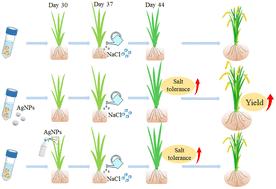
Rice is highly susceptible to salt stress. Increasing the salt tolerance of rice is critical to reduce yield loss. Herein, we investigated the possibility of using an AgNP-based priming method (seed soaking (SP) and leaf spraying (LP)) to enhance rice salt tolerance. Under saline conditions, both SP (40 mg L−1) and LP (∼0.15 mg per plant) significantly increased the biomass (10.4–13.4%) and height (6.6–6.9%) of 6-week-old rice seedlings. In addition, SP significantly increased chlorophyll a (7.3%) and carotenoid (7.9%) content as well as total antioxidant capacity (10.5%), whereas it decreased malondialdehyde (MDA) content (16.9%) in rice leaves. These findings indicate that AgNP priming, especially SP, improved the salt tolerance of rice seedlings. A life cycle field study conducted in a real saline land revealed that SP significantly increased the rice grain yield by 25.8% compared to hydropriming. Multi-omics analyses demonstrated that AgNP priming induced metabolic and transcriptional reprogramming in both seeds and leaves. Notably, both SP and LP upregulated osmoprotectants in seeds and leaves. Furthermore, several transcriptional factors (TFs), such as WRKY and NAC, and salt-tolerance related genes, including the high-affinity K+ channel gene (OsHKT2;4, OsHAK5), the Ca2+/proton exchanger (CAX4), and the cation/Ca2+ exchanger (CCX4), were upregulated in leaves. Omics data provide a deep insight into the molecular mechanisms for enhanced salinity tolerance. Together, the results of this study suggest that seed priming with AgNPs can enhance the salt tolerance of rice and increase rice yield in saline soil, which provides an efficient and simple way to engineering salt-tolerant rice.
期刊介绍:
Environmental Science: Nano serves as a comprehensive and high-impact peer-reviewed source of information on the design and demonstration of engineered nanomaterials for environment-based applications. It also covers the interactions between engineered, natural, and incidental nanomaterials with biological and environmental systems. This scope includes, but is not limited to, the following topic areas:
Novel nanomaterial-based applications for water, air, soil, food, and energy sustainability
Nanomaterial interactions with biological systems and nanotoxicology
Environmental fate, reactivity, and transformations of nanoscale materials
Nanoscale processes in the environment
Sustainable nanotechnology including rational nanomaterial design, life cycle assessment, risk/benefit analysis




 京公网安备 11010802042870号
京ICP备2023020795号-1
京公网安备 11010802042870号
京ICP备2023020795号-1

 分享
分享
 求助内容:
求助内容: 应助结果提醒方式:
 扫码关注我们
