Neuronal cathepsin S increases neuroinflammation and causes cognitive decline via CX3CL1-CX3CR1 axis and JAK2-STAT3 pathway in aging and Alzheimer's disease
{"title":"Neuronal cathepsin S increases neuroinflammation and causes cognitive decline via CX3CL1-CX3CR1 axis and JAK2-STAT3 pathway in aging and Alzheimer's disease","authors":"Pei-Pei Liu, Xiao-Hui Liu, Ming-Jing Ren, Xiao-Tong Liu, Xiao-Qing Shi, Ming-Li Li, Shu-Ang Li, Yang Yang, Dian-Dian Wang, Yue Wu, Fan-Xiang Yin, Yan-Hong Guo, Run-Zhou Yang, Meng Cheng, Yong-Juan Xin, Jian-Sheng Kang, Bing Huang, Kai-Di Ren","doi":"10.1111/acel.14393","DOIUrl":null,"url":null,"abstract":"<p>Aging is an intricate process involving interactions among multiple factors, which is one of the main risks for chronic diseases, including Alzheimer's disease (AD). As a member of cysteine protease, cathepsin S (CTSS) has been implicated in inflammation across various diseases. Here, we investigated the role of neuronal CTSS in aging and AD started by examining CTSS expression in hippocampus neurons of aging mice and identified a significant increase, which was negatively correlated with recognition abilities. Concurrently, we observed an elevation of CTSS concentration in the serum of elderly people. Transcriptome and fluorescence-activated cell sorting (FACS) results revealed that CTSS overexpression in neurons aggravated brain inflammatory milieu with microglia activation to M1 pro-inflammatory phenotype, activation of chemokine C-X3-C-motif ligand 1 (CX3CL1)—chemokine C-X3-C-motif receptor 1 (CX3CR1) axis and janus kinase 2 (JAK2)—signal transducer and activator of transcription 3 (STAT3) pathway. As CX3CL1 is secreted by neurons and acts on the CX3CR1 in microglia, our results revealed for the first time the role of neuron CTSS in neuron–microglia “crosstalk.” Besides, we observed elevated CTSS expression in multiple brain regions of AD patients, including the hippocampus. Utilizing CTSS selective inhibitor, LY3000328, rescued AD-related pathological features in <i>APP/PS1</i> mice. We further noticed that neuronal CTSS overexpression increased cathepsin B (CTSB) activity, but decreased cathepsin L (CTSL) activity in microglia. Overall, we provide evidence that CTSS can be used as an aging biomarker and plays regulatory roles through modulating neuroinflammation and recognition in aging and AD process.</p>","PeriodicalId":55543,"journal":{"name":"Aging Cell","volume":"24 2","pages":""},"PeriodicalIF":7.1000,"publicationDate":"2024-10-25","publicationTypes":"Journal Article","fieldsOfStudy":null,"isOpenAccess":false,"openAccessPdf":"https://onlinelibrary.wiley.com/doi/epdf/10.1111/acel.14393","citationCount":"0","resultStr":null,"platform":"Semanticscholar","paperid":null,"PeriodicalName":"Aging Cell","FirstCategoryId":"99","ListUrlMain":"https://onlinelibrary.wiley.com/doi/10.1111/acel.14393","RegionNum":1,"RegionCategory":"医学","ArticlePicture":[],"TitleCN":null,"AbstractTextCN":null,"PMCID":null,"EPubDate":"","PubModel":"","JCR":"Q1","JCRName":"Biochemistry, Genetics and Molecular Biology","Score":null,"Total":0}
引用次数: 0
Abstract
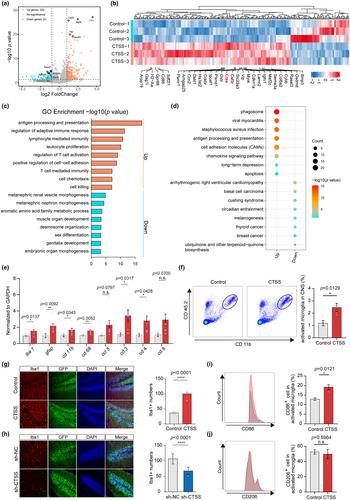
Aging is an intricate process involving interactions among multiple factors, which is one of the main risks for chronic diseases, including Alzheimer's disease (AD). As a member of cysteine protease, cathepsin S (CTSS) has been implicated in inflammation across various diseases. Here, we investigated the role of neuronal CTSS in aging and AD started by examining CTSS expression in hippocampus neurons of aging mice and identified a significant increase, which was negatively correlated with recognition abilities. Concurrently, we observed an elevation of CTSS concentration in the serum of elderly people. Transcriptome and fluorescence-activated cell sorting (FACS) results revealed that CTSS overexpression in neurons aggravated brain inflammatory milieu with microglia activation to M1 pro-inflammatory phenotype, activation of chemokine C-X3-C-motif ligand 1 (CX3CL1)—chemokine C-X3-C-motif receptor 1 (CX3CR1) axis and janus kinase 2 (JAK2)—signal transducer and activator of transcription 3 (STAT3) pathway. As CX3CL1 is secreted by neurons and acts on the CX3CR1 in microglia, our results revealed for the first time the role of neuron CTSS in neuron–microglia “crosstalk.” Besides, we observed elevated CTSS expression in multiple brain regions of AD patients, including the hippocampus. Utilizing CTSS selective inhibitor, LY3000328, rescued AD-related pathological features in APP/PS1 mice. We further noticed that neuronal CTSS overexpression increased cathepsin B (CTSB) activity, but decreased cathepsin L (CTSL) activity in microglia. Overall, we provide evidence that CTSS can be used as an aging biomarker and plays regulatory roles through modulating neuroinflammation and recognition in aging and AD process.
期刊介绍:
Aging Cell, an Open Access journal, delves into fundamental aspects of aging biology. It comprehensively explores geroscience, emphasizing research on the mechanisms underlying the aging process and the connections between aging and age-related diseases.



 京公网安备 11010802042870号
京ICP备2023020795号-1
京公网安备 11010802042870号
京ICP备2023020795号-1

 分享
分享
 求助内容:
求助内容: 应助结果提醒方式:
 扫码关注我们
