{"title":"Assessing Rapid Adaptation Through Epigenetic Inheritance: A New Experimental Approach","authors":"Meret Huber, Alexandra Chávez","doi":"10.1111/pce.15220","DOIUrl":null,"url":null,"abstract":"<p>The hallmark of evolutionary biology posits that species adapt to stresses through selection of phenotypic variants that arise from DNA sequence variation. Yet, increasing evidence shows that DNA sequence variation is not the sole source of heritable phenotypic variation: for instance, flowers of natural toadflax mutants develop radial instead of bilateral symmetry because a floral symmetry gene became hypermethylated (Cubas, Vincent, and Coen <span>1999</span>). Similarly, homeotic floral phenotypes in the oil palm arose during tissue culture because a homeotic gene is alternatively spliced upon spontaneous hypomethylation of an intron-located transposon (Ong-Abdullah et al. <span>2015</span>). Furthermore, fruit ripening in a spontaneous tomato mutant is hampered because a gene of the SBP-box family of transcription factors became hypermethylated and was thereby silenced (Manning et al. <span>2006</span>). These examples highlight that mechanisms other than DNA sequence variation may lead to heritable, variable, and fitness-relevant phenotypes, and as such they open up an exciting question: which role do mechanisms that generate heritable phenotypic variation in the absence of DNA sequence variation play in the adaptation to environmental stresses? Considering the ongoing loss of intraspecific genetic diversity and the rapid pace of environmental change (Des Roches et al. <span>2021</span>; Sage <span>2020</span>), answering this question is becoming increasingly relevant.</p><p>Heritable phenotypic variation that is not caused by DNA sequence changes may arise through so-called ‘nongenetic’ or ‘epigenetic’ inheritance (Bonduriansky and Day <span>2009</span>; O'Dea et al. <span>2016</span>). Epigenetic inheritance often refers to mechanisms that alter gene expression across generations through genome-associated mechanisms such as DNA methylation, histone modifications and small RNAs, whereas nongenetic inheritance includes any other mechanism such as the vertical transfer of microbes, nutrients or hormones (Bonduriansky and Day <span>2009</span>). To improve readability, we here use the term ‘epigenetic’ to refer to both epigenetic and all other nongenetic mechanisms, regardless of how many generations the traits are inherited.</p><p>Many types of epigenetic marks share two features: first, epigenetic marks may change spontaneously over generations in a largely stochastic manner (Becker et al. <span>2011</span>; Schmitz et al. <span>2011</span>), and second, the environment may alter epigenetic marks, and thereby lead to predictable phenotypic variation (Wibowo et al. <span>2016</span>; Zhang, Lang, and Zhu <span>2018</span>). Consequently, epigenetic inheritance may lead to stress adaptation through two fundamentally different routes: the ‘stochastic’ and the ‘deterministic’ route (Figure 1a) (Baugh and Day <span>2020</span>).</p><p>The stochastic route is comparable to the adaptive process that is based on DNA sequence variation. Here, spontaneous changes (‘epimutations’) arise either in the presence or absence of stress in a largely random manner. For instance, in <i>Arabidopsis thaliana</i>, variations in CG and to a much lower extent also CHG and CHH methylation (H = A, T, C) accumulate across generations (Becker et al. <span>2011</span>; Denkena, Johannes, and Colomé-Tatché <span>2021</span>; Schmitz et al. <span>2011</span>), and both the frequency and the spectrum of these spontaneous epimutations may be altered by stress (Jiang et al. <span>2014</span>; Johannes and Schmitz <span>2019</span>). In plants, these spontaneous epimutations are semistable, meaning that many epimutations are inherited across several generations but also frequently reverse (Johannes and Schmitz <span>2019</span>). Although most of these epimutations likely do not affect phenotypes, a few epimutations, particularly those that cover differentially methylated regions rather than individual cytosines (Denkena, Johannes, and Colomé-Tatché <span>2021</span>), could increase the phenotypic diversity in genetically uniform individuals upon which natural selection can act.</p><p>The deterministic route, in contrast, is not comparable to the adaptive process that is based on DNA sequence variation. In the deterministic route, also described as transgenerational plasticity and reviewed in Anastasiadi et al. (<span>2021</span>), environmental stresses induce epigenetic variation and thereby lead to predictable epigenetic variations that are shared among individuals (‘deterministic epialleles’). For instance, in <i>A. thaliana</i>, environmental stresses remodel CHG and CHH methylation in specific repeat sequences, which is associated with altered expression of stress-related genes nearby (Annacondia et al. <span>2021</span>; Luna et al. <span>2011</span>; Wibowo et al. <span>2016</span>). Such stress-induced epialleles are usually considered to have limited heritability, as they often vanish after maximally three offspring generations (Luna et al. <span>2011</span>; Wibowo et al. <span>2016</span>), and thus may be the consequence of the direct stress exposure during the early development of the offspring rather than being truly inherited (Grossniklaus et al. <span>2013</span>). Recent evidence, however, indicates that deterministic epialleles may be substantially more stable than anticipated: in the duckweed <i>Lemna minor</i>, heat stress remodelled CHG methylation, and part of this variation was still observed after at least three clonal generations under control conditions (Van Antro et al. <span>2023</span>). Similarly, in the closely related duckweed <i>S. polyrhiza</i>, copper excess induced variation in phenotypes and fitness that persisted for up to 10 clonal generations under control conditions (Huber, Gablenz, and Höfer <span>2021</span>). Furthermore, in the sexually reproducing <i>A. thaliana</i>, abiotic stresses induced gene expression changes that were retained even for four generations (Lin et al. <span>2024</span>). If deterministic epialleles are heritable across multiple generations, as these studies suggest, they may lead to rapid stress adaption even in the absence of selection.</p><p>While the stochastic route relies on random variation being selected upon, the deterministic route may allow populations to adapt in the absence of selection. Teasing apart these two routes is important in at least two reasons: first, the concept that species adapt through selection of beneficial variants is fundamental to evolutionary biology. The deterministic route of epigenetic adaptation would challenge this paradigm. Second, the deterministic route could be relevant for plant resistance in the field, particularly when intraspecific genetic variation is low, which is typical for crop species or endangered species. For instance, plants that are cultivated for seed production could be induced by a short-term environmental stress, thereby altering offspring resistance (Vázquez-Hernández et al. <span>2019</span>). Similarly, endangered species could be exposed to mild levels of an environmental stress that the species likely experience in its habitat, which may increase offspring performance and the likelihood that the species persists. Thus, teasing apart the stochastic and deterministic routes is fundamental to evolutionary theory and could inform breeders and conservation biologists about whether epigenetic inheritance might improve crop performance and the resilience of endangered species. Yet, assessing and teasing apart the stochastic and deterministic route is experimentally challenging.</p><p>Experiments that aim to test the deterministic route are relatively common (Baugh and Day <span>2020</span>; Huber, Gablenz, and Höfer <span>2021</span>; Luna et al. <span>2011</span>; Wibowo et al. <span>2016</span>). Usually, genetically uniform organisms are grown for multiple generations under different environments (‘pretreatment’) as single descendants—thereby minimizing the confounding effects of genetic variation and selection of beneficial (epi-) genetic variants (Baugh and Day <span>2020</span>). Subsequently, individuals are grown for at least three generations under control conditions to ensure that the organisms were not directly exposed to stress during their early development (Heard and Martienssen <span>2014</span>). Subsequently, fitness and epigenetic variation between the pretreatments are assessed and correlated to each other. Ideally, this experiment is accompanied with genetic or chemical manipulation of the epigenetic machinery and/or genes that are transgenerationally regulated to assess the underlying molecular mechanisms. While this approach is powerful to test the role of deterministic epialleles in stress adaptation, it does not allow to infer whether selection of stochastic variants may lead to stress adaptation.</p><p>Experiments that test whether stochastic epigenetic variants may mediate rapid stress adaption through natural selection are rather rare (Heckwolf et al. <span>2020</span>; Huber, Gablenz, and Höfer <span>2021</span>; Kronholm et al. <span>2017</span>; Schmid et al. <span>2018</span>), likely because of the experimental challenges. The most common approach is to grow large, genetically uniform populations for many generations under different environments (‘pretreatment’), subsequently grow individuals for a few generations under a shared control environment to erase environment-induced effects, and then compare fitness and epigenetic variation between the populations of the different pretreatments. The limitation of this approach is that during the pretreatment, populations simultaneously experience both selection of stochastic variants as well as the induction of deterministic epialleles—and if the deterministic epialleles are heritable for multiple generations, and show unexpected temporal inheritance patterns (Bell and Hellmann <span>2019</span>; Huber, Gablenz, and Höfer <span>2021</span>)—variation between the populations could be either due to selection of stochastic variants or heritable deterministic epialleles. To assess whether stochastic epigenetic variation may mediate rapid adaption through natural selection, we thus need an approach in which selection of stochastic variants can take place while teasing apart the contribution of deterministic epialleles.</p><p>Here, we propose an experimental approach that unifies both above-mentioned setups and thereby allows to simultaneously assess whether selection of stochastic variants and/or the formation of deterministic epialleles lead to rapid stress adaptation. One of the key differences between the stochastic and deterministic route is whether selection is needed—and as such, to differentiate among these two routes, one can manipulate the efficacy of selection. This can be achieved through the population size, as selection is most effective in large populations (McDonald <span>2019</span>; Wahl, Gerrish, and Saika-Voivod <span>2002</span>). We therefore propose to subject populations for several generations to different environments (‘pretreatments’) at two different population sizes.</p><p>On the one hand, one should grow the species in population sizes sufficiently large that selection is effective. As space is limited, these populations will need to be grown either under recurring bottlenecks, or under constant population sizes by randomly removing individuals or—in case of annuals—establishing the same population size each generation (Schmid et al. <span>2018</span>). It is difficult to predict how large the population size needs to be that selection is effective, because first, it is not trivial to infer the effective population size based on the—usually much larger—census population size (Frankham <span>2007</span>), and second, it is largely unclear how quickly epimutations accumulate and to which extent epimutations improve fitness (Johannes and Schmitz <span>2019</span>). To maximize the effective population size, one should keep the populations sizes as large as possible throughout the entire experiment. Particularly, the bottleneck size should not be smaller than 10% (Wahl, Gerrish, and Saika-Voivod <span>2002</span>). To increase the number of epimutations, one could use—if available—either epigenetic recombinant inbred lines (epiRILs) (Johannes et al. <span>2009</span>), which harbour substantial epigenetic but not genetic variation, or genetic mutants in which a gene in the epigenetic machinery is either impaired or newly introduced, which should increase the number of newly emerging epigenetic variants. Given sufficient fitness-relevant epigenetic variation and sufficiently large population size, these populations will undergo both the stochastic and deterministic route of adaptation.</p><p>On the other hand, one should grow the species in population sizes sufficiently small that selection is not effective, that is, that drift overcomes the effect of selection. This is achieved once the effective population size <i>N</i><sub>e</sub> < 1/s (s = selection coefficient) (McDonald <span>2019</span>; Nielsen and Slatkin <span>2013</span>); the smallest possible effective population size is obtained in single descendant lineages. Thus, the small population will evolve almost exclusively through drift, and thereby only undergo the deterministic route. Importantly, the large and small populations must be grown side by side in the very same environment to ensure that the stress level is equal for both population sizes and that the deterministic route is equally induced in the small and large populations.</p><p>After several generations of pretreatment, one can assess whether populations adapted to stress through the stochastic and/or deterministic route. To this end, individuals of the small and large populations of the different pretreatments are grown in a shared control environment for at least three generations to ensure that any variation is truly heritable. Subsequently, phenotypes and fitness under the different environments are compared. This allows differentiating whether selection of epigenetic variants and/or deterministic epialleles lead to rapid adaptation: if deterministic epialleles confer resistance, variation in resistance and epigenetic variation will arise between the small populations of the different pretreatments. If selection of epigenetic variants contributes to resistance, variation in resistance and in epigenetic variation will establish between the small and large population within each pretreatment (Figure 1b).</p><p>While the proposed experiment is in principle applicable to species across the tree of life, the species under investigation should have following characteristics:</p><p><i>Rapid reproduction and small body size</i>. As with all species used for experimental evolution, rapid reproduction and small body size are desirable.</p><p><i>Low genetic variation</i>. Teasing apart genetic from epigenetic effects is notoriously difficult, see discussion below. We thus suggest minimizing genetic variation by using clonally reproducing organisms or organisms that are highly inbred; ideally, genetic mutation rates should be small to reduce genetic variation that arise during the experiment.</p><p><i>Accurate assessments of fitness and epigenetic variation</i>. Measuring Darwinian fitness is critical when assessing adaptation—thus, direct fitness assessments (e.g., number of offspring) are preferred over indirect assessments such as phenotypes or altered performance of interacting species; such assessments are nevertheless valuable. Furthermore, the ability to measure epigenetic variation (e.g., DNA methylation, histone modification, small RNAs) in a largely unbiased, genome-wide manner and to link these variations to specific genes, is desirable. Although these analyses often require a reference genome, new developments in high-throughput sequencing will likely overcome some of the limitations of nonmodel species that do not have a high-quality reference genome or whose genome is prohibitively large (Amarasinghe et al. <span>2020</span>; Gawehns et al. <span>2022</span>).</p><p>In principle, both asexually as well as sexually reproducing species can be used for the proposed approach. The mode of reproduction will, however, affect how likely either the deterministic or stochastic route is. The deterministic route appears to be more likely in asexually reproducing than sexually reproducing plants, because stress-induced epigenetic mark seem to be more stable during mitotic, asexual reproduction compared to meiotic, sexual reproduction (Van Antro et al. <span>2023</span>; Wibowo et al. <span>2016</span>). The stochastic route is possible in both sexually as well as asexually reproducing plants, as in plants, spontaneous epimutations are heritable through both mitosis and meiosis (Becker et al. <span>2011</span>; Yao, Schmitz, and Johannes <span>2021</span>). Suitable asexually reproducing species include green algae, for example, <i>Chlamydomonas reinhardtii</i>, aquatic ferns such as <i>Azolla filiculoides</i>, <i>Salvinia cucullata</i>, <i>Marsilea quadrifolia</i> or <i>Regnellidium diphyllum</i>, and aquatic angiosperms including duckweeds or water pennyworts. Suitable sexually reproducing species include <i>A. thaliana, Lepidium sativum</i> and <i>Capsella bursa-pastoris</i>.</p><p>Here, we presented an experimental approach to test a long-standing controversy: whether epigenetic inheritance can lead to rapid adaptation to environmental stresses through stochastic or deterministic epigenetic variation. One of the major differences between the stochastic and deterministic route is whether selection is needed for adaptation. Thus, to tease apart the stochastic and deterministic route, we suggest manipulating the efficacy of selection through the population size by growing both small and large populations for many generations in different environments and subsequently assess whether variation in phenotypes, fitness or epigenetic marks establish between environments or population sizes. The deterministic route would yield variations between the small populations of the different pretreatments, whereas the stochastic route would result in differences between the small and large population within each pretreatment.</p><p>The advantage of the approach is that we can accurately assess which variations between the large populations of the different environments are due to selection and which variations due to the induction of deterministic epialleles. Alternative approaches, in which the deterministic epialleles are inferred by growing small populations separated from the large ones do not accurately mimic the biotic and abiotic conditions of the large populations and thus likely do not induce deterministic epialleles to a similar extent in the small and large populations. Similarly, it is not sufficient to grow the small populations only for short term in the environment of the large populations, as the duration of the stress may alter the induction of epigenetic marks and phenotypes, as well as their heritability (Huber, Gablenz, and Höfer <span>2021</span>). Thus, although growing the small populations alongside the large populations is tedious, this is needed to accurately assess whether variation in epigenetic marks or phenotypes is due to natural selection.</p><p>The disadvantage of the approach is that it relies on the assumption that the stochastic and deterministic route are separate, nonoverlapping entities. This, however, may not be the case. For instance, deterministic epialleles may be induced in a largely but not entirely deterministic manner: environmental stresses may simply increase the likelihood of an epiallele to appear but not cause all individuals changing their epigenetic status. Selection could thus still act on environment-induced ‘deterministic’ epialleles. Similar accounts for the stochastic epimutations: environmental stresses may increase the likelihood that certain epimutations appear, associated with epigenetic hotspots (Hazarika et al. <span>2022</span>; Zheng et al. <span>2017</span>), and thus epimutations may not be entirely stochastic. Are the stochastic and deterministic route therefore two extremes of the same process? One argument holds against this: in <i>A. thaliana</i>, spontaneous epimutations mostly accumulate in the CG context (Becker et al. <span>2011</span>; Denkena, Johannes, and Colomé-Tatché <span>2021</span>; Schmitz et al. <span>2011</span>; van der Graaf et al. <span>2015</span>) whereas environment-induced epialleles are most prominent in the CHG and/or CHH context (Annacondia et al. <span>2021</span>; Lin et al. <span>2022</span>; Wibowo et al. <span>2016</span>; Yadav et al. <span>2022</span>; Zhou et al. <span>2019</span>). This supports the idea that the stochastic and deterministic route are, at least in the context of DNA methylation in plants, two fundamentally different processes that can be teased apart using the proposed approach.</p><p>If the experiments reveals that the deterministic or stochastic route alters phenotypes or epigenetic marks, it will be critical to assess whether the underlying molecular mechanism is of genetic or epigenetic nature. Even when using highly inbred or clonally reproducing species, genetic mutations may accumulate and account for variation in phenotypes or epigenetic marks, particularly in the large populations and when using epigenetic mutants in which transposons are mobilized (Miura et al. <span>2001</span>). We suggest the following experiments and analyses to tease apart genetic from epigenetic effects: first, unbiased methods (e.g., high-throughput sequencing) should be deployed to screen for epigenetic variations. Second, transcriptome and proteome data should be generated to link fitness and phenotypes to gene expression and epigenetic variation. Third, differentially regulated genes or epigenetic machineries should be manipulated both genetically as well as chemically to test whether the identified genes or epigenetic machinery affect stress resistance or the process of stress adaptation. Ideally, site-specific manipulation of DNA methylation of candidate genes is performed (Papikian et al. <span>2019</span>). Fourth, phenotypes or fitness should be continuously assessed for multiple generations after stress release—if variations between groups have an epigenetic basis, the variation should diminish or at least change in some lineages over time. Fifth, high-throughput sequencing should be deployed to screen for genetic variation in identified genomic regions. While in isolation none of these approaches will provide a clear answer whether genetic or epigenetic mechanisms are at play, combining these approaches will be powerful to disentangle genetic and epigenetic factors.</p><p>The above-mentioned approach to identify and test the molecular mechanisms is promising particularly for the deterministic route, in which we expect all or at least most lineages carrying the same modifications. Identifying candidate genes or epigenetic marks involved in the stochastic route is more challenging, as we expect that each lineage carries different modifications. To narrow down the list of candidate genes that are epigenetically regulated, one could use a-priory knowledge about which genes contribute to resistance or are at least which genes are induced by the stress. While this approach may overlook some genes that are epigenetically regulated, the approach is a reasonable first step to identify the most promising candidate loci.</p><p>If experiments suggest that epigenetic inheritance leads to rapid adaptation, the question arises how fast and effective such adaptation is compared to adaptation based on genetic variation—either standing genetic variation or de novo mutations. This question is important, because in nature, genetic variation is usually present. To answer this question, one could compare experimentally evolved populations in which standing genetic variation is initially either present or absent. Furthermore, one could reverse de novo mutations in experimentally evolved populations using genetic engineering to quantify the effect of the mutations on plant fitness. Such experiments are important to infer how important epigenetic inheritance is for rapid adaption in nature.</p><p>Taken together, we here provide an experimental framework to assess the relative contribution of deterministic epialleles and selection of stochastic epigenetic variants to rapid stress adaptation. Through this approach, carefully designed experiments can provide novel insights whether and how epigenetic inheritance may lead to rapid stress adaptation. Considering the on-going loss of intraspecific genetic diversity and the rapid pace of environmental change, these insights may become increasingly relevant when assessing the species resilience during global change.</p><p>The authors declare no conflicts of interest.</p>","PeriodicalId":222,"journal":{"name":"Plant, Cell & Environment","volume":"48 2","pages":"1494-1499"},"PeriodicalIF":6.3000,"publicationDate":"2024-10-25","publicationTypes":"Journal Article","fieldsOfStudy":null,"isOpenAccess":false,"openAccessPdf":"https://www.ncbi.nlm.nih.gov/pmc/articles/PMC11695797/pdf/","citationCount":"0","resultStr":null,"platform":"Semanticscholar","paperid":null,"PeriodicalName":"Plant, Cell & Environment","FirstCategoryId":"2","ListUrlMain":"https://onlinelibrary.wiley.com/doi/10.1111/pce.15220","RegionNum":1,"RegionCategory":"生物学","ArticlePicture":[],"TitleCN":null,"AbstractTextCN":null,"PMCID":null,"EPubDate":"","PubModel":"","JCR":"Q1","JCRName":"PLANT SCIENCES","Score":null,"Total":0}
引用次数: 0
Abstract
The hallmark of evolutionary biology posits that species adapt to stresses through selection of phenotypic variants that arise from DNA sequence variation. Yet, increasing evidence shows that DNA sequence variation is not the sole source of heritable phenotypic variation: for instance, flowers of natural toadflax mutants develop radial instead of bilateral symmetry because a floral symmetry gene became hypermethylated (Cubas, Vincent, and Coen 1999). Similarly, homeotic floral phenotypes in the oil palm arose during tissue culture because a homeotic gene is alternatively spliced upon spontaneous hypomethylation of an intron-located transposon (Ong-Abdullah et al. 2015). Furthermore, fruit ripening in a spontaneous tomato mutant is hampered because a gene of the SBP-box family of transcription factors became hypermethylated and was thereby silenced (Manning et al. 2006). These examples highlight that mechanisms other than DNA sequence variation may lead to heritable, variable, and fitness-relevant phenotypes, and as such they open up an exciting question: which role do mechanisms that generate heritable phenotypic variation in the absence of DNA sequence variation play in the adaptation to environmental stresses? Considering the ongoing loss of intraspecific genetic diversity and the rapid pace of environmental change (Des Roches et al. 2021; Sage 2020), answering this question is becoming increasingly relevant.
Heritable phenotypic variation that is not caused by DNA sequence changes may arise through so-called ‘nongenetic’ or ‘epigenetic’ inheritance (Bonduriansky and Day 2009; O'Dea et al. 2016). Epigenetic inheritance often refers to mechanisms that alter gene expression across generations through genome-associated mechanisms such as DNA methylation, histone modifications and small RNAs, whereas nongenetic inheritance includes any other mechanism such as the vertical transfer of microbes, nutrients or hormones (Bonduriansky and Day 2009). To improve readability, we here use the term ‘epigenetic’ to refer to both epigenetic and all other nongenetic mechanisms, regardless of how many generations the traits are inherited.
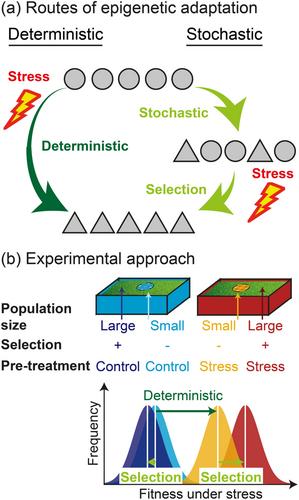
Many types of epigenetic marks share two features: first, epigenetic marks may change spontaneously over generations in a largely stochastic manner (Becker et al. 2011; Schmitz et al. 2011), and second, the environment may alter epigenetic marks, and thereby lead to predictable phenotypic variation (Wibowo et al. 2016; Zhang, Lang, and Zhu 2018). Consequently, epigenetic inheritance may lead to stress adaptation through two fundamentally different routes: the ‘stochastic’ and the ‘deterministic’ route (Figure 1a) (Baugh and Day 2020).
The stochastic route is comparable to the adaptive process that is based on DNA sequence variation. Here, spontaneous changes (‘epimutations’) arise either in the presence or absence of stress in a largely random manner. For instance, in Arabidopsis thaliana, variations in CG and to a much lower extent also CHG and CHH methylation (H = A, T, C) accumulate across generations (Becker et al. 2011; Denkena, Johannes, and Colomé-Tatché 2021; Schmitz et al. 2011), and both the frequency and the spectrum of these spontaneous epimutations may be altered by stress (Jiang et al. 2014; Johannes and Schmitz 2019). In plants, these spontaneous epimutations are semistable, meaning that many epimutations are inherited across several generations but also frequently reverse (Johannes and Schmitz 2019). Although most of these epimutations likely do not affect phenotypes, a few epimutations, particularly those that cover differentially methylated regions rather than individual cytosines (Denkena, Johannes, and Colomé-Tatché 2021), could increase the phenotypic diversity in genetically uniform individuals upon which natural selection can act.
The deterministic route, in contrast, is not comparable to the adaptive process that is based on DNA sequence variation. In the deterministic route, also described as transgenerational plasticity and reviewed in Anastasiadi et al. (2021), environmental stresses induce epigenetic variation and thereby lead to predictable epigenetic variations that are shared among individuals (‘deterministic epialleles’). For instance, in A. thaliana, environmental stresses remodel CHG and CHH methylation in specific repeat sequences, which is associated with altered expression of stress-related genes nearby (Annacondia et al. 2021; Luna et al. 2011; Wibowo et al. 2016). Such stress-induced epialleles are usually considered to have limited heritability, as they often vanish after maximally three offspring generations (Luna et al. 2011; Wibowo et al. 2016), and thus may be the consequence of the direct stress exposure during the early development of the offspring rather than being truly inherited (Grossniklaus et al. 2013). Recent evidence, however, indicates that deterministic epialleles may be substantially more stable than anticipated: in the duckweed Lemna minor, heat stress remodelled CHG methylation, and part of this variation was still observed after at least three clonal generations under control conditions (Van Antro et al. 2023). Similarly, in the closely related duckweed S. polyrhiza, copper excess induced variation in phenotypes and fitness that persisted for up to 10 clonal generations under control conditions (Huber, Gablenz, and Höfer 2021). Furthermore, in the sexually reproducing A. thaliana, abiotic stresses induced gene expression changes that were retained even for four generations (Lin et al. 2024). If deterministic epialleles are heritable across multiple generations, as these studies suggest, they may lead to rapid stress adaption even in the absence of selection.
While the stochastic route relies on random variation being selected upon, the deterministic route may allow populations to adapt in the absence of selection. Teasing apart these two routes is important in at least two reasons: first, the concept that species adapt through selection of beneficial variants is fundamental to evolutionary biology. The deterministic route of epigenetic adaptation would challenge this paradigm. Second, the deterministic route could be relevant for plant resistance in the field, particularly when intraspecific genetic variation is low, which is typical for crop species or endangered species. For instance, plants that are cultivated for seed production could be induced by a short-term environmental stress, thereby altering offspring resistance (Vázquez-Hernández et al. 2019). Similarly, endangered species could be exposed to mild levels of an environmental stress that the species likely experience in its habitat, which may increase offspring performance and the likelihood that the species persists. Thus, teasing apart the stochastic and deterministic routes is fundamental to evolutionary theory and could inform breeders and conservation biologists about whether epigenetic inheritance might improve crop performance and the resilience of endangered species. Yet, assessing and teasing apart the stochastic and deterministic route is experimentally challenging.
Experiments that aim to test the deterministic route are relatively common (Baugh and Day 2020; Huber, Gablenz, and Höfer 2021; Luna et al. 2011; Wibowo et al. 2016). Usually, genetically uniform organisms are grown for multiple generations under different environments (‘pretreatment’) as single descendants—thereby minimizing the confounding effects of genetic variation and selection of beneficial (epi-) genetic variants (Baugh and Day 2020). Subsequently, individuals are grown for at least three generations under control conditions to ensure that the organisms were not directly exposed to stress during their early development (Heard and Martienssen 2014). Subsequently, fitness and epigenetic variation between the pretreatments are assessed and correlated to each other. Ideally, this experiment is accompanied with genetic or chemical manipulation of the epigenetic machinery and/or genes that are transgenerationally regulated to assess the underlying molecular mechanisms. While this approach is powerful to test the role of deterministic epialleles in stress adaptation, it does not allow to infer whether selection of stochastic variants may lead to stress adaptation.
Experiments that test whether stochastic epigenetic variants may mediate rapid stress adaption through natural selection are rather rare (Heckwolf et al. 2020; Huber, Gablenz, and Höfer 2021; Kronholm et al. 2017; Schmid et al. 2018), likely because of the experimental challenges. The most common approach is to grow large, genetically uniform populations for many generations under different environments (‘pretreatment’), subsequently grow individuals for a few generations under a shared control environment to erase environment-induced effects, and then compare fitness and epigenetic variation between the populations of the different pretreatments. The limitation of this approach is that during the pretreatment, populations simultaneously experience both selection of stochastic variants as well as the induction of deterministic epialleles—and if the deterministic epialleles are heritable for multiple generations, and show unexpected temporal inheritance patterns (Bell and Hellmann 2019; Huber, Gablenz, and Höfer 2021)—variation between the populations could be either due to selection of stochastic variants or heritable deterministic epialleles. To assess whether stochastic epigenetic variation may mediate rapid adaption through natural selection, we thus need an approach in which selection of stochastic variants can take place while teasing apart the contribution of deterministic epialleles.
Here, we propose an experimental approach that unifies both above-mentioned setups and thereby allows to simultaneously assess whether selection of stochastic variants and/or the formation of deterministic epialleles lead to rapid stress adaptation. One of the key differences between the stochastic and deterministic route is whether selection is needed—and as such, to differentiate among these two routes, one can manipulate the efficacy of selection. This can be achieved through the population size, as selection is most effective in large populations (McDonald 2019; Wahl, Gerrish, and Saika-Voivod 2002). We therefore propose to subject populations for several generations to different environments (‘pretreatments’) at two different population sizes.
On the one hand, one should grow the species in population sizes sufficiently large that selection is effective. As space is limited, these populations will need to be grown either under recurring bottlenecks, or under constant population sizes by randomly removing individuals or—in case of annuals—establishing the same population size each generation (Schmid et al. 2018). It is difficult to predict how large the population size needs to be that selection is effective, because first, it is not trivial to infer the effective population size based on the—usually much larger—census population size (Frankham 2007), and second, it is largely unclear how quickly epimutations accumulate and to which extent epimutations improve fitness (Johannes and Schmitz 2019). To maximize the effective population size, one should keep the populations sizes as large as possible throughout the entire experiment. Particularly, the bottleneck size should not be smaller than 10% (Wahl, Gerrish, and Saika-Voivod 2002). To increase the number of epimutations, one could use—if available—either epigenetic recombinant inbred lines (epiRILs) (Johannes et al. 2009), which harbour substantial epigenetic but not genetic variation, or genetic mutants in which a gene in the epigenetic machinery is either impaired or newly introduced, which should increase the number of newly emerging epigenetic variants. Given sufficient fitness-relevant epigenetic variation and sufficiently large population size, these populations will undergo both the stochastic and deterministic route of adaptation.
On the other hand, one should grow the species in population sizes sufficiently small that selection is not effective, that is, that drift overcomes the effect of selection. This is achieved once the effective population size Ne < 1/s (s = selection coefficient) (McDonald 2019; Nielsen and Slatkin 2013); the smallest possible effective population size is obtained in single descendant lineages. Thus, the small population will evolve almost exclusively through drift, and thereby only undergo the deterministic route. Importantly, the large and small populations must be grown side by side in the very same environment to ensure that the stress level is equal for both population sizes and that the deterministic route is equally induced in the small and large populations.
After several generations of pretreatment, one can assess whether populations adapted to stress through the stochastic and/or deterministic route. To this end, individuals of the small and large populations of the different pretreatments are grown in a shared control environment for at least three generations to ensure that any variation is truly heritable. Subsequently, phenotypes and fitness under the different environments are compared. This allows differentiating whether selection of epigenetic variants and/or deterministic epialleles lead to rapid adaptation: if deterministic epialleles confer resistance, variation in resistance and epigenetic variation will arise between the small populations of the different pretreatments. If selection of epigenetic variants contributes to resistance, variation in resistance and in epigenetic variation will establish between the small and large population within each pretreatment (Figure 1b).
While the proposed experiment is in principle applicable to species across the tree of life, the species under investigation should have following characteristics:
Rapid reproduction and small body size. As with all species used for experimental evolution, rapid reproduction and small body size are desirable.
Low genetic variation. Teasing apart genetic from epigenetic effects is notoriously difficult, see discussion below. We thus suggest minimizing genetic variation by using clonally reproducing organisms or organisms that are highly inbred; ideally, genetic mutation rates should be small to reduce genetic variation that arise during the experiment.
Accurate assessments of fitness and epigenetic variation. Measuring Darwinian fitness is critical when assessing adaptation—thus, direct fitness assessments (e.g., number of offspring) are preferred over indirect assessments such as phenotypes or altered performance of interacting species; such assessments are nevertheless valuable. Furthermore, the ability to measure epigenetic variation (e.g., DNA methylation, histone modification, small RNAs) in a largely unbiased, genome-wide manner and to link these variations to specific genes, is desirable. Although these analyses often require a reference genome, new developments in high-throughput sequencing will likely overcome some of the limitations of nonmodel species that do not have a high-quality reference genome or whose genome is prohibitively large (Amarasinghe et al. 2020; Gawehns et al. 2022).
In principle, both asexually as well as sexually reproducing species can be used for the proposed approach. The mode of reproduction will, however, affect how likely either the deterministic or stochastic route is. The deterministic route appears to be more likely in asexually reproducing than sexually reproducing plants, because stress-induced epigenetic mark seem to be more stable during mitotic, asexual reproduction compared to meiotic, sexual reproduction (Van Antro et al. 2023; Wibowo et al. 2016). The stochastic route is possible in both sexually as well as asexually reproducing plants, as in plants, spontaneous epimutations are heritable through both mitosis and meiosis (Becker et al. 2011; Yao, Schmitz, and Johannes 2021). Suitable asexually reproducing species include green algae, for example, Chlamydomonas reinhardtii, aquatic ferns such as Azolla filiculoides, Salvinia cucullata, Marsilea quadrifolia or Regnellidium diphyllum, and aquatic angiosperms including duckweeds or water pennyworts. Suitable sexually reproducing species include A. thaliana, Lepidium sativum and Capsella bursa-pastoris.
Here, we presented an experimental approach to test a long-standing controversy: whether epigenetic inheritance can lead to rapid adaptation to environmental stresses through stochastic or deterministic epigenetic variation. One of the major differences between the stochastic and deterministic route is whether selection is needed for adaptation. Thus, to tease apart the stochastic and deterministic route, we suggest manipulating the efficacy of selection through the population size by growing both small and large populations for many generations in different environments and subsequently assess whether variation in phenotypes, fitness or epigenetic marks establish between environments or population sizes. The deterministic route would yield variations between the small populations of the different pretreatments, whereas the stochastic route would result in differences between the small and large population within each pretreatment.
The advantage of the approach is that we can accurately assess which variations between the large populations of the different environments are due to selection and which variations due to the induction of deterministic epialleles. Alternative approaches, in which the deterministic epialleles are inferred by growing small populations separated from the large ones do not accurately mimic the biotic and abiotic conditions of the large populations and thus likely do not induce deterministic epialleles to a similar extent in the small and large populations. Similarly, it is not sufficient to grow the small populations only for short term in the environment of the large populations, as the duration of the stress may alter the induction of epigenetic marks and phenotypes, as well as their heritability (Huber, Gablenz, and Höfer 2021). Thus, although growing the small populations alongside the large populations is tedious, this is needed to accurately assess whether variation in epigenetic marks or phenotypes is due to natural selection.
The disadvantage of the approach is that it relies on the assumption that the stochastic and deterministic route are separate, nonoverlapping entities. This, however, may not be the case. For instance, deterministic epialleles may be induced in a largely but not entirely deterministic manner: environmental stresses may simply increase the likelihood of an epiallele to appear but not cause all individuals changing their epigenetic status. Selection could thus still act on environment-induced ‘deterministic’ epialleles. Similar accounts for the stochastic epimutations: environmental stresses may increase the likelihood that certain epimutations appear, associated with epigenetic hotspots (Hazarika et al. 2022; Zheng et al. 2017), and thus epimutations may not be entirely stochastic. Are the stochastic and deterministic route therefore two extremes of the same process? One argument holds against this: in A. thaliana, spontaneous epimutations mostly accumulate in the CG context (Becker et al. 2011; Denkena, Johannes, and Colomé-Tatché 2021; Schmitz et al. 2011; van der Graaf et al. 2015) whereas environment-induced epialleles are most prominent in the CHG and/or CHH context (Annacondia et al. 2021; Lin et al. 2022; Wibowo et al. 2016; Yadav et al. 2022; Zhou et al. 2019). This supports the idea that the stochastic and deterministic route are, at least in the context of DNA methylation in plants, two fundamentally different processes that can be teased apart using the proposed approach.
If the experiments reveals that the deterministic or stochastic route alters phenotypes or epigenetic marks, it will be critical to assess whether the underlying molecular mechanism is of genetic or epigenetic nature. Even when using highly inbred or clonally reproducing species, genetic mutations may accumulate and account for variation in phenotypes or epigenetic marks, particularly in the large populations and when using epigenetic mutants in which transposons are mobilized (Miura et al. 2001). We suggest the following experiments and analyses to tease apart genetic from epigenetic effects: first, unbiased methods (e.g., high-throughput sequencing) should be deployed to screen for epigenetic variations. Second, transcriptome and proteome data should be generated to link fitness and phenotypes to gene expression and epigenetic variation. Third, differentially regulated genes or epigenetic machineries should be manipulated both genetically as well as chemically to test whether the identified genes or epigenetic machinery affect stress resistance or the process of stress adaptation. Ideally, site-specific manipulation of DNA methylation of candidate genes is performed (Papikian et al. 2019). Fourth, phenotypes or fitness should be continuously assessed for multiple generations after stress release—if variations between groups have an epigenetic basis, the variation should diminish or at least change in some lineages over time. Fifth, high-throughput sequencing should be deployed to screen for genetic variation in identified genomic regions. While in isolation none of these approaches will provide a clear answer whether genetic or epigenetic mechanisms are at play, combining these approaches will be powerful to disentangle genetic and epigenetic factors.
The above-mentioned approach to identify and test the molecular mechanisms is promising particularly for the deterministic route, in which we expect all or at least most lineages carrying the same modifications. Identifying candidate genes or epigenetic marks involved in the stochastic route is more challenging, as we expect that each lineage carries different modifications. To narrow down the list of candidate genes that are epigenetically regulated, one could use a-priory knowledge about which genes contribute to resistance or are at least which genes are induced by the stress. While this approach may overlook some genes that are epigenetically regulated, the approach is a reasonable first step to identify the most promising candidate loci.
If experiments suggest that epigenetic inheritance leads to rapid adaptation, the question arises how fast and effective such adaptation is compared to adaptation based on genetic variation—either standing genetic variation or de novo mutations. This question is important, because in nature, genetic variation is usually present. To answer this question, one could compare experimentally evolved populations in which standing genetic variation is initially either present or absent. Furthermore, one could reverse de novo mutations in experimentally evolved populations using genetic engineering to quantify the effect of the mutations on plant fitness. Such experiments are important to infer how important epigenetic inheritance is for rapid adaption in nature.
Taken together, we here provide an experimental framework to assess the relative contribution of deterministic epialleles and selection of stochastic epigenetic variants to rapid stress adaptation. Through this approach, carefully designed experiments can provide novel insights whether and how epigenetic inheritance may lead to rapid stress adaptation. Considering the on-going loss of intraspecific genetic diversity and the rapid pace of environmental change, these insights may become increasingly relevant when assessing the species resilience during global change.
进化生物学的标志假设物种通过选择由DNA序列变异引起的表型变异来适应压力。然而,越来越多的证据表明,DNA序列变异并不是可遗传表型变异的唯一来源:例如,由于花对称基因高度甲基化,天然蟾蜍突变体的花发育成径向对称而不是双边对称(Cubas, Vincent, and Coen 1999)。同样,油棕的同种异体花表型在组织培养过程中出现,因为同种异体基因在内含子位置转座子的自发低甲基化上被选择性地拼接(Ong-Abdullah et al. 2015)。此外,由于SBP-box转录因子家族的一个基因被高度甲基化并因此被沉默,在自发突变的番茄中,果实成熟受到阻碍(Manning et al. 2006)。这些例子强调了DNA序列变异以外的机制可能导致可遗传的、可变的和健康相关的表型,因此它们提出了一个令人兴奋的问题:在没有DNA序列变异的情况下产生可遗传的表型变异的机制在适应环境压力中起什么作用?考虑到种内遗传多样性的持续丧失和环境变化的快速步伐(Des Roches et al. 2021;Sage 2020),回答这个问题变得越来越重要。不是由DNA序列变化引起的可遗传表型变异可能通过所谓的“非遗传”或“表观遗传”遗传产生(Bonduriansky和Day 2009;O’dea et al. 2016)。表观遗传通常是指通过基因组相关机制(如DNA甲基化、组蛋白修饰和小rna)改变基因代际表达的机制,而非基因遗传包括任何其他机制,如微生物、营养物质或激素的垂直转移(Bonduriansky和Day 2009)。为了提高可读性,我们在这里使用术语“表观遗传”来指代表观遗传和所有其他非遗传机制,而不管遗传了多少代。许多类型的表观遗传标记有两个共同的特点:首先,表观遗传标记可能以很大程度上随机的方式自发地在几代人中发生变化(Becker et al. 2011;其次,环境可能改变表观遗传标记,从而导致可预测的表型变异(Wibowo et al. 2016;Zhang, Lang, and Zhu 2018)。因此,表观遗传可能通过两种根本不同的途径导致压力适应:“随机”和“确定性”途径(图1a) (Baugh和Day 2020)。这种随机路径与基于DNA序列变异的自适应过程类似。在这里,自发变化(“突变”)以一种很大程度上随机的方式在存在或不存在压力的情况下发生。例如,在拟南芥(Arabidopsis thaliana)中,CG的变化以及在更低程度上CHG和CHH甲基化(H = a, T, C)的变化会在几代之间积累(Becker et al. 2011;Denkena, Johannes, and columbia - tatchache2021;Schmitz et al. 2011),这些自发反应的频率和频谱都可能因压力而改变(Jiang et al. 2014;Johannes and Schmitz 2019)。在植物中,这些自发的进化是半稳定的,这意味着许多进化是跨几代遗传的,但也经常逆转(Johannes和Schmitz 2019)。尽管这些突变中的大多数可能不会影响表型,但少数突变,特别是那些覆盖差异甲基化区域而不是单个胞嘧啶的突变(Denkena, Johannes和colomsamu - tatch<e:1> 2021),可能会增加遗传均匀个体的表型多样性,从而使自然选择发挥作用。相比之下,确定性途径无法与基于DNA序列变异的自适应过程相比较。在确定性途径中,也被称为跨代可塑性,Anastasiadi等人(2021)对其进行了回顾,环境压力诱导表观遗传变异,从而导致个体之间共享的可预测的表观遗传变异(“确定性表观等位基因”)。例如,在拟南螺旋体中,环境胁迫在特定重复序列中重塑CHG和CHH甲基化,这与附近应激相关基因的表达改变有关(Annacondia et al. 2021;Luna et al. 2011;Wibowo et al. 2016)。这种应激诱导的外胚轴通常被认为具有有限的遗传力,因为它们通常在最多三代后代后消失(Luna et al. 2011;Wibowo et al. 2016),因此可能是后代早期发育期间直接压力暴露的结果,而不是真正遗传的结果(Grossniklaus et al. 2013)。 在这里,我们提出了一种结合上述两种设置的实验方法,从而可以同时评估随机变异的选择和/或确定性外胚层的形成是否会导致快速的应激适应。随机路径和确定性路径之间的关键区别之一是是否需要选择——因此,为了区分这两种路径,人们可以操纵选择的有效性。这可以通过种群规模来实现,因为选择在大种群中最有效(McDonald 2019;Wahl, Gerrish, and Saika-Voivod 2002)。因此,我们建议在两种不同的种群规模下,将种群置于不同的环境(“预处理”)中几代。一方面,人们应该使物种的种群规模足够大,以使选择是有效的。由于空间有限,这些种群需要在反复出现的瓶颈下生长,或者通过随机移除个体来保持恒定的种群规模,或者在一年生的情况下,每一代建立相同的种群规模(Schmid et al. 2018)。很难预测种群规模需要多大才能使选择有效,因为首先,根据通常更大的人口普查人口规模推断有效种群规模并非易事(Frankham 2007),其次,在很大程度上不清楚类群积累的速度有多快,以及类群在多大程度上提高了适应性(Johannes and Schmitz 2019)。为了使有效的种群规模最大化,在整个实验过程中应该保持尽可能大的种群规模。特别是,瓶颈大小不应小于10% (Wahl, Gerrish, and Saika-Voivod 2002)。为了增加表观变异的数量,如果可能的话,可以使用表观遗传重组自交系(epiRILs) (Johannes et al. 2009),它包含大量的表观遗传而不是遗传变异,或者使用表观遗传机制中的基因受损或新引入的基因突变,这应该会增加新出现的表观遗传变异的数量。如果有足够的与适应度相关的表观遗传变异和足够大的种群规模,这些种群将经历随机和确定性的适应途径。另一方面,一个物种的种群规模应该足够小,这样选择就不会有效,也就是说,漂变会克服选择的影响。这是在有效种群规模Ne <; 1/s (s =选择系数)时实现的(McDonald 2019;Nielsen and Slatkin 2013);在单后代谱系中,有效种群大小最小。因此,这个小种群将几乎完全通过漂移进化,从而只经历确定性的路线。重要的是,大种群和小种群必须在完全相同的环境中并行生长,以确保两种种群规模的压力水平相等,并且在小种群和大种群中同样诱导确定性路线。经过几代的预处理,人们可以评估种群是否通过随机和/或确定性途径适应压力。为此,不同预处理的小种群和大种群的个体在一个共享的控制环境中生长至少三代,以确保任何变异都是真正可遗传的。随后,比较了不同环境下的表型和适应度。这就可以区分表观遗传变异和/或确定性表观等位基因的选择是否会导致快速适应:如果确定性表观等位基因赋予抗性,那么在不同预处理的小群体之间就会产生抗性和表观遗传变异。如果表观遗传变异的选择有助于抗性,那么在每次预处理中,小群体和大群体之间将建立抗性和表观遗传变异的差异(图1b)。虽然拟议的实验原则上适用于整个生命之树的物种,但被调查的物种应该具有以下特征:繁殖迅速和体型小。与所有用于实验进化的物种一样,快速繁殖和小体型是可取的。低遗传变异。把遗传效应和表观遗传效应分开是出了名的困难,见下面的讨论。因此,我们建议通过使用无性繁殖生物或高度近亲繁殖的生物来减少遗传变异;理想情况下,基因突变率应该小,以减少实验过程中产生的基因变异。准确评估适合度和表观遗传变异。在评估适应性时,测量达尔文适应度是至关重要的——因此,直接的适应度评估(例如: 2015),而环境诱导的外胚轴在CHG和/或CHH环境中最为突出(Annacondia等,2021;Lin et al. 2022;Wibowo et al. 2016;Yadav et al. 2022;Zhou et al. 2019)。这支持了这样一种观点,即至少在植物DNA甲基化的背景下,随机途径和确定性途径是两个根本不同的过程,可以使用所提出的方法加以区分。如果实验揭示确定性或随机途径改变表型或表观遗传标记,那么评估潜在的分子机制是遗传的还是表观遗传的性质将是至关重要的。即使在使用高度近交或无性繁殖的物种时,基因突变也可能积累并解释表型或表观遗传标记的变化,特别是在大群体中以及使用转座子被调动的表观遗传突变时(Miura等人,2001年)。我们建议通过以下实验和分析来梳理遗传和表观遗传效应:首先,应该采用无偏倚的方法(例如,高通量测序)来筛选表观遗传变异。其次,应该生成转录组和蛋白质组数据,将适应度和表型与基因表达和表观遗传变异联系起来。第三,对差异调控基因或表观遗传机制进行遗传和化学操作,以检测所鉴定的基因或表观遗传机制是否影响抗逆性或胁迫适应过程。理想情况下,对候选基因的DNA甲基化进行位点特异性操作(Papikian et al. 2019)。第四,在压力释放后的几代内,表型或适应性应该持续评估——如果群体之间的差异具有表观遗传基础,那么随着时间的推移,这种差异应该减少或至少在某些谱系中发生变化。第五,利用高通量测序技术筛选已确定基因组区域的遗传变异。虽然单独来看,这些方法都不能提供一个明确的答案,究竟是遗传还是表观遗传机制在起作用,但将这些方法结合起来,将有力地解开遗传和表观遗传因素的谜团。上述鉴定和测试分子机制的方法对于确定性途径尤其有希望,在确定性途径中,我们期望所有或至少大多数谱系携带相同的修饰。识别参与随机途径的候选基因或表观遗传标记更具挑战性,因为我们预计每个谱系携带不同的修饰。为了缩小受表观遗传调控的候选基因的范围,人们可以利用有关哪些基因有助于抗性的先验知识,或者至少哪些基因是由压力诱导的。虽然这种方法可能会忽略一些表观遗传调控的基因,但这种方法是确定最有希望的候选基因座的合理的第一步。如果实验表明表观遗传导致了快速的适应,那么问题就出现了,这种适应与基于遗传变异的适应(无论是长期遗传变异还是新生突变)相比有多快、多有效。这个问题很重要,因为在自然界中,遗传变异通常存在。为了回答这个问题,人们可以比较实验进化的种群,在这些种群中,原始遗传变异要么存在,要么不存在。此外,人们可以利用基因工程来量化突变对植物适应性的影响,从而逆转实验进化群体中的从头突变。这样的实验对于推断表观遗传对自然界快速适应的重要性是很重要的。综上所述,我们提供了一个实验框架来评估确定性外胚轴和随机表观遗传变异选择对快速胁迫适应的相对贡献。通过这种方法,精心设计的实验可以为表观遗传是否以及如何导致快速应激适应提供新的见解。考虑到种内遗传多样性的持续丧失和环境变化的快速步伐,这些见解在评估物种在全球变化中的适应能力时可能变得越来越重要。作者声明无利益冲突。
期刊介绍:
Plant, Cell & Environment is a premier plant science journal, offering valuable insights into plant responses to their environment. Committed to publishing high-quality theoretical and experimental research, the journal covers a broad spectrum of factors, spanning from molecular to community levels. Researchers exploring various aspects of plant biology, physiology, and ecology contribute to the journal's comprehensive understanding of plant-environment interactions.



 京公网安备 11010802042870号
京ICP备2023020795号-1
京公网安备 11010802042870号
京ICP备2023020795号-1

 分享
分享
 求助内容:
求助内容: 应助结果提醒方式:
 扫码关注我们
